
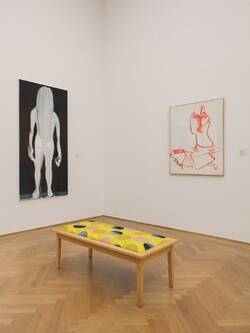
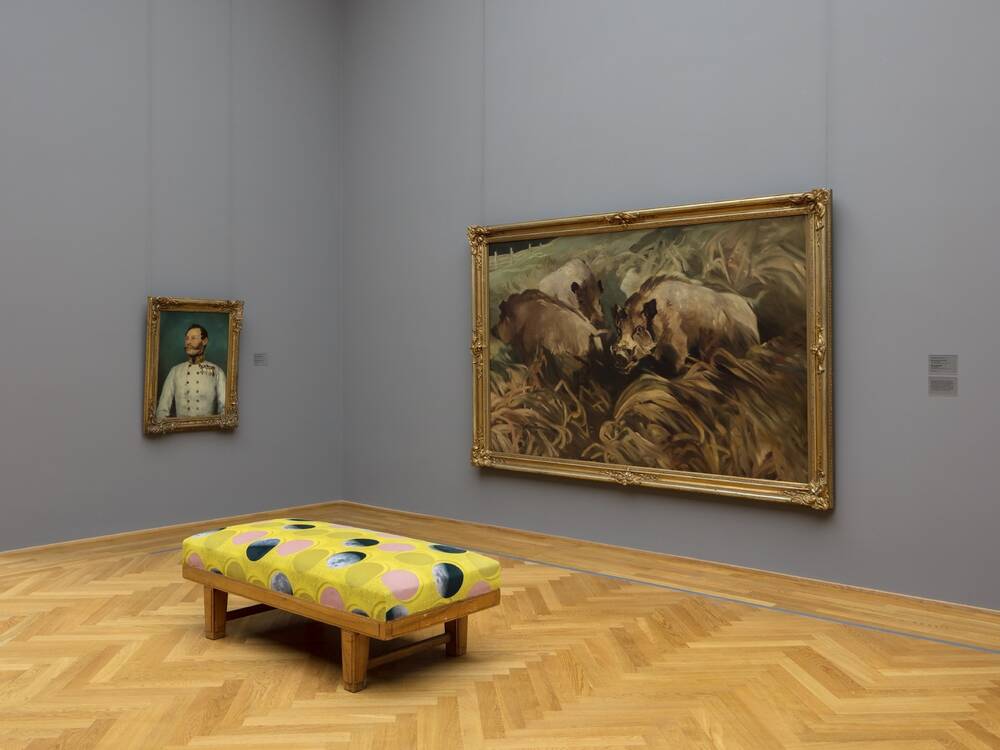
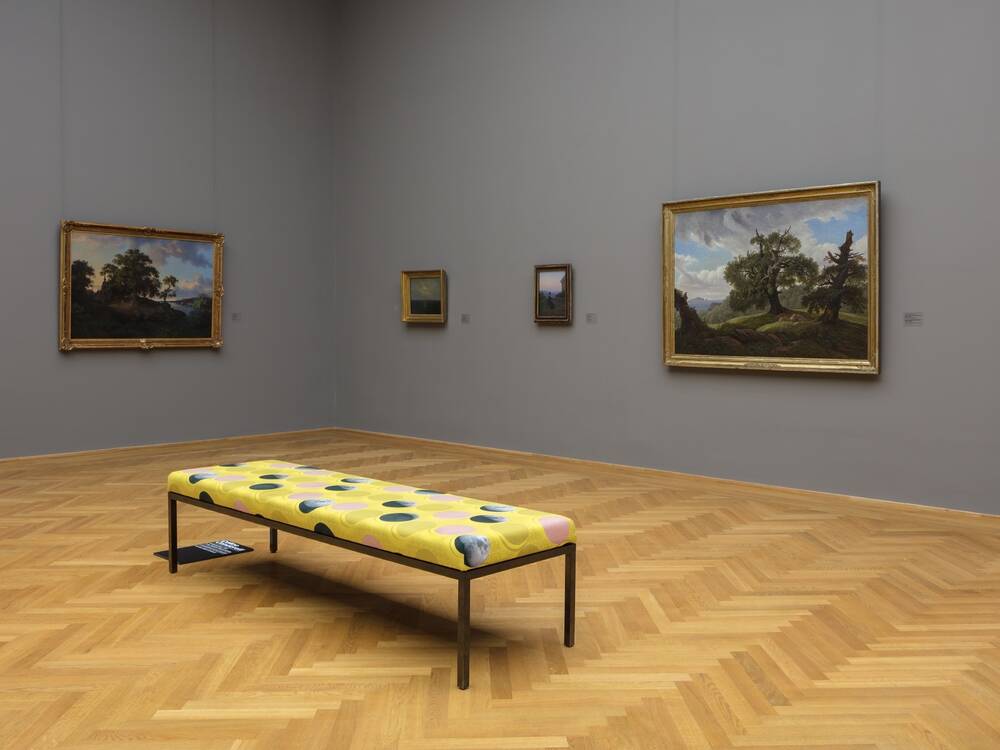
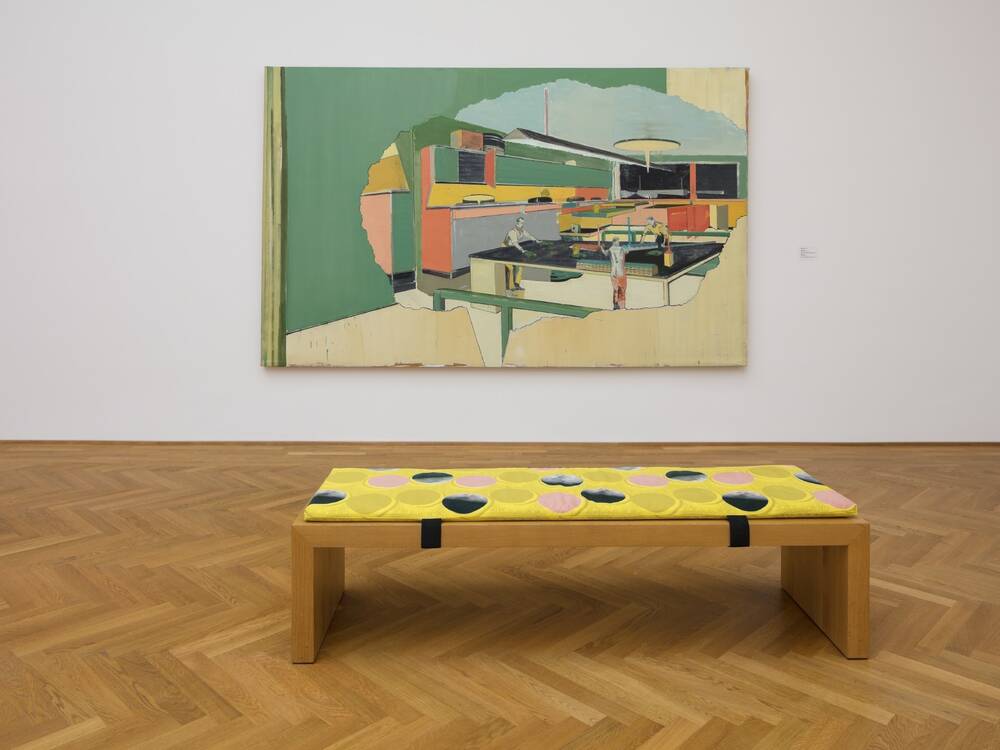
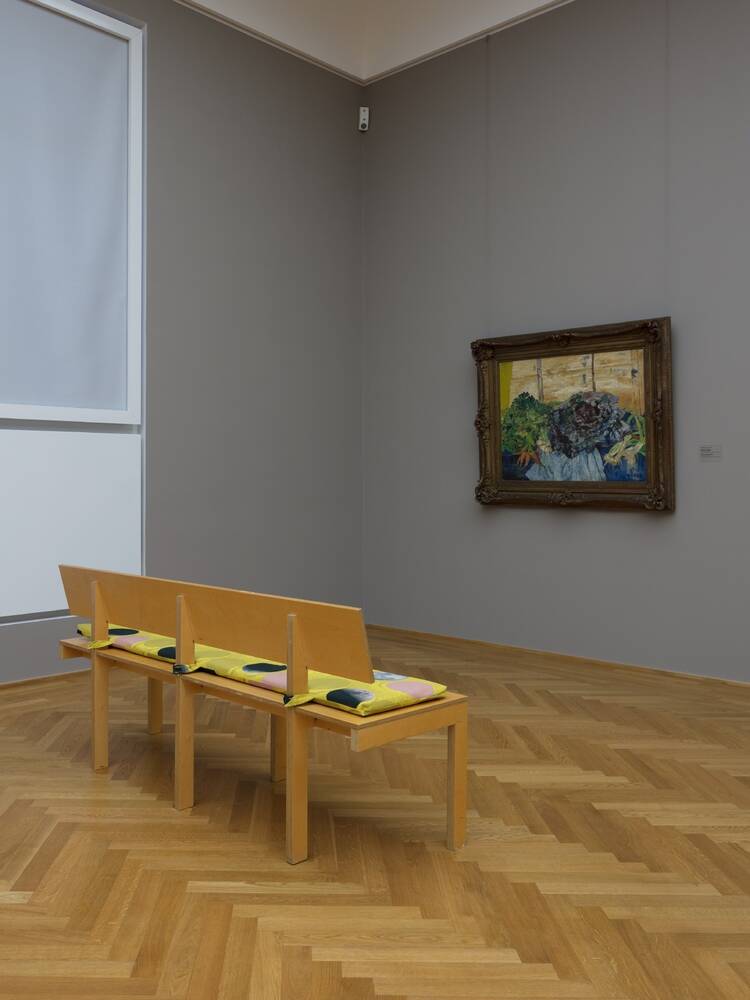
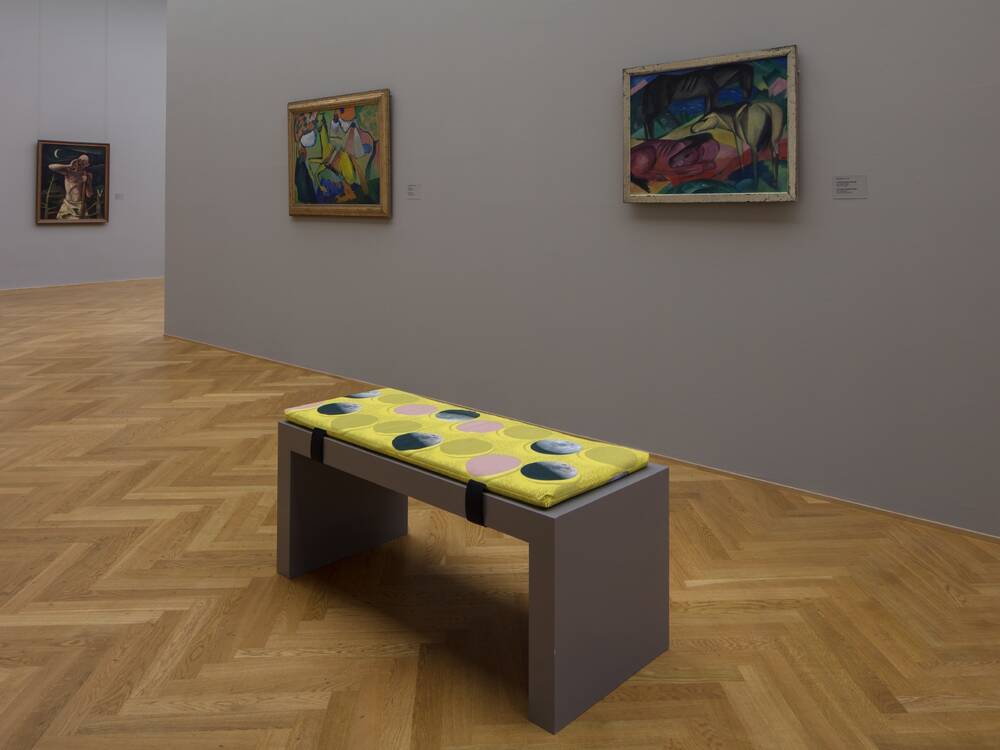
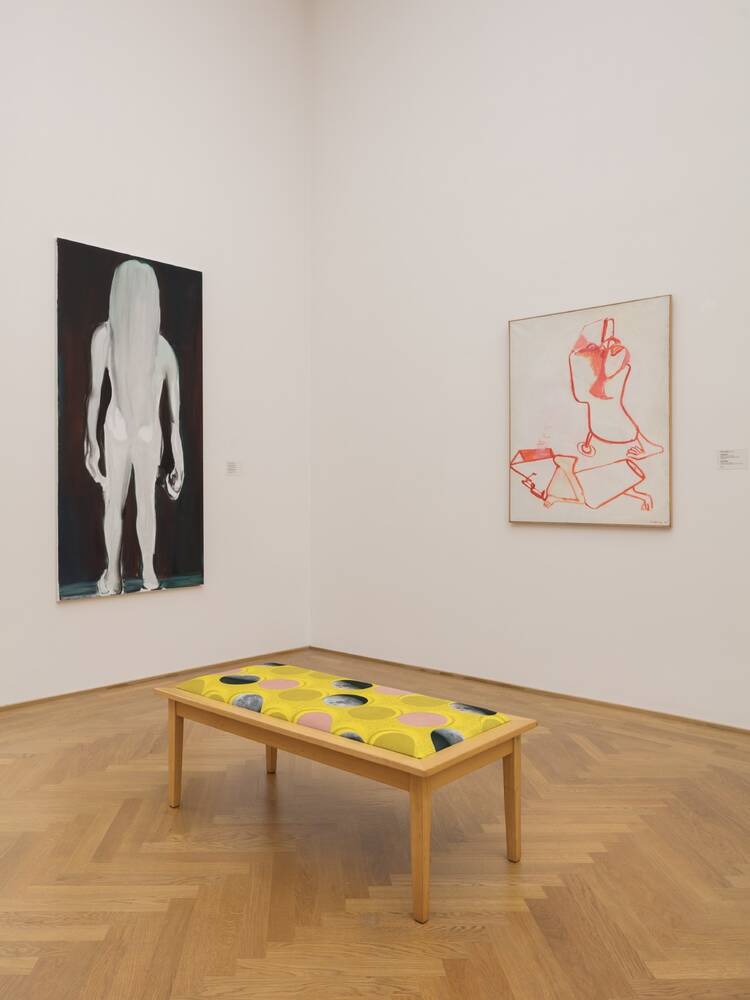
Bänke im Museum sind normalerweise eines: unauffällig. Nichts soll die Kunst beeinträchtigen. So war das auch im Albertinum, bis Céline Condorelli die Einladung zur „Intervention“ bekam. Sie recherchierte, suchte im Depot, fragte Mitarbeiterinnen und Mitarbeiter nach ausrangierten Stücken und verwandelte schließlich sechs unterschiedliche Bänke in Kunstwerke, die nun seit 2019 selbstbewusst im Raum stehen. Das siebte Sitzmöbel entwarf sie selbst: die Stahlrohrkonstruktion „Spatial Composition 12“ – ein Hybrid aus Skulptur und Liegestühlen.
Sie dürfen auf allen Bänken gerne Platz nehmen, entspannt die Werke an der Wand betrachten und Sie dürfen sich auch unterhalten. Das Albertinum ist keine „heilige Halle für die Kunst“, es versteht sich als Ort der Begegnung und des Austausches. Dafür steht das Werk der 1974 in Paris geborenen Künstlerin.
Das verbindende Element ist der Stoff, mit dem Céline Condorelli alle Bänke und Sitzkissen bezogen hat. Er ist von afrikanischen Waxprints inspiriert. So nennt man die gemusterten Stoffe in kräftigen Farben, die an handgefertigte Batikstoffe erinnern, heute aber industriell hergestellt werden, vor allem für Kleider. Sie werden oft mit Afrika in Verbindung gebracht, wobei sie dort nur durch koloniale Verflechtungen heimisch wurden. Céline Condorelli zitiert in dem Rosa ihres Stoffes die Wandfarben historischer Ausstellungsräume. Der Mond steht für den ewigen Zyklus. Die Künstlerin nimmt damit Bezug auf Caspar David Friedrichs „Zwei Männer in Betrachtung des Mondes“, ein Hauptwerk im Albertinum. Condorelli schlägt also einen weiten Bogen durch Zeiten und Kulturen – auch um zu zeigen, dass ein Ausstellungsraum nie neutral sein kann, sondern immer von historischen und aktuellen Bedingungen beeinflusst wird.
Weitere Medien
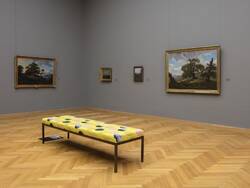
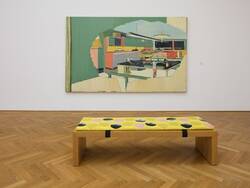
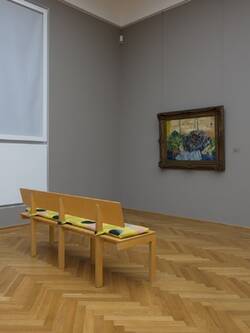
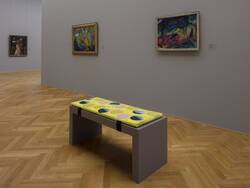
Seit langem beschäftigt sich Céline Condorelli mit dem Phänomen der musealen Präsentation. Insbesondere interessiert sie sich für das Publikum. Ihr fiel auf, dass sich Besucherinnen und Besucher auf eine ganz bestimmte Art und Weise verhalten:
„Die Menschen sind sehr gut geschult. Wenn sie ein Museum betreten, wissen sie, was sie anfassen dürfen und was nicht. Das ist das Kunstwerk und das ist das Licht. Das ist die Bank und das ist das Belüftungssystem. Jeder weiß, dass es diese Flyer gibt, die man mitnehmen kann, und Dinge, die aus demselben Material bestehen, nämlich aus Papier, die man nicht mitnehmen und nicht anfassen darf.“
Zum Beispiel Zeichnungen, die als Kunstwerke an der Wand hängen. Céline Condorelli über die Hierarchie der Dinge im Museum:
„Diese Hierarchie der Arbeit ist es, die mich letztendlich interessiert. Warum bewerten wir bestimmte Arbeiten höher als andere? Worin genau besteht die Arbeit, wenn man Kunst macht? Es ist nicht nur die Malerei. Es ist natürlich alles drum herum, das total wichtig ist. Die Präsentation, dass ein Text an der Wand dazugeschrieben wird, die gesamte Finanzierung dahinter, das System, das künstlerische Arbeiten fördert oder nicht fördert. Als Künstlerin konzentriere ich mich auf wenige Dinge. Wenn man sich zum Beispiel auf eine Museumsbank setzt, merkt man vielleicht gar nicht, dass das ein Kunstwerk ist. Aber das wirft Fragen auf; sehr einfache Fragen, die ich aber für sehr sinnvoll halte. Welchen Status hat das Ding, auf dem ich sitze, im Vergleich zu dem Ding, das ich betrachte?“
In Ausstellungen, so Céline Condorelli, erscheint Kultur in der Regel als etwas, das vor den Menschen geschützt werden müsse. Ihre Sitzbänke dagegen sind beides: Kunstwerke – und Gebrauchsgegenstände:
„Manchmal geht man in eine Galerie und denkt, dass man schmutzig ist oder laut, oder man weiß, dass der eigene Körper dieses Extra ist, das stört, weil man etwas tun könnte, das stört. Diese Vorstellung, dass die Ausstellung ohne dich besser ist, ist sehr stark, aber auf einer grundlegenden politischen Ebene völlig falsch, absolut falsch. Die Kunstwerke existieren nicht ohne Menschen und ohne ein Publikum.
Es ist doch ziemlich seltsam, zu denken, dass Kultur von einem ferngehalten werden sollte, unantastbar sein sollte, nicht Teil des täglichen Lebens sein sollte. Ich sage nicht, dass alles für jeden zugänglich sein muss. Mich interessiert einfach die Vorstellung einer intimeren Kultur; und ob es möglich ist, kulturelle Arbeiten, künstlerische Arbeiten in den Alltag zu integrieren."
Normally, the seating in museums is designed, first and foremost, to blend in and leave the art works to speak for themselves. In the Albertinum, that was just the same – until we invited artist Céline Condorelli, born in Paris in 1974, to create an art intervention here. She conducted research into seating areas in the museum, explored the storage facilities, and asked staff about items removed from the display. Then she transformed six benches from different periods into artworks. Since 2019, these renewed benches have been integral elements of the galleries. She also designed a complementary seventh element herself. Her Spatial Composition 12, a steel tube construction, is a hybrid of sculpture and deck chairs.
You are welcome to sit on any of the benches, view the works on the walls and talk to each other about them. After all, the Albertinum is not a ‘sacred hall for the arts’, but a place of encounters, dialogues and exchanges – something also epitomised by these works by Céline Condorelli.
They are all connected by a single element – the fabric on the upholstery of the benches, deck chairs, or cushions. The design is inspired by African wax prints. The bold serial patterns and colours of these textiles are reminiscent of handmade wax print fabrics – though today, they are manufactured industrially. Wax print fabrics are often associated with Africa, although it was only through the colonial networks that they passed into domestic production there. Céline Condorelli’s light pink tone in her fabric references the colours of walls in historic exhibition spaces. The moon, depicted in different forms, not only represents a universal cycle of time, but also alludes to Caspar David Friedrich’s Two Men Contemplating the Moon, one of the Albertinum’s main works. Here, then, Condorelli forges another arc across times and cultures – also as a way of showing how an exhibition space can never be neutral, but is always influenced by historical resonances and present conditions.
Céline Condorelli has long been investigating the phenomenon of the exhibition. She is especially interested in the audience in exhibitions, and has noticed how visitors behave in a very particular way.
“People are very well trained when they walk into a museum knowing what they can and cannot touch. So, this is the artwork and this is the light. This is the bench and this is the ventilation system, right. Everybody knows that there are these leaflets they can take and then things that are made of the same material – paper – that they cannot take and cannot touch.”
For example, the sketches which, as art works, are hanging on the walls. This led Céline Condorelli to consider the hierarchy of things in a museum:
“So, this hierarchy of work at the end of the day this is what interest me, you know. Why we consider certain forms of work higher than others? What is the labour involved in the making of culture? It's not just the painting. It is everything around it, of course, which is absolutely important: decoration, the writing of the text on the wall, the entire funding organisations behind it, and the system of supporting or not supporting cultural production. As an artist I focuse on few things, right? So, the museum bench, for example, you sit on it, maybe you don't notice that it's an artwork. But then it raises a few questions, that are very simple questions, but I think very very useful: What is the status of the thing that I'm sitting on versus the thing that I'm looking at?”
As a rule, according to Céline Condorelli, culture is presented in exhibitions as something needing to be protected from people. But her benches are both an art work – and an everyday object.
“Sometimes you walk into a gallery and you think you're dirty or loud or know that the body is this thing that is extra, that you are disturbing, because you're going to do something that disturbs, you know. This idea, that the exhibition is better without you inside it, is very strong and on a very basic political level completely wrong, and absolutely wrong. The artworks do not exist without people and a public.
Because it is quite strange actually, to think that culture should be kept away, should be untouchable, should be also not part of everyday life. I'm not saying that everything needs to be available for everybody. I'm just interested in this idea of a culture that is more intimate and whether it is possible to integrate cultural production, artistic production within everyday life.”
Lavičky či sedačky v muzeích jsou obvykle nenápadné, neboť vystavená umělecká díla nemá nic rušit. Tak tomu bylo také v Albertinu – dokud Céline Condorelli neobdržela příležitost „do prostoru zasáhnout“. Pátrala, hledala ve skladu, ptala se zaměstnanců, jestli vědí o vyřazených kusech nábytku, a nakonec proměnila šest různých lavic v umělecká díla, která od roku 2019 stojí sebevědomě v muzeu. Sedmou část nábytku umělkyně navrhla sama: „Spatial Composition 12“, kombinaci z uměleckého díla a lehátek s ocelovou konstrukcí.
Můžete se na některou z laviček posadit, odpočinout si, v klidu si prohlédnout díla visící na stěnách a také si popovídat. Albertinum není žádnou „posvátnou síní“ prezentující umění. Naopak, snažíme se zde nabídnout prostor a místo pro setkání a rozhovory. A to je právě záměrem uměleckého díla Céline Condorelli, narozené v Paříži roku 1974.
Spojujícím prvkem všech částí je látka, kterou Céline Condorelli lavice a lehátka potáhla. Vzor je inspirován africkými voskovými tisky – tedy vzorovanými látkami ve výrazných barvách, které připomínají ručně vyráběné batikované látky, které se dnes vyrábějí již průmyslově, především pro oděvy. Tyto vzory a látky jsou často spojovány s Afrikou, ačkoli se tam rozšířily až díky kolonializaci. Růžová barva na látkách cituje barvy zdí v historických výstavních místnostech. Měsíc je symbolem věčného běhu času. Autorka tak odkazuje na obraz Caspara Davida Friedricha s názvem „Dva muži pozorující měsíc“, který patří v Albertinu k nejdůležitějším dílům. Condorelli tak napíná velký oblouk mezi různými časovými obdobími a kulturami – také proto, aby ukázala, že výstavní prostory nikdy nejsou neutrální, ale jsou vždy ovlivňovány historickými a aktuálními souvislostmi.
Céline Condorelli se již dlouho zabývá fenoménem výstavy jako takové a svou pozornost věnuje zejména publiku. Všimla si, že návštěvníci se zde chovají zvláštním způsobem:
„Návštěvníci muzea jsou dobře poučeni. Když přijdou do muzea, vědí, čeho se smějí dotýkat a čeho ne. Zde je umělecké dílo a zde je světlo. Zde je lavička a zde je ventilační systém. Každý ví, že se v muzeích na určitých místech nacházejí informační letáky, které si člověk může vzít. Jsou zde ale také věci ze stejného materiálu, tedy papíru, které si vzít nemůže a nesmí se jich dokonce ani dotknout.“
Například kreseb, které visí na stěnách. Céline Condorelli o hierarchii předmětů v muzeích:
„Je to především hierarchie prací, která mě vlastně zajímá. Proč si některých prací ceníme více než jiných? V čem přesně spočívá práce, když umělecky tvoříme? Nejde jen o malířství. Důležité je samozřejmě také všechno okolo. Prezentace, popisný text na zdi u jednotlivých děl, ale také financování, které se za vším skrývá, a celý systém, který buď uměleckou práci podporuje nebo také ne. Jako umělkyně se soustředím na několik málo věcí. Když si člověk například sedne na lavičku v muzeu, možná si ani nevšimne, že se jedná o umělecké dílo. A to podle mě vyvolává otázky, velmi jednoduché otázky, které však považuju za velmi důležité. Jaký status má předmět, na které právě sedím, ve srovnání s předmětem, na který se dívám?“
Na výstavách, říká Céline Condorelli, se kultura obvykle jeví jako něco, co je třeba před lidmi chránit. Lavičky na výstavě jsou však obojím: uměleckými díly – a zároveň předměty denní potřeby:
„Někdy člověk přijde do galerie a myslí si, že je špinavý nebo příliš hlučný, možná také ví, že jeho vlastní tělo je právě to, co zde ruší, protože by mohl udělat něco, co ostatní ruší. Tato představa, že výstava by byla lepší bez jeho přítomnosti, je velmi silná, ale politicky v podstatě naprosto chybná, absolutně chybná. Umělecká díla neexistují bez lidí a bez publika.
Je přeci dosti podivné si myslet, že by kultura a člověk měli být odděleni, že by kultura měla být nedotknutelná a že by neměla být součástí všednodenního života. Nechci tím říct, že by všechno mělo být přístupné všem. Mě zajímá jen představa intimnější kultury a to, zda je možné kulturní práce, umělecká díla začlenit do všedního dne.“
- Ort & Datierung
- 2019
- Museum
- Galerie Neue Meister
- Inventarnummer
- Inv.-Nr. 2019/03