
Weitere Medien
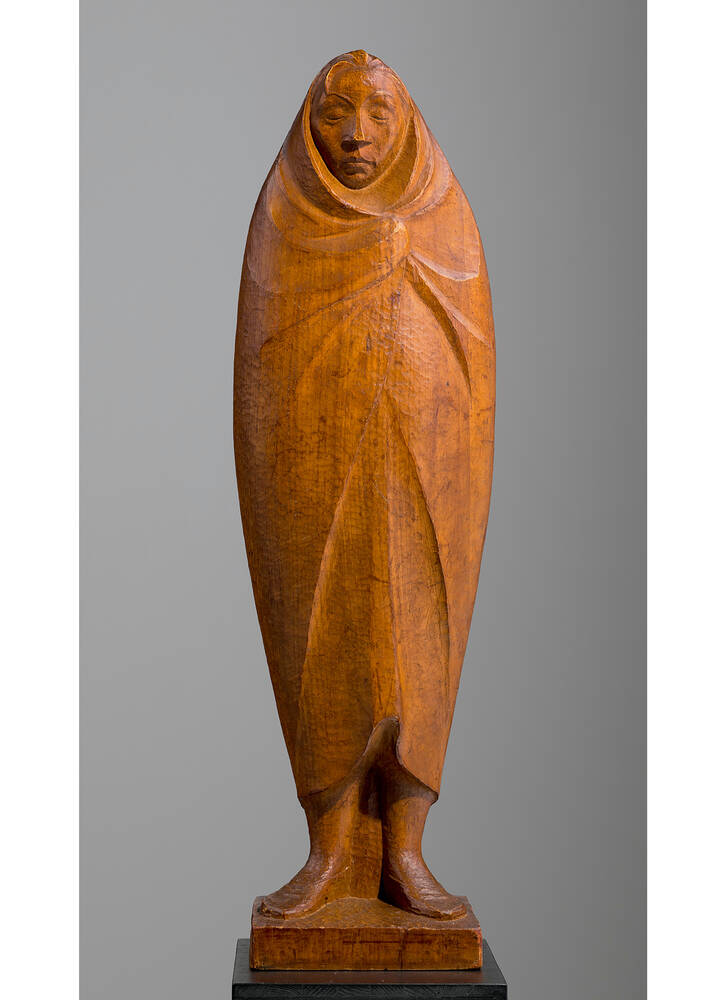
Nach dem Ankauf wurde die Skulptur des "Schwangeren Mädchens" gründlich in der Restaurierungswerkstatt untersucht. Die Restauratorin Stephanie Exner konnte anhand der Analysen die Arbeitsweise des Künstlers nachvollziehen:
„Ernst Barlach ist akademisch geschulter Bildhauer. Er hat die klassischen Techniken des Modellierens und Abformens erlernt. 1906 wendet er sich dem Material Holz zu und bringt sich das Schnitzen als Autodidakt selbst bei. Für seine Bildwerke stellt Barlach in der Regel immer ein Werkmodell aus Gips her. Dafür wird erst die Form in Ton modelliert und dann in Gips abgegossen.“
Auch für das "Schwangere Mädchen" fertigt Barlach ein Gipsmodell. Im Anschluss schnitzt er die Figur aus Lindenholz:
„Barlach hat sie nicht aus EINEM Stück Vollholz geschnitzt, sondern aus einem sogenannten Werkblock. Hier werden mehrere Holzstücke oder Holzbretter zu einem Block verleimt, was Rissbildung verhindern soll.“
Auffällig ist die Aushöhlung auf der Rückseite, wie man sie auch bei mittelalterlichen Holzskulpturen findet. Damals entfernte man den Kern, damit sich bei der Skulptur keine Risse bilden:
„Dass Barlach diese Skulptur rückseitig ausgehöhlt hat, ist für uns etwas verwunderlich und eigentlich nicht nötig, und ist auch ein Alleinstellungsmerkmal im gesamten Oeuvre Barlachs.“
Zum Schluss glättet Barlach die Oberfläche der Figur mit Schnitzeisen und versieht das helle Lindenholz mit einem Überzug aus Schellack und Bienenwachs, dem er rote und schwarze Farbpigmente beifügte.
“Ernst Barlach is among the most important and best-known German sculptors in modern art in the early twentieth century. Barlach’s ‘Pregnant Girl’ dates from 1924, and embodies all the defining qualities of his art.”
Throughout his life, Barlach was fascinated by the human form. The powerful figures he created are timeless. Here, we see a young, pregnant woman, pensive, withdrawn, absorbed in herself.
Barlach’s striking style was inspired by a key experience in his life. During his travels in Russia in 1906, he was profoundly impressed by Russian folk art and the simple life of the peasants. Curator Astrid Nielsen explains:
“After this journey, he developed a formal idiom which became his signature style, with simplified contours, and a more or less block-like depiction of figures without too many narrative details.”
Under the Nazi regime, many of Barlach’s works were confiscated from museums as “degenerate art” – just as they were in Dresden:
“After 1920, the Dresden Sculpture Collection had a wooden sculpture by Barlach called ‘Das frierende Mädchen’ – ‘The Freezing Girl’. In 1937, this was seized by the Nazis as ‘degenerate art’. Of course, that was a major loss to the collection – and left a considerable gap in the holdings.”
So the joy was even greater when the collection managed to acquire Barlach’s Pregnant Girl sculpture in 2021. In formal terms, this figure is very similar to the Freezing Girl, which today is on show in the Ernst Barlach Haus in Hamburg.
After acquiring Barlach’s sculpture of a pregnant young woman, this work was systematically studied in our restoration workshop. The findings enabled restorer Stephanie Exner to trace the artist’s working methods:
“Ernst Barlach went to a state arts academy. There, he received the traditional training for sculptors at that time and learnt the classical techniques of modelling and moulding. In 1906, he began working primarily with wood, and largely taught himself the art of wood carving. But as a rule for his sculptures, Barlach always continued to make a plaster maquette – a preliminary model. So first he modelled his work in clay, and then cast it in plaster.”
Barlach also applied the same method to his statue of a young pregnant woman. Once he had made the maquette, he then carved the figure in limewood:
“Barlach did not carve the figure from ONE solid block of wood, but from a sculpture block, as it’s called. The block is made of several pieces or planks of wood glued together, a technique supposed to prevent the wood cracking or splitting.”
As is only too clear, the back of the sculpture was hollowed out – an approach similarly used in medieval wooden sculptures. In those days, removing the heartwood was thought to stop the wood of the sculpture splitting.
“Today, to find Barlach hollowing out the back of his sculpture seems rather surprising – and rather unnecessary. But this is also a unique distinguishing feature across Barlach’s entire oeuvre.”
To finish the figure, he smoothed the surfaces with fine chisels, then gave the light-coloured limewood a coat of shellac and beeswax, adding red and black pigments.
„Ernst Barlach patří k nejvýznamnějším a nejznámějším německým sochařům klasické moderny. Dílo „Těhotná dívka“ vzniklo roku 1924 a spojuje v sobě vše, co je pro umění Ernsta Barlacha podstatné.“
Barlach se po celý svůj život zabýval lidskou postavou a vytvořil díla, která mají nadčasovou platnost. Vidíme zde těhotnou mladou ženu, která je plně ponořena do svých vlastních myšlenek, nedbajíc na své okolí.
Barlachův osobitý styl je ovlivněn jedním klíčovým zážitkem: Během cesty do Ruska v roce 1906 na něj hluboce zapůsobili prostý život rolníků a ruské lidové umění. Kurátorka Astrid Nielsenová:
„Po této cestě dospěl k formálnímu výrazu, který se pro něj stal zcela typickým: zjednodušené tvary, víceméně blokovité zobrazení lidského těla bez četných popisných detailů.“
Během nacistické nadvlády byla mnohá Barlachova díla označena za „zvrhlé umění“ a zabavena – tak tomu bylo také v Drážďanech:
„Po roce 1920 se v drážďanské sbírce sochařského umění nacházela dřevěná plastika „Mrznoucí dívka“, kterou v roce 1937 zabavili nacisté jako „zvrhlé umění“, což samozřejmě pro zdejší sbírku znamenalo velkou ztrátu a zanechalo velkou mezeru.“
O to větší byla radost, když se nám roku 2021 podařilo pro naší sbírku získat sochu „Těhotné dívky“. Formálně a stylisticky se postavě „Mrznoucí dívky“ velmi podobá. Ta je dnes vystavena v Domě Ernsta Barlacha v Hamburku.
Po zakoupení byla socha „Těhotné dívky“ důkladně prozkoumána v restaurátorských dílnách. Restaurátorce Stephanie Exnerové se podařilo na základě analýz zrekonstruovat umělcův pracovní postup:
„Ernst Barlach studoval sochařství na akademii a ovládal klasické techniky modelování a odlévání. Roku 1906 začal pracovat se dřevem, přičemž se řezbářství naučil jako samouk. Pro svá díla Barlach zpravidla vytvořil nejprve sádrový model, přičemž nejprve sochu vymodeloval z hlíny a poté ji odlil do sádry.“
Také pro sochu „Těhotné dívky“ Barlach nejprve zhotovil sádrový model a teprve pak ji vyřezal z lipového dřeva:
„Barlach ji nevyřezal z JEDNOHO kusu masivního dřeva, ale z dřevěného bloku, který vznikl sklížením několika kusů dřeva nebo prken. To má zabránit praskání dřeva.“
Nápadná je také skutečnost, že socha je na zadní straně vydlabána, což vidíme také u středověkých dřevěných soch. Tenkrát se jádro sochy vydlabávalo, aby socha nepopraskala:
„Pro nás je poněkud překvapivé, že Barlach sochu zezadu vydlabal, protože to nebylo vlastně nutné. Jedná se o ojedinělý případ v celé Barlachově umělecké tvorbě.“
Nakonec Barlach povrch sochy ze světlého lipového dřeva jemně opracoval řezbářskými dlátky a natřel jej vrstvou šelaku a včelího vosku, do které přidal červené a černé pigmenty.
- Ort & Datierung
- 1924
- Material & Technik
- Lindenholz
- Dimenions
- Gesamt: Höhe 86,4 cm, Breite 25 cm, Tiefe 16,5 cm
- Museum
- Skulpturensammlung
- Inventarnummer
- ZV 4381