
Der Expressionist Erich Heckel zählt zu den Gründungsmitgliedern der Dresdener Künstlergruppe „Die Brücke“. Als er 1916 das Bild „Männer am Meer“ malt, ist „Die Brücke“ jedoch längst Vergangenheit. Heckel leistet Kriegsdienst in Flandern. Die Kuratorin Birgit Dalbajewa erläutert:
„Heckel war als Sanitäter nicht direkt an der vordersten Front, sondern in Ostende stationiert, im Hinterland. Und in diesem Umfeld in Ostende hat man sich natürlich mit dem Schicksal junger Männer, verwundeter junger Männer auseinandergesetzt –“
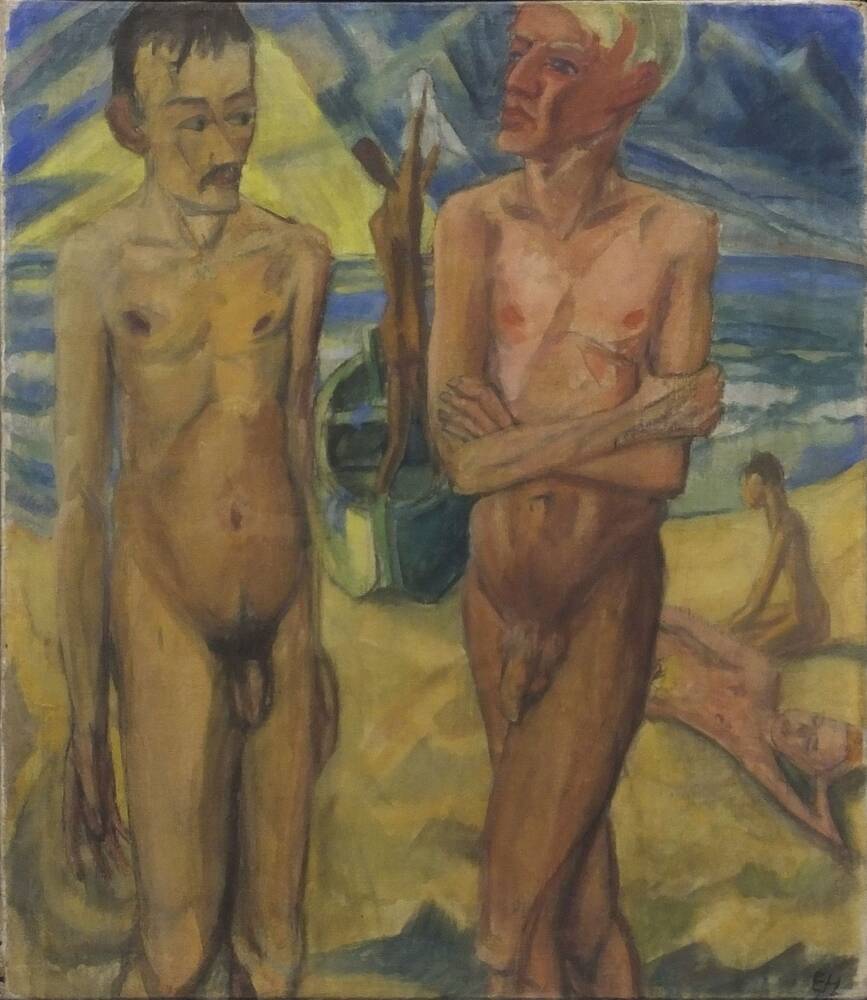
– was Heckel wohl auch zu den „Männern am Meer“ inspirierte. Vordergründig zeigt das Bild eine Alltagssituation. In der Freizeit durften die Sanitäter und leichter verwundete Soldaten am Strand baden gehen. Die beiden Männer, der eine schwarzhaarig, der andere hellblond, sind ganz selbstverständlich nackt; wie im Gespräch blicken sie einander an. Zugleich hat Heckel, inspiriert von der Romantik, so etwas wie ein modernes Freundschaftsbild geschaffen:
„Wichtig waren für die Expressionisten in der Zeit solche Begriffe wie das Wir, das Ich, das Du. Also ein Mensch ist moralisch nur vollständig, wenn er ein Gegenüber, ein Du hat.“
Mit dem Boot im Hintergrund verweist Heckel auf das romantische Symbol des Lebensschiffs:
„In dieser Phase von Heckel denkt er und arbeitet er so – ein Lebensschiff im Strom der Zeit. Also wohin geht es mit uns, wohin geht es mit der ganzen Generation?“
Das Bild gehört zu den frühen Ankäufen moderner Kunst für die Gemäldegalerie nach Ende des Ersten Weltkriegs. Der Direktor Hans Posse erwarb es 1920, finanziert vom Förderverein der Dresdner Galeriefreunde. 1937 wurde das Gemälde von den Nationalsozialisten als „entartet“ beschlagnahmt und 1940 einem Kunsthändler überantwortet, der es im Ausland verkaufen sollte. 2011 konnte es für die Galerie Neue Meister zurückerworben werden.
Weitere Medien
Dresden, 1905. Ernst Ludwig Kirchner, Fritz Bleyl, Karl Schmidt-Rottluff und Erich Heckel sind Studenten an der Technischen Hochschule. Ihr Fach: Architektur. Eigentlich interessiert sie jedoch die Kunst. Nicht die akademische Kunst nach vorgegebenen Theorien. Ihnen schwebt eine neue Kunst vor, ohne Regeln, die spontan aus dem Augenblick heraus entstehen soll, im Atelier, das zugleich auch als Wohnraum dient. Kunst und Leben sollen eins sein. Um ihr Projekt zu verwirklichen, gründen die vier eine Künstlergruppe: "Die Brücke":
"Als Jugend, die die Zukunft trägt, wollen wir uns Arm- und Lebensfreiheit verschaffen gegenüber den wohlangesessenen älteren Kräften. Jeder gehört zu uns, der unmittelbar und unverfälscht wiedergibt, was ihn zum Schaffen drängt."
Für junge Künstler war es nicht leicht, sich in der Kunstszene zu etablieren – als Gruppe war das einfacher. Bereits im ersten halben Jahr produzieren die vier genügend Bilder für eine Ausstellung in Dresden – in einem Lampengeschäft. In den folgenden Jahren zeigen sie ihre Werke sowohl in renommierten Dresdner Galerien als auch in Wanderausstellungen, die durch ganz Deutschland geschickt werden – in Kunstvereinen und Galerien. Dort ist man generell von Neuem angetan, konservative Kritiker aber schreiben abwertend von "Farbenirrsinn" und "Höllenkarneval".
Auch Werbung macht die Gruppe gemeinsam, mit selbst entworfenen Plakaten, Katalogen und Einladungskarten. Gegen einen Jahresbeitrag bietet sie passive Mitgliedschaften an, verbunden mit eigens gestalteten Mitgliedskarten und Jahresmappen. Auf diese Weise schafft sich die "Brücke" ein Netzwerk aus Förderern und Sammlern.
1906 tritt Max Pechstein der Gruppe bei, Fritz Bleyl verlässt sie 1907. Bis Ende 1911 ziehen alle Mitglieder von Dresden nach Berlin. Dort kommt es zu Konflikten. 1913 löst sich die "Brücke" nach acht Jahren auf.
The expressionist artist Erich Heckel was one of the founding members of the renowned Dresden artists’ group, Die Brücke. But in 1916 when Heckel painted this scene of men by the sea, the Brücke was long a thing of the past. Heckel had volunteered at the start of the First World War, and spent the war years in Belgium. Curator Birgit Dalbajewa explains:
“Heckel served in a medical unit, so he was not directly on the front line. He was stationed in the hinterland, in Ostende. But in his medical unit, he naturally still witnessed the fate of many wounded young men... “
– an experience which probably also inspired Heckel to paint this scene of men by the sea. On the surface, it seems just an everyday situation. In their free time, the medical orderlies and the less severely wounded soldiers could go swimming at the beach. The two men, one dark haired and one very fair, are both naked, as if it was the most natural thing in the world. They look towards at each other as though in conversation. Yet simultaneously, inspired by ideas in Romanticism, Heckel has created something like a modern ‘friendship picture’:
“For German Expressionist artists at that time, concepts such as togetherness, the sense of self, and of the Other, were crucially important – the idea that a person can only be fully moral if they have an ‘Other’, a counterpart.”
With the boat in the background, Heckel alludes to the Romantic symbol of the ship of life:
“In this phase of his life, Heckel thought of himself and his work as a ship of life in the tide of time, confronting the questions, ‘Where are we going? And what is the future of my entire generation?’”
This painting is one of the early acquisitions of modern art for the Paintings Gallery after the end of the First World War. It was bought by the Paintings Gallery Director Hans Posse, and funded by the Dresden Gallery Friends’ Association. In 1937, Heckel’s painting was confiscated in the Nazi regime’s “degenerate art” campaign. In 1940, the Nazis passed it a trusted art dealer to be sold abroad. In 2011, the work could be reacquired by the New Masters Gallery.
Dresden, 1905. Ernst Ludwig Kirchner, Fritz Bleyl, Karl Schmidt-Rottluff and Erich Heckel were all at the city’s Royal Saxon Polytechnic Institute studying architecture. But their real interest lay in the visual arts. Rather than following academic art based on fixed theories, they envisaged a new art without rules. Their art would emerge spontaneously from the immediate moment in the studio – a space which also served as a place to live. In this vision, life and art ought to be one – and to realise their project, these four students founded an artists’ group which they called “Die Brücke” – “The Bridge”:
“...as youth that is carrying the future, we intend to obtain freedom of movement and of life for ourselves in opposition to older, well-established powers. Whoever renders directly and authentically that which impels him to create is one of us…”
Young artists found it hard to gain a foothold in the art scene – and as a group, that was easier. After just six months, these four aspiring artists already had enough pictures to hold a first exhibition in Dresden – in a lamp shop. Over the following years, they not only presented their works in renowned galleries in Dresden, but also in temporary exhibitions shown in galleries and art associations across Germany. In general, the audiences in these locations appreciated this new art, though conservative critics disparagingly called it a “madness of colour” and a “carnival of hell”.
The group organised their own advertising, designing posters, catalogues and invitations themselves. The Brücke artists’ group also offered passive membership against an annual fee. Passive members received a personal membership card designed by one of the artists and annual portfolios. In this way, the Brücke created a network of supporters and collectors.
There were also some changes in the members, with Max Pechstein joining in 1906 and Fritz Bleyl leaving one year later in 1907. By the end of 1911, all the Brücke members had moved from Dresden to Berlin. There, the group became looser and various conflicts emerged between the members. Ultimately, in 1913, after eight years, the Brücke group disbanded.
Expresionistický malíř Erich Heckel byl jedním ze zakládajících členů drážďanské umělecké skupiny „Die Brücke“ – česky „Most“. Když v roce 1916 maloval obraz „Muži u moře“, patřila skupina již dávno minulosti. Heckel sloužil během války ve Flandrech. Kurátorka Birgit Dalbajewa vysvětluje:
„Heckel sloužil jako zdravotník, a tak nebyl přímo na frontové linii, ale v Ostende, tedy v zázemí. A v tomto prostředí stál v centru pozornosti samozřejmě především osud mladých mužů, zraněných mladých mužů –“
– což Heckela pravděpodobně také inspirovalo k namalování obrazu „Muži u moře“. Na první pohled vidíme všednodenní scenérii. Ve volném čase se zdravotníci a vojáci, kteří měli pouze lehčí zranění, mohli koupat v moři. Oba muži na pláži, jeden černovlasý, druhý blonďatý, jsou přirozeně nazí a vzájemně opětují svůj pohled, téměř jako při rozhovoru. Zároveň Heckel, inspirován romantismem, vytvořil něco jako moderní obraz přátelství:
„Pro expresionisty byly v té době důležité pojmy jako „My“, „Já“ a „Ty“. Člověk byl podle jejich názoru morálně dokonalý pouze tehdy, když měl svůj protějšek, své „ty“.“
Loď v pozadí obrazu je odkazem na romantický symbol lodi života:
„V této fázi svého života Heckel takto přemýšlí a pracuje – pluje na lodi života v proudu času. Kam loď směřuje, kterým směrem se vydá celá generace?“
Obraz byl po skončení první světové války zakoupen pro zdejší sbírku jako jeden z prvních děl moderního umění. Ředitel Hans Posse jej získal roku 1920 z prostředků Spolku přátel drážďanské galerie. Roku 1937 nacisté obraz zabavili jako „zvrhlé umění“ a předali ho roku 1940 jednomu obchodníkovi s uměním, který měl obraz prodat do zahraničí. Roku 2011 naše galerie obraz znovu zakoupila.
Drážďany, roku 1905. Ernst Ludwig Kirchner, Fritz Bleyl, Karl Schmidt-Rottluff a Erich Heckel studují právě na Technické univerzitě. A sice obor architektury. Ve skutečnosti se však zajímají o umění. Ne o akademické umění podle předem daných teorií. Představují si nový druh umění, bez pravidel, které by vznikalo ze spontánního okamžiku, v ateliéru, který by zároveň sloužil jako obytná místnost. Umění a život mají tvořit jednotu. A aby mohli svůj projekt zrealizovat, založila čtveřice umělců skupinu Die Brücke – česky Most:
„My mladí, kteří neseme budoucnost, se chceme osvobodit od chudoby a získat svobodu oproti starším, majetným vrstvám. Patří k nám každý, kdo se přímo a nezkresleně snaží vyjádřit to, co ho nutí tvořit.“
Pro mladé umělce nebylo snadné prosadit se na umělecké scéně – ale jako skupina to bylo o něco snazší. Již během prvního půl roku tito čtyři umělci vytvořili dostatek obrazů pro vlastní výstavu v Drážďanech, která se konala v obchodě s lampami. V následujících letech pak vystavují svá díla v renomovaných drážďanských galeriích stejně jako na putovních výstavách, které se konají po celém Německu – v uměleckých spolcích a galeriích. Publikum je novým uměním nadšeno, ale konzervativní kritici píšou pejorativně o „barevném šílenství“ a „pekelném karnevalu“.
Skupina také vydává pro své výstavy vlastnoručně navržené plakáty, katalogy a pozvánky. Za roční poplatek nabízí pasivní členství, spojené se speciálně navrženými členskými průkazy a ročenskými sborníky. Tímto způsobem si skupina Brücke vytvořila celou síť mecenášů a sběratelů.
Roku 1906 se ke skupině připojil Max Pechstein a roku 1907 ji naopak Fritz Bleyl opustil. Do konce roku 1911 se všichni členové přestěhovali z Drážďan do Berlína, kde však došlo k neshodám, a roku 1913 se skupina Brücke po osmi letech rozpadla.
- Ort & Datierung
- 1916
- Material & Technik
- Tempera auf Leinwand
- Dimenions
- 81 x 70,5 cm
- Museum
- Galerie Neue Meister
- Inventarnummer
- Inv.-Nr. 2011/38