
Auch Künstler brauchen Tapetenwechsel. Gustav Klimt, im Wien der Jahrhundertwende prominenter Maler des Jugendstils, verbrachte die Sommermonate regelmäßig im oberösterreichischen Salzkammergut am Attersee. Pinsel und Palette hatte er im Gepäck, aber er malte dort keines seiner berühmten Frauenporträts, sondern außergewöhnlich reizvolle Landschaftsbilder – darunter das Gemälde, das Sie hier sehen. Ein Wäldchen, das die ganze Bildfläche ausfüllt. Der Horizont liegt ungewöhnlich hoch, so dass der mit Laub übersäte Waldboden in unseren Blick gerät – gemalt mit kleinen, aneinandergesetzten Pinselstrichen in zarten, harmonischen Farbtönen. Der flirrende Laubboden – die fleckige Baumrinde – die Reflexe des Sonnenlichts, die in der oberen Bildhälfte aufblitzen: Alle Einzelheiten sind minutiös geschildert und fügen sich doch – ganz im Sinne des Jugendstils – zu einem großen, die Bildfläche überziehenden Ornament.
Ist Ihnen eigentlich das Format aufgefallen? Das Bild ist ein exaktes Quadrat, ein mal ein Meter. Den Grund dafür erwähnte Klimt in einem Brief:
"Ich habe am frühen Morgen, am Tage und Abend mit einem 'Sucher', das ist ein in Pappendeckel geschnittenes Loch, nach Motiven für meine zu malenden Landschaften gesucht."
Klimt hatte aus dem Karton ein Quadrat ausgeschnitten, deshalb sind seine Landschaftsgemälde in der Regel quadratisch. Für das Bild des Wäldchens hatte er den Sucher so gehalten, dass nur ein schmaler Streifen Himmel im Ausschnitt erschien.
Weitere Medien
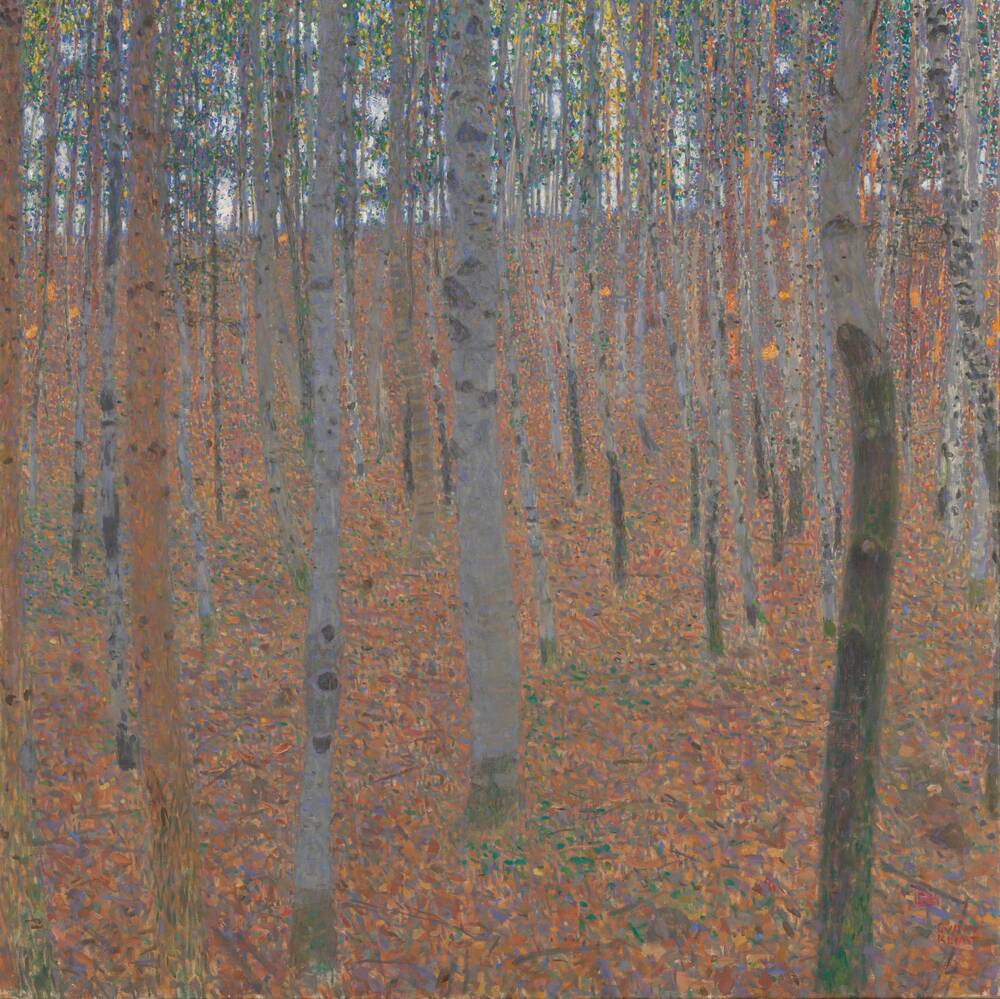
Even artists need a change of scene. Gustav Klimt, a leading figure in the art nouveau movement in Vienna in the 1890s and early 1900s, regularly spent his summers at the Attersee lake near Salzburg. He took his brushes and paints with him – but none of his famous portraits of women were painted there. Instead, he worked on his exceptionally attractive landscapes, including the picture on show here – a stretch of woodland which fills the entire pictorial surface. With the horizon set unusually high, we primarily just see a leaf-covered forest floor – painted in little dabs of colour set directly adjacent in soft, harmonious tones. All the details are depicted in minute detail: the shimmering layer of leaves – the patchy tree trunks – the reflecting sunlight as it breaks through the trees in the upper half of the painting. And quite in the spirit of art nouveau, these details merge to form a large decorative image covering the surface.
Have you noticed the format of the work? The painting is a perfect square, exactly 100 centimetres on all four sides. In a letter, Klimt explained why he chose this format:
“In the early morning, during the day and early evening, looked for motifs to paint in my landscapes with my 'viewfinder’ – a hole cut into a piece of cardboard.”
Since Klimt’s ‘viewfinder’ was a square hole cut into a piece of cardboard, his landscapes generally all have the same square format. For this painting of the woods, he held the ‘viewfinder’ so only a narrow strip of sky was visible.
Také umělci potřebují změnu ovzduší. Gustav Klimt, který na přelomu století ve Vídni patřil k nejvýznačnějším secesním malířům, trávil pravidelně letní měsíce v hornorakouském pohoří Solné komory u Atterského jezera. Samozřejmě s sebou měl vždy také svou paletu a štětce, ale nemaloval zde žádný zen svých známých portrétů žen, nýbrž nádhernou krajinu, která jej obklopovala. A tak vznikly neobvykle půvabné krajinné obrazy - jako například ten, který vidíte před sebou. Lesík zaplňující celou plochu obrazu. Horizont leží poměrně vysoko a tak je náš pohled směřován na půdu pokrytou spadlým lístím - malovanou krátkými tahy štětce v jemných, harmonických barvách. Mihotavě se třpytící listoví - skvrnitá kůra stromů - odrazy slunečních paprsků, které prosvítají v horní části malby: Všechny detaily jsou pečlivě vypracovány a vytvářejí společně jeden velký dekorativní ornament - typický pro secesní umění.
Všimli jste si také rozměrů obrazu? Jedná se o přesný čtverec - jeden metr na jeden metr. Ve svém dopise Klimt uvádí důvod pro tuto volbu:
"Časně ráno, během dne stejně jako večer jsem zvláštním "hledáčkem", tedy dírou vyříznutou do víka z lepenkové krabice, hledal motivy krajin, které jsem chtěl malovat."
Klimt do lepenky vystřihl čtverec, proto má většina jeho krajinných obrazů čtvercový formát. Pro svůj obraz lesa držel hledáček tak, že na obzoru je vidět pouze malý pruh oblohy.
- Ort & Datierung
- Um 1902
- Material & Technik
- Öl auf Leinwand
- Dimenions
- 100 x 100 cm
- Museum
- Galerie Neue Meister
- Inventarnummer
- Gal.-Nr. 2479 A