
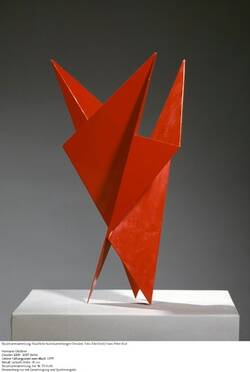
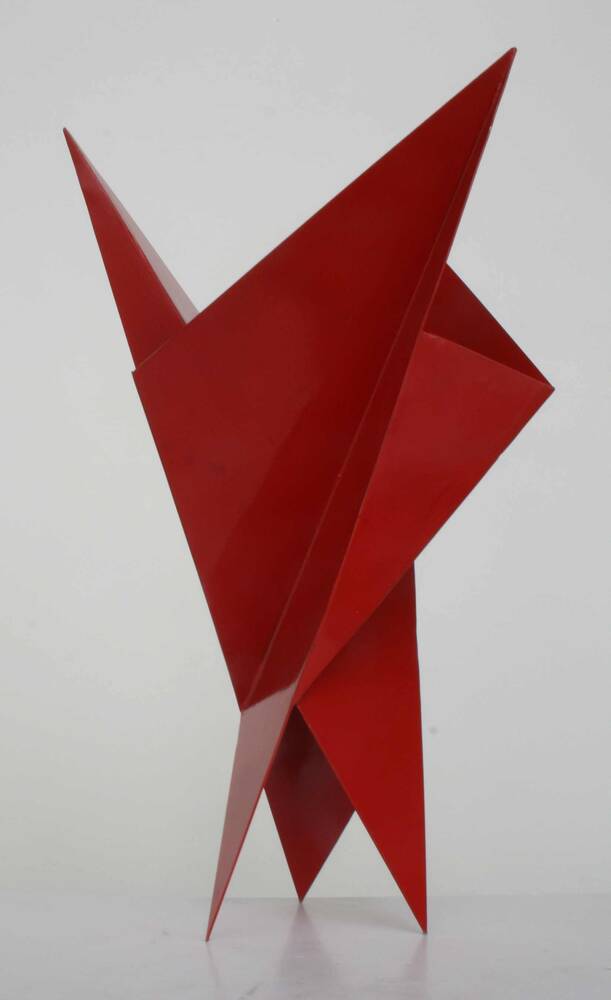
Die Schönheit geometrischer Formen berührte den Dresdner Künstler Hermann Glöckner schon beim Zeichnen in der Gewerbeschule, als er in den Linien und Flächen etwas erspürte, das über die reine Geometrie hinausging. Er erlernte den Beruf des Musterzeichners, was ihm aber schon bald nicht mehr genügte. Er wollte künstlerisch und frei arbeiten. An der Akademie mehrmals abgelehnt, entwickelte sich Glöckner weitgehend autodidaktisch weiter und arbeitete bis zu seinem Tod im Jahr 1987 abstrakt. Diese kleine rote Skulptur verkörpert das wichtigste Gestaltungsprinzip in seinem Schaffen – die Faltung. Sie steht aber auch für seine späte Anerkennung in der DDR.
Viele Jahre musste Hermann Glöckner im Stillen arbeiten. Abstraktion galt in der DDR lange als individualistisch und reaktionär. 1975 erhielt der damals 86-Jährige dann aber doch den Auftrag für eine große Außenplastik. Sein 15 Meter hoher „Mast mit zwei Faltungszonen“ vor der Mensa der Technischen Universität Dresden gilt als erste konstruktivistische Monumentalplastik im öffentlichen Raum der DDR. Die „Untere Faltungszone vom Mast“ stellte Glöckner auch im kleinen Format her und lackierte sie rot. Kein Zweifel: Es ist eine eigenständige Arbeit.
Den Ursprung der „Faltungen“ finden wir in Glöckners „Tafelwerk“. So nannte er seine experimentelle Werkreihe ab Ende der 1920er-Jahre, bei der er Flächen in geometrische Formen aufteilte. Als er dabei auch gefaltete Seidenpapierstreifen aufklebte, war der erste Schritt in Richtung Dreidimensionalität vollzogen.
Glöckners Skulpturen sind nach geometrischen Regeln exakt berechnet und sorgfältig ausgeführt. Die „Untere Faltungszone vom Mast“ ist so kompliziert gefaltet, dass die Ausgangsformen kaum nachvollziehbar sind.
Weitere Medien
Unser Bestand an Kunst aus der DDR ist umfangreich und vielfältig. Er reicht von konformen bis hin zur non-konformen Positionen, spiegelt aber vor allem die vielen Facetten dazwischen, von Künstlern also, die sich weniger über den Staat, in dem sie lebten, als über ihre Inhalte definierten.
Wie für die meisten Sammlungsbereiche gilt jedoch auch hier: Künstlerinnen sind proportional sehr wenig vertreten, insbesondere natürlich solche, die außerhalb des etablierten Mediums Malerei arbeiteten. Dabei gab es gerade innerhalb der Subkultur sehr viele mutige, innovative, subversive Künstlerinnen, die leider vor und nach der Wende unter dem Radar der öffentlichen Wahrnehmung blieben. Wir haben diesen Künstlerinnen 2018/2019 mit der Sonderausstellung „Medea muckt auf. Radikale Künstlerinnen hinter dem Eisernen Vorhang“ eine Ausstellung gewidmet. Aber unsere Aufgabe ist es nun diese Lücken im Bestand zu schließen, auch um für nachfolgende Generationen die Vielfalt der Kunst in der DDR angemessen museal spiegeln zu können.
Zu den Neuzugängen der Sammlung von Kunst aus der DDR gehören daher in den letzten Jahren vor allem Künstlerinnen: darunter die Fotografin Tina Bara, die Malerinnen Cornelia Schleime und Christine Schlegel, wobei letztere auch im Bereich Experimentalfilm zum Beispiel zusammen mit der legendären Tänzerin Fine agierte, aber auch Künstlerinnen, wie Christa Jeitner, die im Bereich Textilkunst arbeitete und die Faser von den kunsthandwerklichen Konnotationen befreite. Um die umfangreiche Performance-Tradition spiegeln zu können, die es auch in der DDR gab, wurden zudem von den Staatlichen Kunstsammlungen Dresden Kostüme und Archivalien, also Fotografieren zum Beispiel angekauft, etwa von der Künstlerinnengruppe Erfurt um die Künstlerin Gabriele Stötzer, die in den 1980er Jahren für die feministischen Tendenzen in der Kunst aus der DDR exemplarisch stehen mag.
Als gattungsübergreifendes Haus der Kunst umfassen die Sammlungen des Albertinum eine Fülle an Werken aus dem Zeitraum von 1800 bis heute, von den bahnbrechenden Gemälden eines Caspar David Friedrich bis zu den fantastischen Glasbildern Gerhard Richters. Aber so reich die Sammlung auch ist: Bei der Direktorin Hilke Wagner sind durchaus noch Wünsche offen:
„Wir haben natürlich viele Frauenbildnisse in der Sammlung, was wir jedoch schmerzlich vermissen, sind Werke von Künstlerinnen. Und das gilt bis ins 19. Jahrhundert; wir haben im Bestand ungefähr 5 Prozent Künstlerinnen in der Zeit von 1800 bis ins 21. Jahrhundert. Und hier tatsächlich rückwirkend auch Kanons zu korrigieren, der natürlich Frauen, Künstlerinnen immer wieder übersehen hat, ist eine unserer zentralen Aufgaben der nächsten Jahre.“
Was Hilke Wagner, die aus Kassel stammt, besonders überraschte: Auch im Bestand der DDR-Kunst finden sich nur sehr wenige Werke von Frauen:
„Ich hatte natürlich immer ein Bild von einer absoluten Gleichberechtigung von Mann und Frau in der DDR im Kopf. Tatsächlich im Gespräch mit den Künstlerinnen zeigt sich, dass das keineswegs besser war als im Westen. Also da gibt es, finde ich, in der Kunstszene keinen großen Unterschied zwischen Ost und West.“
Um so wichtiger ist es für die Direktorin, die Lücken in der Sammlung zu schließen und rückwirkend Kunst von DDR-Künstlerinnen anzukaufen. Ein Vergleich mit Werken der Künstler wäre vielversprechend:
„Also insgesamt in der DDR gibt es einen ganz starken Rückbezug auf mythologische Figuren. Und da finde ich es aufschlussreich, dass es bei den Malern, also den männlichen Künstlern, häufig so die Verlierer der Mythologie sind.
Also Sisyphos zum Beispiel oder Ikarus. Und bei den Frauen, bei den Künstlerinnen in der DDR, da sind es häufig die durchgeknallten, mutigen Revoluzzerinnen. Also Kassandra, Penthesilea, Medea. Also das finde ich schon mal sehr auffällig, und dass gerade Künstlerinnen in der DDR auffallen durch eine große Resilienz.“
Dresden artist Hermann Glöckner studied technical drawing at vocational school. Even in those days, he was fascinated by the beauty of geometric forms, sensing something in the lines and surfaces going beyond sheer geometry. When he began working as a pattern designer, he quickly found he had other aspirations and dreamt of working freely as an artist. After several unsuccessful applications to the Academy of Fine Arts in Dresden, Glöckner became largely self-taught. Until his death in 1987 aged 98, his creative output was informed by his abstract sculptural ideas. This small sculpture not only embodies the major design principle in his entire oeuvre – the art of folding – but also stands for the late appreciation of his work in the GDR.
For many years, Hermann Glöckner made his works in isolation. In the GDR, abstraction was long regarded as reactionary and individualist. In 1975, when Hermann Glöckner was 86 years old, he finally received a commission for a large outdoor sculpture. His 15-meter-high Folding Zone with Two Masts in front of the refectory at Dresden University of Technology is ranked as the first monumental Constructivist sculpture in public space in the GDR. Glöckner also produced this Lower Folding Zone of the Mast in a small format, painting it bright red. It is, without doubt, an independent work.
Incidentally, Glöckner’s ‘folding’ technique first appeared in his Tafelwerk, an experimental series from the late 1920s dividing surfaces into geometric forms. When he then began gluing on folded strips of silk paper, he took the first step towards three-dimensional works.
His sculptures follow the rules of geometry, precisely calculated and meticulously created. The Lower Folding Zone of the Mast is so intricately folded, it is almost impossible to imagine the source material it started from.
“We have an extensive and diverse collection of art from the GDR. The works range from positions conforming to state-approved art to those radically breaking with them – and include many facets in between where artists defined themselves more by their content and less by the system they lived under.
As for most collection areas, here too you find proportionally far fewer women artists – especially those working outside the established medium of painting. Yet in subcultures, in particular, there were many courageous, innovative and subversive women artists, though unfortunately before and after the Berlin Wall fell, they remained off the radar of public art discourse. In 2018 to 2019, with The Medea Insurrection. Radical Women Artists behind the Iron Curtain we dedicated a special exhibition to them. Now our task, though, is to close these gaps in our holdings, ensuring we can, in this museum context, suitably reflect the diversity of art in the GDR for future generations. Over the last years, in this spirit, we have primarily acquired works by women artists for our collection of GDR art.
These artists include photographer Tina Bara, as well as painters Cornelia Schleime, or Christine Schlegel, who is also known for her work in experimental film with, for instance, the legendary dancer Fine. But we also have new acquisitions from artists such as Christa Jeitner, a textile artist who liberates fabrics from the label of ‘merely’ craftwork. To do justice to the comprehensive tradition of performance art, which was also part of the GDR’s art scene, the SKD – the Dresden State Art Collections – have also acquired, for instance, costumes and archival materials, such as photography. One example here would be acquisitions from the Erfurt Women Artists’ Group founded by artist Gabriele Stötzer, a group which can be considered exemplary for feminist tendencies in art in the GDR in the 1980s.”
As a museum for art across the genres, the Albertinum’s collections offer a vast array of works from around 1800 to today, from the groundbreaking paintings by an artist such as Caspar David Friedrich to amazing glass works by Gerhard Richter. Yet despite the wealth of art in the collection, the Albertinum’s Director Hilke Wagner still sees areas for improvement:
“Of course, we have a lot of women’s portraits in our collection, but what we are painfully missing are works by women artists – and that applies far back into the nineteenth century. Around five per cent of our holdings are by women artists in the years from 1800 to the twenty-first century. So naturally one of our key tasks over the next years is to retrospectively correct the canons which have constantly overlooked the work of women artists.
Hilke Wagner, who was born in Kassel, was especially surprised to find the holdings of art from the GDR also had very few works by women artists.
“Of course, I always had this idea in my mind of absolute gender equality in the GDR. In reality, as I discovered in conversations with women artists, it was no better than in West Germany. In the art world, I think, there was very little difference between East and West Germany.”
So Hilke Wagner regards it as even more important to close the gaps in the collection and retrospectively acquire art by women artists in the GDR. Here, a comparison with works by male artists would be very promising:
“Overall in the GDR, art had a strong tendency to return to mythological figures. I find it telling here that male artists often chose unsuccessful mythological figures – the losers, as it were, such as Sisyphus or Icarus. In contrast, women artists in the GDR frequently portrayed the courageous, crazy female revolutionaries, for instance, Cassandra, Medea, or the Amazon queen Penthesilea. I think that stands out quite prominently, as does the way the GDR’s women artists are particularly conspicuous for their greater resilience.”
Hermann Glöckner pro sebe objevil krásu geometrických tvarů již v době, kdy se na průmyslové škole učil kreslit. V liniích a plochách vycítil něco, co přesahovalo hranice čisté geometrie. Vyučil se kreslířem vzorů, ale toto povolání mu brzo nestačilo. Chtěl pracovat volně a umělecky. Přihlásil se na akademii, byl ale několikrát odmítnut, a proto se vyvíjel dál jako autodidakt a až do své smrti v roce 1987 pracoval výhradně abstraktně. Tato malá červená plastika ztělesňuje nejdůležitější princip v jeho tvorbě – skládání. Uznání se Glöckner dočkal až v pozdních letech svého života.
Glöckner pracoval mnoho let bez zájmu veřejnosti v ústraní. Abstraktní umění bylo v NDR dlouho považováno za individualistické a reakční. Roku 1975 byl však tehdy již 86ti letý umělec pověřen vypracováním velké venkovní plastiky. Jeho „Stožár se dvěma skládanými zónami“, který stojí před menzou Technické univerzity v Drážďanech, je považován za první konstruktivistickou monumentální plastiku v NDR vystavenou ve veřejném prostoru. „Spodní skládanou zónu stožáru“ vytvořil Glöckner také v malém formátu a natřel ji červenou barvou. Bez pochyby je tato malá plastika ale také samostatným dílem.
Původ Glöcknerových „skládaných“ děl najdeme v jeho díle „Tafelwerk“, jak nazval svou experimentální sérii prací z konce 20tých let. Rozdělil zde plochy do geometrických tvarů a pak na ně přilepil složené proužky hedvábného papíru, čímž učinil první krok k trojrozměrnosti.
Glöcknerovy sochy jsou přesně propočítané podle geometrických pravidel a pečlivě vypracované. „Spodní skládaná zóna stožáru“ je poskládána tak složitě, že původní tvar již téměř není možné zrekonstruovat.
„Naše sbírka umění z bývalé NDR je rozsáhlá a velmi rozmanitá a je v ní zastoupeno umění jak konformních, tak nekonformních umělců, ale především také všech, kteří se v různých odstínech pohybovali mezi oběma póly. Tito umělci definovali svůj postoj méně v poměru ke státu, ve kterém žili, ale snažili se vyjádřit své názory svým dílem a jeho obsahem.
Jako ve většině sbírkách jsou také v naší sbírce málo zastoupeny ženy, a samozřejmě zejména umělkyně, které pracovaly mimo etablovanou oblast malířství. Přitom v NDR pracovalo mnoho odvážných, inovativních a nepřizpůsobených umělkyň, na něž bohužel společnost před pádem komunismu stejně jako po něm pohlížela zvláštním způsobem. Právě těmto umělkyním jsme v roce 2018/2019 věnovali samostatnou výstavu „Médeia se bouří. Radikální umělkyně za železnou oponou“. Naším dnešním úkolem je právě tyto mezery ve sbírkách zaplnit, a tak umožnit i budoucím generacím udělat si pokud možno ucelený obraz rozmanitého umění v NDR.
K novým přírůstkům ve sbírce umění NDR v posledních letech patří především umělkyně: fotografka Tina Baraová, malířky Cornelia Schleimeová a Christine Schlegelová, která také působila v oblasti experimentálního filmu a spolupracovala s legendární tanečnicí Fine, ale také umělkyně jako Christa Jeitnerová, která pracovala v oblasti textilního umění. Aby ve sbírce bylo zastoupeno i performanční umění, které mělo v NDR také tradici, zakoupily Státní umělecké sbírky v Drážďanech navíc kostýmy a archivní materiály jako fotografie, například od erfurtské skupiny umělců kolem umělkyně Gabriele Stötzerové, která je příkladem pro feministické hnutí v umění NDR 80tých let.“
Sbírky Albertina obsahují umění různých žánrů a zároveň množství uměleckých děl z 19. století až po současnost, od průkopnických obrazů Caspara Davida Friedricha až po fantastické obrazy ze skla od Gerharda Richtera. Ale jakkoli je naše sbírka bohatá, má ředitelka Hilke Wagnerová ještě nesplněná přání:
„Samozřejmě se v naší sbírce nachází mnoho ženských portrétů, co nám však velmi chybí, jsou díla od ženských autorek. A to platí již pro 19. století. Ve sbírce máme pouze přibližně pět procent prací od umělkyň z období od roku 1800 až do 21. století. A proto je jedním z našich hlavních úkolů v následujících letech i zpětně opravit umělecký kánon, ve kterém nehrály téměř žádnou roli právě ženy, umělkyně.“
Hilke Wagnerovou, pocházející z Kasselu, překvapilo zejména to, že se i ve fondu umění NDR nachází jen velmi málo uměleckých děl od žen:
„Já jsem si samozřejmě vždycky představovala, že v NDR panovala absolutní rovnost mezi muži a ženami. Na základě rozhovorů s umělkyněmi jsem však pochopila, že tam situace nebyla v žádném případě lepší než na západě. V umělecké scéně podle mě neexistoval žádný velký rozdíl mezi východem a západem.“
Pro ředitelku sbírky je proto velmi důležité zaplnit mezery ve sbírce a zpětně zakoupit umělecká díla umělkyň z NDR. Srovnání s díly umělců je velmi poučné a zajímavé:
„V celé NDR v dílech najdeme silný odkaz na mytologické postavy. Velmi zajímavá je ale skutečnost, že se u malířů, tedy umělců mužského pohlaví, jedná hlavně o poražené mytologické hrdiny. Tedy například o Sisyfa nebo o Ikara. A u žen, umělkyň z NDR se jedná často o trochu bláznivé, odvážné revolucionářky. Jako o Kasandru, Penthesileu či Médeiu. To považuju za velmi pozoruhodné, stejně jako to, že umělkyně v NDR vynikaly svou velkou resiliencí tedy odolností.“
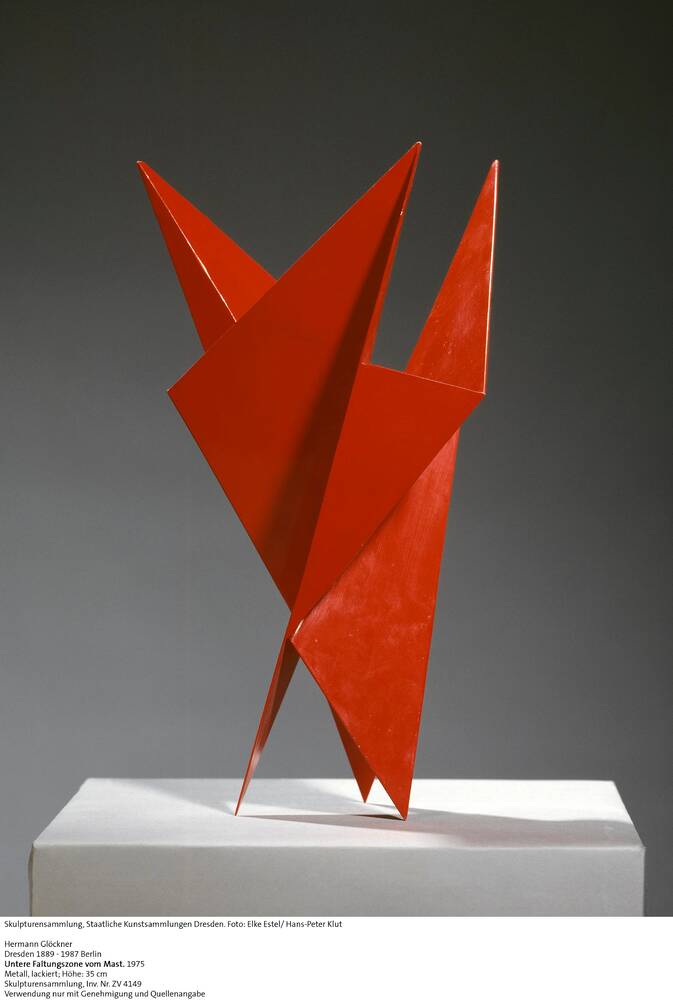
- Ort & Datierung
- 1975
- Material & Technik
- Metall, rot lackiert
- Dimenions
- H: 35,4 cm, B: 20,4 cm, T: 18,5 cm Gewicht: 0,8 kg
- Museum
- Skulpturensammlung
- Inventarnummer
- ZV 4149