
„China. Du liegst drüben und dein Meer ist wirklich gelb. Je mehr wir uns China näherten, um so gelber wurde das Wasser. Der mächtige Huang Ho führte sein Lehmwasser ins Meer.“
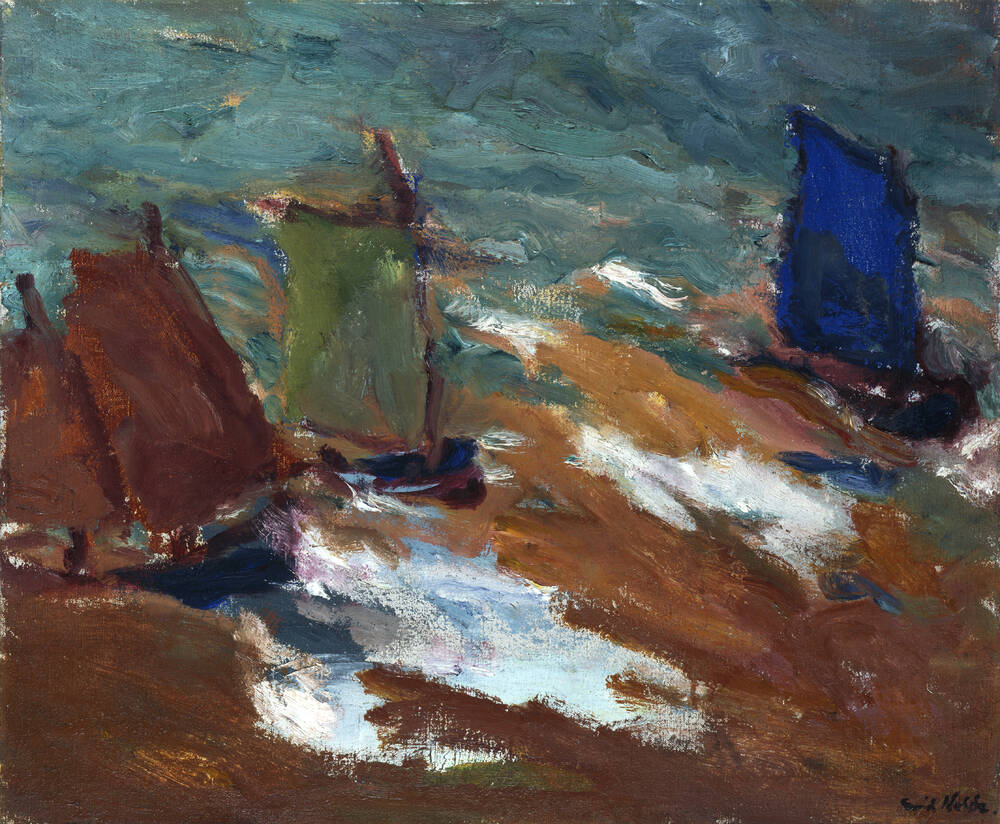
Das Reise-Erlebnis, das er hier im Rückblick schildert, hielt Emil Nolde auch in diesem Gemälde fest. 1913/14 nahmen er und seine Frau Ada als Privatreisende an einer elfmonatigen "Medizinisch-demografischen Expedition" teil, die das Reichskolonialamt organisiert hatte. Sie führte in die Südsee, in die Kolonie Deutsch-Neuguinea; heute gehört das Gebiet zum Inselstaat Papua-Neuguinea. Als die Expeditionsteilnehmer auf der Hinreise von Japan aus über das Gelbe Meer nach China fuhren, fertigte Nolde einige Aquarelle; das Ölgemälde in den erdigen Grün-, Braun- und Orangetönen schuf er nach seiner Rückkehr im Atelier. Mit dem leuchtend blauen Segel der rechten Dschunke durchbricht er kühn den warmen Farbklang.
Aufgabe der Expedition war es, die Ursachen für den angeblichen Bevölkerungsrückgang in der Kolonie zu ergründen; zu diesem Zweck untersuchten die Mediziner die Einwohner und Einwohnerinnen und nahmen an ihren Körpern Vermessungen vor, nach den in der Anthropologie damals gebräuchlichen Verfahren. Nolde hielt zahlreiche Männer und Frauen in ausdrucksvollen Zeichnungen und Aquarellen fest, wobei er den kolonialen Alltag gänzlich ausblendete. Er zeigte seine Modelle kaum bekleidet, mit großen Ohrringen oder Halsketten, obwohl manche in Wirklichkeit auch europäische Kleidung trugen. Der Grund: Noldes tief empfundener Wunsch, Menschen anzutreffen, die noch nicht von der europäischen Zivilisation verdorben seien und in einem vermeintlich urtümlichen Naturzustand existieren würden. Er stellte jedoch genauso wenig wie die Mediziner die koloniale Herrschaft der Deutschen in Frage.
Weitere Medien
“China. You lie over there, and your sea really is yellow. The closer we came to China, the yellower the water became. The mighty Huang Ho carried its loamy water into the sea.”
Later in his studio, Nolde captured in this painting the experience he described on his journey. In 1913 to 1914, together with his wife Ada, he took part as a private person an eleven-month Medical Demographic Expedition organised by the Imperial Colonial Office. They travelled to the South Seas, to the German New Guinea colony – today, a region belonging to the island state of Papua New Guinea. On a return journey taking members of the exhibition from Japan across the Yellow Sea to China, Nolde painted several watercolours. Back in his studio, he worked up this oil painting with its earthy green, brown, and orange tones, boldly using the luminous blue sail of the junk on the right to break the harmony of this warm tonality.
Since the Medical Demographic Expedition set out to identify the reasons for an alleged decline in the population of German New Guinea, the medical officers examined the residents of local villages and measured their bodies using the standard anthropological procedures of their day. Nolde produced many impressive sketches and watercolours of indigenous men and women, though he totally excluded everyday colonial life. He depicts his models largely nude, with large earrings or necklaces, even though in reality some of them normally wore European clothes. Nolde’s approach was rooted in his profound desire to meet people living in an imagined “pristine” state, not yet corrupted by European civilisation – yet he questioned German colonial rule just as little as the medical specialists on the journey.
„Číno. Rozléháš se přede mnou a tvé moře je opravdu žluté. Čím více jsme se blížili k čínskému pobřeží, tím byla voda žlutější. Jílovitá voda stékala z mohutného Huang Ho přímo do moře.“
Zážitky a dojmy z cest, které zde Nolde popisuje, zachytil také na tomto obraze. V letech 1913 až 14 se Nolde spolu se svou manželkou zúčastnil jedenáctiměsíční lékařsko-demografické expedice, kterou organizoval říšský koloniální úřad. Cesta vedla do Jižního Pacifiku, do kolonie Nová Guinea. Dnes tato oblast patří k ostrovnímu státu Papua-Nová Guinea. Na cestě z Japonska přes Žluté moře do Číny vytvořil Nolde několik akvarelů. Obraz malovaný olejovými barvami v zemitých odstínech zelené, hnědé a oranžové vytvořil až ve svém ateliéru po návratu z výpravy. Jasně modrá plachta džunky vpravo se odráží od jinak teplých barevných tónů.
Cílem expedice bylo zjistit příčiny údajného úbytku obyvatelstva v kolonii. Za tímto účelem lékaři vyšetřovali tamější obyvatelstvo a měřili jejich těla podle návodů, které byly tenkrát běžné v antropologii. Nolde zachytil několik mužů a žen na svých expresívních kresbách a akvarelech, přičemž naprosto potlačil tamní všednodenní život v kolonii. Své modely zobrazil téměř nahé, s velkými náušnicemi nebo náhrdelníky, přestože někteří z nich nosili ve skutečnosti také evropské oblečení. Důvodem bylo Noldeho hluboké přání setkat se s obyvateli, kteří ještě nebyli zkaženi evropskou civilizací a kteří vedli zdánlivě primitivní život v souladu s přírodou. Koloniální nadvládu německé říše však vůbec nezpochybňoval stejně jako lékaři zúčastňující se výpravy.
- Ort & Datierung
- 1914
- Material & Technik
- Öl auf Leinwand
- Dimenions
- 73 x 88 cm (Katalogmaß 2010) 73 x 88 cm (Katalogmaß 1987) 73 x 88,3 cm (Inventurmaß, 23.04.2010) 90,5 x 106,5 x 5 cm (Rahmenmaß, Tobias Lange, 23.04.2010) 90,5 x 106,5 x 5 cm (Rahmenmaß, Neumann/ Ebert, 29.09.2009)
- Museum
- Galerie Neue Meister
- Inventarnummer
- Gal.-Nr. 2818