
Auf die Frage, warum er vor allem afroamerikanische Menschen male, antwortet Kehinde Wiley:
„... weil ich Menschen sehen möchte, die aussehen wie ich …“
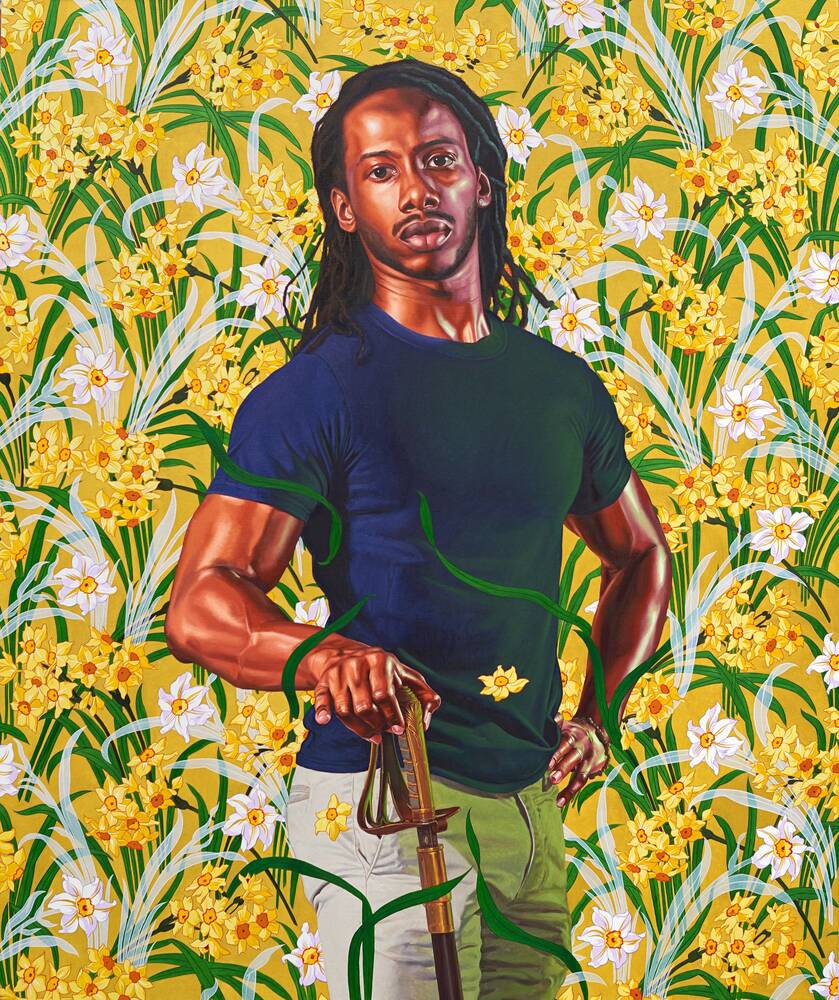
… und zwar auf Kunstwerken im Museum und nicht nur auf der Straße, wo er seine Modelle findet. Hier sehen wir einen New Yorker Drehbuchautoren, der sich selbstbewusst auf einen Degen stützt – in der gleichen Pose wie einst General John Burgoyne auf dem Porträt des Malers Joshua Reynolds. Kehinde Wiley bezieht sich auf das Vorbild, interpretiert es aber völlig neu.
Kurator Holger Birkholz ist sehr froh, dieses Porträt im Mosaiksaal zeigen zu können:
„Einem Raum, in dem tatsächlich die Geschichte der Macht der weißen Männer in besonderer Weise anschaulich wird: sowohl durch politische Größen, Könige und andere Machthaber und Geistesgrößen wie Lessing, Goethe und Schiller. Da zeigt sich die Vormachtstellung sehr massiv. Deshalb war es so interessant, eine künstlerische Position zu finden, die sich kritisch mit dieser Tradition auseinandersetzt“.
Kehinde Wiley gehört zu den bekanntesten US-amerikanischen Malern. 2018 schuf er das offizielle Porträt von Präsident Barack Obama.
Aber wir alle wissen: die Geschichte der Afroamerikanerinnen und Afroamerikaner in den USA war von Beginn an durch Verschleppung, Sklaverei und Gewalt geprägt und sie werden bis heute diskriminiert. Wiley gibt ihnen einen Platz in der Geschichte. Dabei verknüpft er Tradition und Moderne auf mehreren Ebenen: Der junge Mann ist auffallend muskulös und erscheint so als Ikone sexuellen Begehrens.
Das Streben nach dem idealen Körper finden wir in der Antike, aber auch im Klassizismus. Der Dargestellte zeigt sich selbstbewusst, trägt Alltagskleidung und steht inmitten wunderschöner Blumen, die ihn zart umschlingen. Seine Hand hält die Waffe ein wenig geziert. Das erinnert an die Sitten und die Pracht im höfischen Frankreich und ist auch eine Hommage des Malers an seine Mutter – eine Frau aus einfachen Verhältnissen, die ihre Wohnung opulent ausgestattet hatte.
Weitere Medien
Asked why he mainly paints African Americans in his work, artist Kehinde Wiley said:
“... because I want to see people who look like me…”
And he wants to see them in art works in museums, and not just on the street where he finds his models. In this work, Kehinde Wiley’s model was a New York screenwriter. His confident posture with one hand holding a sword echoes the pose of General John Burgoyne in a portrait by the English artist Joshua Reynolds. So here, Wiley has taken an eighteenth-century portrait as his inspiration, but completely reinterpreted it.
Curator Holger Birkholz is very pleased to be able to show this work in the Mosaic Hall.
“This room actually visually displays the history of white men’s power in a particular way – through grand political figures, kings and other rulers, as well as intellectual greats like Lessing, Goethe and Schiller. This eminently illustrates the dominance of the white narrative permeating our history. In that context, it was especially interesting to find an artistic position critiquing this tradition.”
Kehinde Wiley is ranked among the best-known American painters. In 2018, he painted the official portrait of the former President Barack Obama.
Yet from the outset, as we all know, the history of African Americans in the United States was a story of abduction, slavery and violence – and even today, Black people still face discrimination. Wiley gives them a place in history, linking tradition and modernity across a variety of levels. With his strongly athletic body, the young man could be an icon of gay desire – yet the ‘ideal body’ was a key trope in the art of antiquity, just as it was later in neo-classicism.
Dressed in everyday clothes and in a self-confident pose, the figure is set amid wondrous flowers gently twining around his body. His hand on the sword handle seems almost affected. But the position of the hand recalls the customs and magnificence of courtly France – and is also Kehinde Wiley’s homage to his mother, a woman from a simple background who gave their home an opulent interior design.
Na otázku, proč maluje především Afroameričany, Kehinde Wiley odpovídá:
„... protože chci vidět lidi, kteří vypadají jako já … “
… a to nejen na ulici, kde Wiley nachází své modely, ale také na uměleckých dílech v muzeu. Na zdejším obraze vidíme newyorského scénáristu, který se sebevědomě opírá o kord – ve stejné póze jako kdysi generál John Burgoyne na portrétu malíře Joshuy Reynoldse. Kehinde Wiley se vztahuje na Reynoldsův motiv, interpretuje ho však zcela novým způsobem.
Kurátor Holger Birkholz je velmi potěšen, že tento portrét visí právě v Mozaikovém sále, tedy …
„… v místnosti, ve které je historie moci a nadvlády bílých mužů obzvlášť jasně viditelná: Zastupují ji tu politické osobnosti, králové a různí panovníci stejně jako kulturní velikáni, jako byli Lessing, Goethe nebo Schiller. Zde pociťujeme tuto nadřazenost velmi silně. Proto bylo velmi zajímavé, hledat – a také najít – umělecký přístup a postoj, které se kriticky touto tradicí zabývají.“
Kehinde Wiley patří k nejznámějším americkým malířům. V roce 2018 vytvořil oficiální portrét amerického prezidenta Baracka Obamy.
Všichni ale víme, že historie Afroameričanů v USA byla od začátku spojená s únosy, otroctvím a násilím a že diskriminace je dodnes ještě na denním pořádku. Wiley tyto motivy zařazuje do historického kontextu a propojuje přitom tradici a modernu hned na několika úrovních. Mladý muž na obraze má svalnaté tělo a je zobrazen jako ikona sexuálních tužeb.
Již v antice nacházíme snahu o zobrazení ideálního těla, a také klasicismus byl inspirován tímto vzorem. Zobrazený muž vyzařuje sebevědomí. Má na sobě všednodenní oblečení a stojí uprostřed nádherných květin, které jej jemně objímají. Zbraň v ruce drží trochu zdráhavě a afektovaně, jeho gesto připomíná zvyky a přepych na francouzském královském dvoře. Obraz je ale také zároveň poctou malířově matce – ženě z prostých poměrů, která si navzdory skromným možnostem svůj byt bohatě vyzdobila.
- Ort & Datierung
- 2017
- Material & Technik
- Öl auf Leinwand
- Dimenions
- 182,5 x 152,5 cm
- Museum
- Galerie Neue Meister
- Inventarnummer
- Leih-Nr. L 490