
Die goldene Siegerbinde im Haar hat sich dieser junge Mann sicher redlich verdient, darauf lässt zumindest sein harmonisch trainierter Körper schließen. Aber hätten Sie gedacht, dass diese Plastik vom Maler und Bildhauer Sascha Schneider vor über einhundert Jahren mal in einer Art Fitness-Studio aufgestellt war, als Vorbild für leibhaftig Trainierende? Die Initiative kam vom Künstler selbst. Schneider suchte schon eine Weile nach einem physischen Ideal – mithilfe von Vorbildern aus der Antike, aber auch mit lebenden Modellen.
Nach seiner Ausbildung an der Dresdner Kunstakademie und einer anschließenden Zeit in Weimar ging Schneider für einige Jahre nach Italien ins Exil. Anders als im deutschen Kaiserreich stand seine Homosexualität dort nicht unter Strafe. Zugleich ließ sich die Kunst der Antike dort anhand zahlreicher Skulpturen studieren. In Italien fand Schneider auch die Vorbilder für diese Figur, die er 1911 formte, vermutlich in seinem Atelier nahe Florenz. Etwa zeitgleich stießen in Dresden andere seiner Werke auf Ablehnung, wegen ihrer vermeintlichen Obszönität. Dennoch nahm das Albertinum diese Plastik, ein Geschenk aus Privatbesitz, 1913 in seine Sammlung auf – wohl nicht zuletzt auch, weil sie in der Traditionslinie der Antikensammlung stand, die damals hier ausgestellt war.
Sascha Schneider kehrte bald wieder nach Dresden zurück, wo er 1919 ein Institut namens „Kraft-Kunst“ gründete, eine Art Trainings-Zentrum für Aktmodelle, wie Kurator Andreas Dehmer beschreibt:
„In diesem Kraft-Kunst-Institut durften sich vorwiegend männliche Besucher körperlich bilden, fortbilden, und ihm zugleich Modell stehen. Und dieser Knabe mit Siegerbinde, stand inmitten dieser Palästra, diesem Übungsraum, auch gewissermaßen als leuchtendes Vorbild.“
Weitere Medien
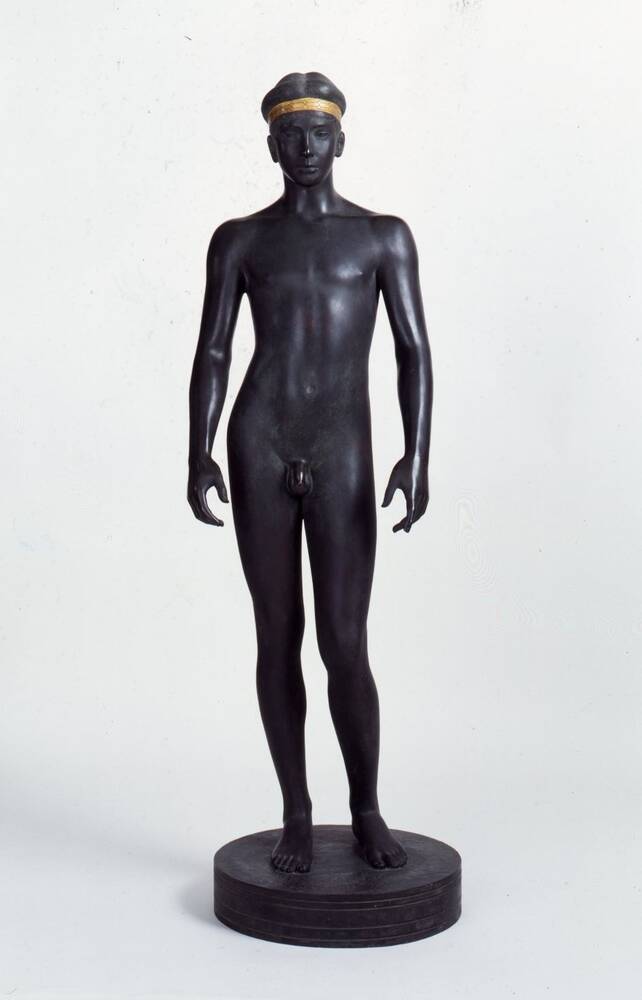
This young man certainly deserved his victor’s golden headband – at least, if his perfectly trained body is anything to go by. But would you have thought over one hundred years ago this work by painter and sculptor Sascha Schneider was set up in a kind of fitness studio as a model for physical training? But it was – at Schneider’s own initiative. For some time, with the help of paragons from antiquity as well life models, Schneider had been trying to express a physical ideal.
He originally trained at the Academy of Fine Arts in Dresden and spent some years as a professor of art in Weimar. But Schneider left Weimar for exile in Italy since there, in contrast to the German Reich, homosexuality was not criminalised. During his years in Italy, Schneider studied numerous sculptures to develop his knowledge of classical art. There too, he found the model and inspiration for this figure made in 1911, most likely in his studio near Florence. Around the same time, other works by Schneider were rejected in Dresden, condemned for alleged obscenity. Nonetheless in 1913, as a gift from a private collector, the Albertinum took this sculpture into its collection – probably not least as Schneider’s Victor was informed by the same traditions as the antiquities collection shown here at that time.
Sascha Schneider soon returned to Dresden. In 1919, he founded the Kraft-Kunst institute. As curator Andreas Dehmer explains, this was a kind of bodybuilding centre for life models:
“The Kraft-Kunst institute was primarily designed for men to train and develop an athletic physique, and also pose at the same time as Schneider’s life models. His Victorious Youth was set up at the centre of this palaestra, this exercise room – in certain sense, also as a shining example.”
Zlatou čelenku vítěze si tento mladík jistě zasloužil, alespoň to naznačuje jeho harmonicky vytrénované tělo. Ale napadlo by Vás, že tato socha malíře a sochaře Saschy Schneidera před více než sto lety stála v jakémsi fitness studiu jako model pro lidi, kteří tam trénovali? Nápad na umístění sochy vzešel od samého autora. Schneider již delší dobu hledal vhodný model, který by odpovídal jeho představě tělesného ideálu, a obracel se proto k antickým modelům, pracoval ale také s živými modely.
Po studiu na drážďanské Akademii umění a následném pobytu ve Výmaru odešel Schneider na několik let do italského exilu, neboť tam tenkrát nebyla jeho homosexualita – na rozdíl od německého císařství – trestná. Navíc v Itálii mohl intenzívně studovat antické sochařské umění. Zde Schneider také našel model pro svou sochu, kterou roku 1911 vytvořil pravděpodobně ve svém ateliéru poblíž Florencie. Přibližně ve stejnou dobu byla v Drážďanech odmítnuta jeho jiná díla z důvodu údajné obscénnosti. Albertinum přesto přijalo roku 1913 tuto sochu do své sbírky – dar soukromého sběratele – pravděpodobně také proto, že stála v tradici antického umění, které zde bylo právě vystaveno.
Sascha Schneider se brzy vrátil do Drážďan a roku 1919 založil institut s názvem „Kraft-Kunst“, česky „Umění síly“, kde měli hlavně možnost trénovat muži, kteří stáli modelem pro akty. Kurátor Andreas Dehmer popisuje:
„V tomto institutu „Kraft-Kunst“ mohli cvičit a trénovat především mužští návštěvnici, kteří mu zároveň stáli modelem. A socha chlapce s čelenkou vítězů stála uprostřed tohoto paláce, této cvičebny, více méně jako zářný příklad.“
- Ort & Datierung
- 1911
- Material & Technik
- Kupferlegierung, Hohlgalvano, dunkelgrün patiniert, Stirnbinde vergoldet
- Dimenions
- H: 175,0 cm, B: 57,0 cm, T: 51,0 cm
- Museum
- Skulpturensammlung
- Inventarnummer
- ZV 2574