
Selbstbewusst und beinahe lasziv sitzt uns die moderne junge Frau gegenüber, die Beine übereinander geschlagen, zwischen den Fingern eine brennende Zigarette. Als der sächsische Maler Oskar Zwintscher sie porträtiert, schreibt man das Jahr 1904. Zigaretten bedeuten Männlichkeit. Rauchende Frauen gelten als unschicklich, als "femmes fatales".
Die Vorstellung der emanzipierten, Männer verführenden und zugleich bedrohenden Frau war damals populär. Aber ist diese junge Frau mit dem schlichten Haar, in ihrem schmucklosen, schwarzen Kleid bedrohlich? Was geht in ihr vor, was empfindet sie? Was bedeutet ihr offener, direkter Blick?
Die "Dame mit Zigarette" wird manchmal die "Sixtina" des Albertinum genannt. Ähnlich wie Raffaels Sixtinische Madonna übt auch sie eine rätselhafte Anziehungskraft aus. Bis heute wissen wir nicht, wer Oskar Zwintscher für das Gemälde Modell saß. Zwintscher war damals Lehrer an der Dresdner Kunstakademie und ein überaus gefragter Porträtmaler. Der Kurator Andreas Dehmer beschreibt ihn so:
"Der war immer so ein bisschen Eigenbrötler, hat dann, als er nach Dresden kam, für Furore gesorgt, vor allem aufgrund solcher Porträts, die eine sehr große Naturtreue aufweisen, aber auch doch symbolistisch im wahrsten Sinne des Wortes sind, weil man sie nicht eindeutig greifen kann."
Zwintscher war ein überaus sorgfältiger Maler. In dem "Bildnis der Dame mit Zigarette" erweist er sich als Virtuose des Schwarz. Schwarz ist das Kleid der Frau, schwarz ist der samtene Vorhang im Hintergrund. Falten und Muster schimmern im Licht. Nur der Mund der jungen Frau ist rot – wie die Glut ihrer Zigarette.
Weitere Medien
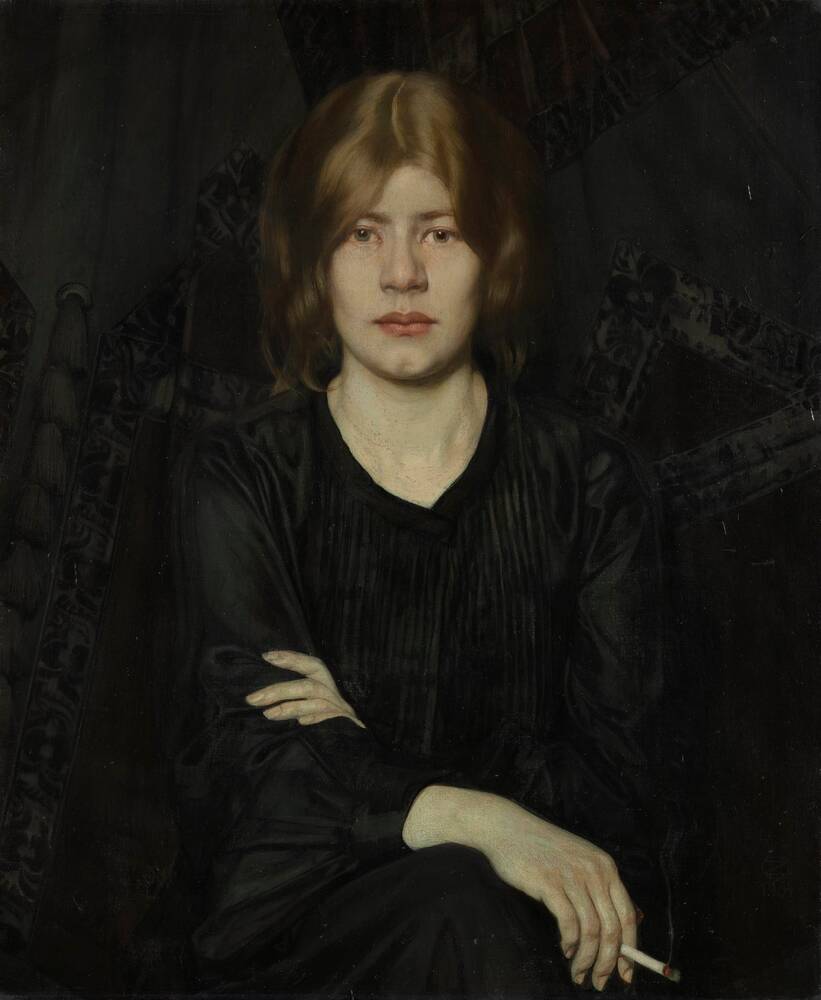
The modern young woman looks out at us confidently. With her legs casually crossed and a lit cigarette between her fingers, she has an almost seductive quality. Oscar Zwintscher, originally from Leipzig, painted her portrait in 1904 – a time when cigarettes were connotated masculine. A woman who smoked was thought at least unseemly, if not a ‘femme fatale’.
In that era, an emancipated woman was commonly regarded as a threat to men, and yet, at the same time, a temptress. But is this young woman with her unassuming hairstyle and her unadorned black dress a threat? What is she thinking? And what is she feeling? What does her direct, open gaze mean?
The Lady with a Cigarette is sometimes referred to as the Albertinum’s Sistine Madonna, since just like Raphael’s famous work, she also has a strangely powerful aura of attraction. Even today, we do not know the name of the model in Oskar Zwintscher’s painting. At that time, he was teaching at the Dresden Academy of Art, and was much in demand as a portrait painter. Curator Andreas Dehmer describes Zwintscher as:
“.. always a bit of a loner. He created a furore when he came to Dresden, especially due to portraits like this – very naturalistic, yet also with a symbolic quality in the truest sense of the word, since they always retain an ambiguity making it impossible to read them unequivocally.”
Zwintscher was an exceptionally painstaking artist. In his Portrait of a Lady with Cigarette, he proved himself to be a virtuoso of the colour black. The woman’s dress is black, as is the velvet curtain behind her. The patterns and folds in the fabric shimmer in the light. Only the young woman’s mouth is red – just like the tip of her cigarette.
Se sebevědomým a téměř lascívním výrazem tu sedí a dívá se na nás mladá žena, s přes sebe skříženýma nohama, v ruce držíc hořící cigaretu. Když ji saský malíř Oskar Zwintscher portrétoval, psal se rok 1904. Cigarety tenkrát symbolizovaly mužnost a kouření bylo pro ženy považováno za nevhodné a ty, které se toho odvážily, za tzv. "femmes fatales".
Představa emancipované a přitažlivé ženy, která svádí muže a zároveň je přivádí do zhoubných situací, byla tenkrát populární. Ale je tato mladá dívka s jednoduchým účesem v černých šatech bez jakýchkoli ozdob opravdu nebezpečná? Co se v ní děje, co právě pociťuje? Co znamená její otevřený, přímý pohled?
"Dáma s cigaretou" je občas považována za albertínskou "Sixtýnu": Stejně jako Rafaelova Sixtýnská madona přitahuje také naši pozornost zvláštním, téměř záhadným způsobem. Dodnes není známo, kdo Oskaru Zwintscherovi vlastně seděl modelem. Zwintscher tenkrát působil jako učitel na drážďanské akademii umění a byl poměrně žádaným malířem portrétů. Kurátor Andreas Dehmer ho popisuje následovně:
"Byl vždycky trochu tak zvláštně svůj, a když přišel do Drážďan, vyvolal velký rozruch, hlavně díky takovýmto portrétům, které se na jednu stranu vyznačují velkou přesností, ale na druhou jsou v pravém slova smyslu velmi symbolické, protože se vymykají jednoznačné interpretaci."
Zwintscher byl nesmírně pečlivým malířem. Na obraze "Portrét dámy s cigaretou" se nám představuje jako mistr černé barvy. Černé jsou šaty stejně jako sametový závěs v pozadí. Sklady na šatech a vzor na závěsu se ve světle lehce třpytí. Pouze ústa ženy jsou červená - jako konec zapálené cigarety.
- Ort & Datierung
- 1904
- Material & Technik
- Öl auf Leinwand
- Dimenions
- 82 x 68 cm (Katalogmaß 2010) 82,5 x 68,5 cm (Inventurmaß, 26.04.2010) 99,5 x 85,5 x 5,5 cm (Rahmenmaß, Tobias Lange, 26.04.2010)
- Museum
- Galerie Neue Meister
- Inventarnummer
- Gal.-Nr. 2690