
Vielleicht kennen Sie den erhebenden Moment, wenn auf einer Bergwanderung der Gipfel in Sichtweite rückt, und auch das Gefühl der Andacht, wenn man vor der Größe der Natur erschauert. Für den 1774 in Greifswald geborenen Caspar David Friedrich waren solche Gefühle von großer Bedeutung. Er suchte und fand Gott nicht mehr nur in den Ritualen der Kirche, sondern auch in der Natur. Und so brachte er seine religiöse Naturbegeisterung auf die Leinwand:
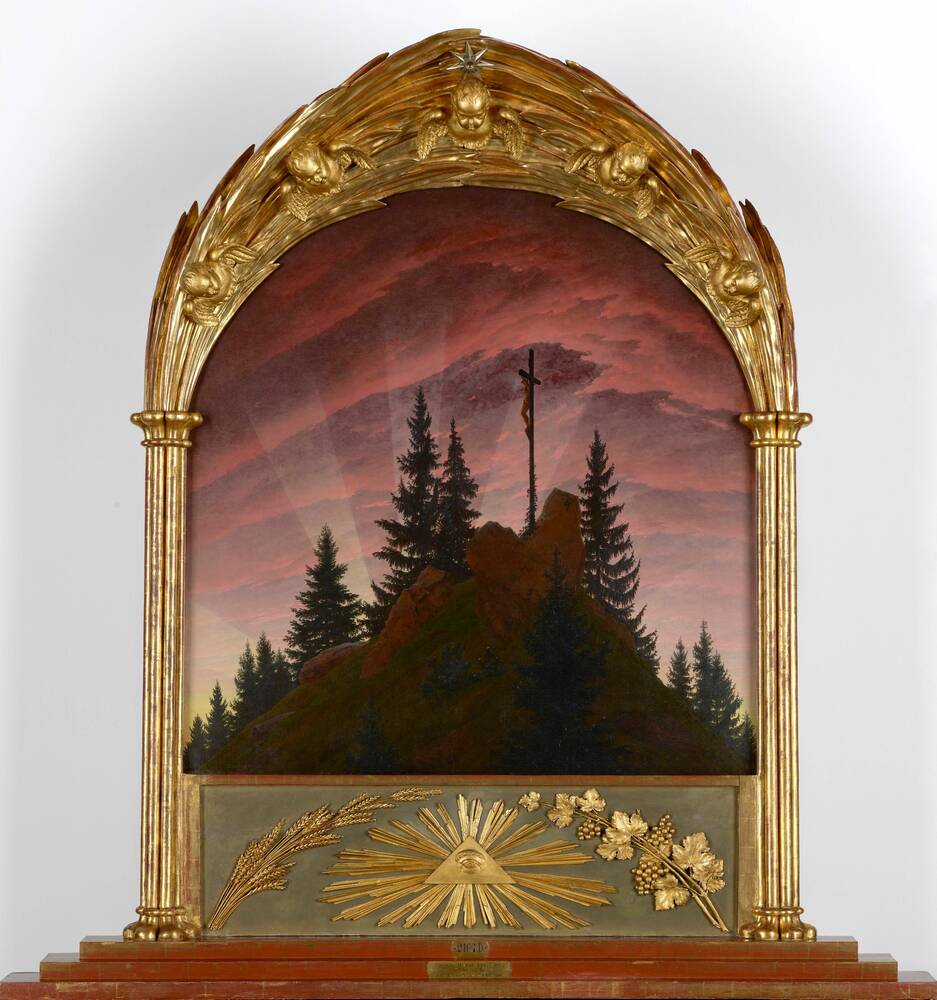
Auf einem steil aufragenden, zerklüfteten Felsen steht einsam das Kreuz. Christus ist nicht uns, sondern der untergehenden Sonne zugewandt. Aus der Tiefe herauf leuchtet sie empor und taucht die Wolken in ein intensives Abendrot. Die Fichten im Gegenlicht bilden einen wirkungsvollen Rahmen.
Doch wo stehen wir? Noch recht weit entfernt von der Bergspitze, vielleicht auf einem benachbarten Hügel, in jedem Fall aber im Dunkel – eine hochsymbolische Situation für den gläubigen Protestanten Caspar David Friedrich. Das Licht jenseits des Berges steht für die göttliche Verheißung, die durch das Leben Christi auf Erden greifbar geworden ist. Und die Figur des Gekreuzigten erinnert daran, dass der Glaube und die Hoffnung nicht gestorben sind.
Religiöse Gefühle in Natursymbolen auszudrücken, galt damals als unerhörte Provokation. Dabei war es keineswegs Friedrichs Anliegen, den christlichen Glauben in Frage zu stellen. Das zeigt der von ihm entworfene Rahmen durch seine traditionelle christliche Symbolik: oben das Auge Gottes, unten die Ähren als Symbol für das Brot des Abendmahls, den Leib Christi, sowie der Wein, der für das Blut Jesu steht.
Weitere Medien
„Der Rahmen vom Tetschener Altar ist ganz besonders, weil es ein Rahmen ist, der aus dem Rahmen fällt! Insofern als die Dekoration dieses Rahmens mit Elementen eine sprechende Ebene hat.“
sagt Kurator Holger Birkholz. Caspar David Friedrich hatte ihn selbst entworfen, und sein Freund, der Bildhauer Christian Gottlob Kühn, führte ihn aus.
„Das ist so etwas, was wir heute vielleicht auch ein Gesamtkunstwerk nennen würden, weil tatsächlich das Plastisch-Bildhauerische und das Malerische sich zu einem künstlerischen Gesamteindruck verbinden.
Wobei Friedrich ganz bewusst auch – gerade in diesem Aspekt des Gesamtkunstwerkes – auf die großen mittelalterlichen Traditionen zurückgreifen kann, wo es in Schnitzaltären oft auch gemalte Bestandteile gab.“
Während er in seinem Gemälde kühn mit der christlichen Bildsprache brach, entschied er sich bei dem Rahmen für traditionelle Symbole:
„Und zwar gibt es Elemente auf dem Rahmen wie im oberen Bereich die fünf Cherubim, den Abendstern und die Palmen im Hintergrund, und im unteren Bereich die Weizenähren, die Trauben und das Auge Gottes im Strahlenkranz.
Die Palmen oben stehen für die Märtyrer, das ist ein ganz klassisches christliches Symbol, und unten die Weizenähren und die Trauben sind Zeichen der Eucharistie, des Abendmahls, die in der christlichen Darstellungswelt ganz geläufig sind.“
Als Grund für die herkömmliche Dekoration vermutet der Kurator:
„Man kann annehmen, dass Friedrich vielleicht ein bisschen beunruhigt war ob dieser neuen religiösen Form, die er gewählt hatte für sein Gemälde und schlägt dann im Rahmen vor, wieder etwas diesen revolutionären Aspekt des Bildes zurückzunehmen und auf traditionellere Motive der christlichen Bildwelt im Rahmen zu vertrauen.“
If you have gone hillwalking, you may be familiar with that uplifting moment when the summit suddenly come into view – and also have experienced a feeling of awe in the face of the grandeur of nature. For Caspar David Friedrich, born in Greifswald in 1774, such feelings were extremely important. He no longer sought and found God solely in church rituals, but also in the natural world – and he conveyed his almost religious love of nature in his works.
A single cross stands on a jagged rock, rising steeply in front of us. The figure of Christ on the cross is not facing us, but the setting sun, its rays spreading upwards from low on the horizon, bathing the clouds in the intensive red of an evening sky. Set against the light, the pine trees effectively frame the scene.
But where are we standing? We are still a long way from the summit, perhaps on an adjacent hill, but in any case in shadowy darkness – a highly symbolic setting for the devout Protestant Caspar David Friedrich. The light on the other side of the rocky summit represents God’s promise given tangible form through Christ’s life on Earth. The figure of the Crucified Christ also reminds us that faith and hope are not dead.
At the time Casper David Friedrich painted this work, expressing religious feelings through the symbolism of nature was regarded as outrageously provocative. Yet Friedrich had no intention of questioning Christian beliefs, as is evident in the traditional Christian symbols on the frame he designed for this work.
“Caspar David Friedrich's painting is also known as the Tetschen Altar – and the frame is very special. It is so extraordinary since the frame’s decorative symbolic elements speak to the beholders.”
And as curator Holger Birkholz adds – Caspar David Friedrich designed the frame himself, and it was made by his friend, sculptor Christian Gottlob Kühn.
“Today, we might well call this a Gesamtkunstwerk – a total work of art – since the three-dimensional and sculptural fuses with the painterly to create an overall artistic impression. Particularly in this aspect of a total art work, Friedrich consciously drew on the great medieval traditions of carved altarpieces, which often integrated painted elements.”
While in his painting, Friedrich boldly broke with accepted Christian iconography, he opted for traditional symbols for the frame.
“The frame’s elements include, for instance, the five cherubim in the arched upper section, the evening star and the palms in the background, as well as, in the lower section, the ears of corn, the vine with bunches of grapes, and the eye of God in a nimbus. The palms at the top are a very classic Christian symbol for the martyrs, while throughout the Christian world the ears of corn and grapes commonly represent the Eucharist, or Holy Communion.”
Our curator also proposes a reason for this traditional decorative scheme:
“It seems safe to assume Friedrich might well have been a little uneasy about the new religious form he had chosen for his painting. So he probably took the frame as a chance to defuse his picture’s revolutionary aspect and used this space for more traditional Christian motifs.”
Možná také znáte ten povznášející okamžik, když se během pěší túry po horách konečně v dohledu objeví vrchol. A možná jste také zažili pocit pokory, když nás ohromí velikost a moc přírody kolem nás. Pro Caspara Davida Friedricha, který se narodil roku 1774 v Greifswaldu, byly takovéto pocity velmi důležité. Svého Boha nehledal a nenacházel pouze v církevních rituálech, nýbrž právě také v přírodě. A toto své nadšení přírodou, která se stala součástí jeho náboženství, přenesl na plátno:
Na strmé, zvětralé skále stojí osamocený kříž. Kristus neobrací svou tvář k nám, nýbrž k zapadajícímu slunci, jehož paprsky barví mraky do intenzívních červených odstínů. Smrky, odrážející světlo z druhé strany, působivě celý motiv rámují.
Ale kde se nacházíme my jako pozorovatelé tohoto výhledu? Ještě poměrně daleko od vrcholku hory, možná na sousedním kopci, v každém případě ale na temném místě – pro protestanta Caspara Davida Friedricha tudíž ve velice symbolické situaci. Světlo vyzařující za vrcholem znamená božské zaslíbení, které se díky Kristově životu na zemi stalo hmatatelným. Postava ukřižovaného nám připomíná, že víra a naděje ještě nezemřely.
V tehdejší době bylo vyjádření náboženského přesvědčení pomocí symbolů přírody považováno za pobuřující provokaci. Přitom Friedrich v žádném případě nechtěl zpochybňovat křesťanskou víru, jak také dokazuje rám obrazu s tradiční křesťanskou symbolikou, který Friedrich sám navrhl.
„Rám Děčínského oltáře je velmi výjimečný, protože neodpovídal tehdejším zvyklostem, v tom smyslu, že jeho výzdoba je takříkajíc sama vlastním dílem.“
Říká kurátor Holger Birkholz. Caspar David Friedrich rám sám navrhl a jeho přítel, sochař Christian Gottlob Kühn, jej realizoval.
„Jedná se celkem o dílo, které bychom dnes možná nazvali jako „všeumělecké dílo“, protože celkový umělecký dojem tu vzniká vlastně spojením sochařských a malířských prvků. Friedrich zde také vědomě navazuje – právě z hlediska všeuměleckého díla – na velké středověké tradice, kde byly často součástí vyřezávaných dřevěných oltářů také malované části.“
Zatímco se Friedrich na svém obraze oprostil od křesťanské symboliky, rozhodl se na rámu obrazu pro tradiční symboly:
„Například se v horní části rámu nachází pět cherubínů, večernice a palmy v pozadí. V dolní části pak vidíme pšeničné klasy, hrozny vína a Boží oko se svatozáří.
Palmy nahoře jsou symbolem mučedníků, přičemž se jedná o opravdu klasický křesťanský symbol. Pšeničné klasy a hrozny dole symbolizují eucharistii, tedy večeři Páně. Tyto motivy jsou v křesťanských znázorněních také naprosto běžné.“
Jako důvod pro tuto zcela konvenční dekoraci rámu udává kurátor:
„Lze se domnívat, že se Friedrich také trochu obával, jak jeho obraz, na kterém zvolil nové znázornění náboženských motivů, bude přijat. A proto se rozhodl tento téměř revoluční obsah obrazu alespoň částečně zmírnit tím, že na rámu zvolil tradičnější křesťanské motivy.“
- Ort & Datierung
- 1807/1808
- Material & Technik
- Öl auf Leinwand, geschnitzter und vergoldeter Bilderrahmen auf Sockel
- Dimenions
- 115 x 110 cm (Rahmenmaß: 183 x 177 x 23,5 cm)
- Museum
- Galerie Neue Meister
- Inventarnummer
- Gal.-Nr. 2197 D