
Die Elbauen vor den Toren Dresdens im Abendlicht mit ihren sich verzweigenden Wasserläufen, mit den sumpfigen Wiesen, mit den dunklen Silhouetten der Bäume, den sanft ansteigenden Hügeln und dem schier endlosen Himmel.
Der Greifswalder Caspar David Friedrich lebte jahrzehntelang in Dresden und kannte die Gegend gut. 1840 starb er hier. In Italien war er nie. Und das, obwohl es damals für Künstler zum guten Ton gehörte, eine Zeit lang in Italien zu leben und zu malen.
Doch Friedrich traf nicht nur für sich, sondern für die ganze Kunst des 19. Jahrhunderts eine folgenreiche Entscheidung. Er beschäftigte sich lieber mit der heimischen Landschaft. Nicht nur die Elbauen, auch die heimischen Mittelgebirge, alte Burgen und verfallene Klosterruinen waren für ihn bildwürdig. Friedrichs Neuorientierung fand viele Nachfolger, wie Carl Blechen, Ernst Ferdinand Oehme oder Ludwig Richter. Ihre romantischen Landschaften können Sie ebenfalls hier sehen.
Friedrichs Gemälde sind bis ins kleinste Detail durchkomponiert. Auch wenn dieses Bild so unmittelbar beobachtet erscheint, stand der Maler nicht mit seiner Staffelei am Fluss. Vor Ort machte er lediglich Vorzeichnungen, die Bildkomposition und die akribische malerische Ausführung erfolgten im Atelier.
Gerade aufgrund seiner bewussten Wahl der Mittel wirken Friedrichs Gemälde so stark. Mit einem Kniff zieht er uns sogartig in das Bild hinein: Zwei symmetrische Bögen lässt er aufeinander zulaufen, der eine gebildet von den Wolken am Abendhimmel, der andere vom Flussufer. Zu den Seiten scheint sich das Gemälde ins Unendliche zu strecken, so wie wir es in der Natur erleben.
Weitere Medien
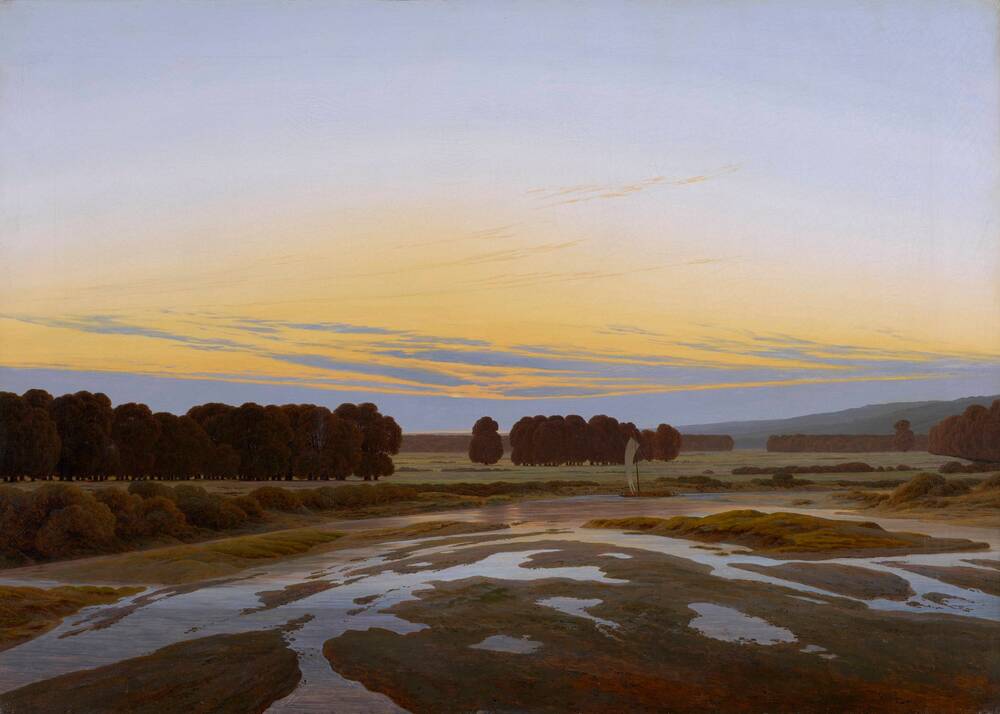
Just outside Dresden, the multitude of streams and marshy pastureland on the River Elbe’s water meadows shimmer in the evening light; across the river, we see the dark silhouettes of trees and gently rising hills – and above it all a seemingly infinite sky.
Originally from Greifswald, Caspar David Friedrich lived much of his life in Dresden. He knew the area very well, and died here in 1840.
However, although in his day living and working for a time Italy was regarded as a rite of passage for aspiring artists, he never went south of the Alps – a decision not only proving momentous for himself, but for all of nineteenth-century European art. So rather than painting Italian scenes, he focused on the landscape in his home regions – and for him, the Elbe water meadows, the Central German uplands, old castles, and derelict monastery ruins were all worthwhile subjects for his art. Friedrich’s new departure inspired many followers, such as Carl Blechen, Ernst Ferdinand Oehme or Ludwig Richter – and you can also see their romantic landscapes on show here.
Casper David Friedrich’s paintings are carefully composed down to the smallest detail. Even if this scene looks as if it is painted from life, Friedrich did not set up his easel at the riverside. He only made preliminary sketches of a subject on site. Back in his studio, he then worked them up into a pictorial composition, meticulously transferring it to the canvas.
His paintings have an immensely powerful effect – which comes precisely from his conscious choice of artistic devices. Here, he employs just such a device to draw us into the picture – our attention held by two symmetrical arches flowing towards one other, the first formed by the clouds in the evening sky, the second by the riverbank. The scene seems to stretch infinitely to the sides, just as we experience it in nature.
Labské luhy před branami Drážďan v podvečeru se svými rozvětvenými toky, bažinatými loukami, s tmavými siluetami stromů, lehce stoupajícími kopci a zdánlivě nekonečným nebem.
Caspar David Friedrich, který pocházel z Greifswaldu, žil několik desetiletí v Drážďanech, jejichž okolí velmi dobře znal. Zde také roku 1840 zemřel. Itálii nikdy nenavštívil, přestože studijní cesta do Itálie pro umělce tenkrát patřila k "povinnému" programu.
Friedrichovo rozhodnutí raději se zabývat místní krajinou dalekosáhle ovlivnilo nejen jeho vlastní, nýbrž celé umění 19. století. Friedrich považoval za hodné zobrazení nejen labské louky a luhy, ale také nedaleké středohoří, staré hrady a zchátralé zříceniny klášterů. Friedrichův nový pohled na rodnou krajinu našel mnoho následníků, kterými byli například Carl Blechen, Ernst Ferdinand Oehme nebo Ludwig Richter. Jejich romantické krajiny si zde můžete také prohlédnout.
Kompozice Friedrichových obrazů jsou propracovány do nejmenších detailů. Přestože nám může připadat, že obraz vznikl dlouhým pozorováním motivu v přírodě, malíř nestál se svým malířským stojanem na břehu řeky. Přímo na místě si motivy pouze lehce předkreslil. Kompozice obrazu a pečlivé malířské provedení vznikly až v ateliéru.
Friedrich své umělecké prostředky volil vědomě a díky tomu na nás jeho obrazy působí tak silně. Podařilo se mu dokonce vtáhnout nás přímo do obrazu: Kompozici tvoří dva symetrické oblouky, které se vzájemně střetají: Jeden tvoří mraky na večerní obloze, ten druhý břeh řeky. Divákovi připadá, že se výhled na krajinu na stranách rozpíná téměř do nekonečna - stejně jako ve volné přírodě.
- Ort & Datierung
- 1832
- Material & Technik
- Öl auf Leinwand
- Dimenions
- 73,5 x 103 cm
- Museum
- Galerie Neue Meister
- Inventarnummer
- Gal.-Nr. 2197 A