
Wir folgen zwei Männern auf ihrem nächtlichen Spaziergang. Der enge, felsige Pfad hat sie durch den Wald geführt, als sich plötzlich auf einer Anhöhe vor ihnen dieser Ausblick öffnet. Der Mond! Und daneben, klein, der Abendstern!
Caspar David Friedrich komponierte dieses Gemälde sorgsam mit mehreren Zweierkonstellationen: Da sind zunächst die beiden Männer, dann das Nebeneinander von Mond und Abendstern, sowie die beiden Bäume, eine Fichte und eine Eiche. Zudem ist da die Beziehung zwischen den Menschen hier unten auf der Erde und dem so unendlich weit entfernten Mond. Sie sehen ihn an, ein wenig scheint es, als ob er zurückschauen würde.
Seit jeher wird darüber diskutiert, ob das Bild nicht auch eine politische Botschaft hat. Tragen doch beide Männer die damalige „Altdeutsche Tracht“ der freiheitlich gesinnten Studenten. Sie wurde genau im Jahr der Entstehung des Bildes, 1819, verboten. Dazu der Kurator Holger Birkholz:
„tatsächlich hat sich die Forschung auch immer wieder gestritten, es gibt da Parteien, die sagen, der Friedrich ist vor allem politisch, andere sagen, der Friedrich ist religiös, aber das Interessante ist eigentlich, dass man in der Zeit der Romantik das nicht zwangsläufig trennen muss, weil das Religiöse mit seinem utopischen Ansatz, also der Idee von Erlösung, oder eben auch einer Befreiung durch Christus, ist eben durchaus ein politisches Thema, und man kann eben auch den zunehmenden Mond als Hoffnungssymbol sehen innerhalb einer politischen Situation, dass sich das bessern wird, mit eben den freiheitlichen Bestrebungen.“
Diese Hoffnungen sollten sich zu Friedrichs Lebzeiten jedoch nicht erfüllen. Die nach dem Wiener Kongress restaurierten Monarchien unterdrückten alle freiheitlichen Bestrebungen in Europa.
Weitere Medien
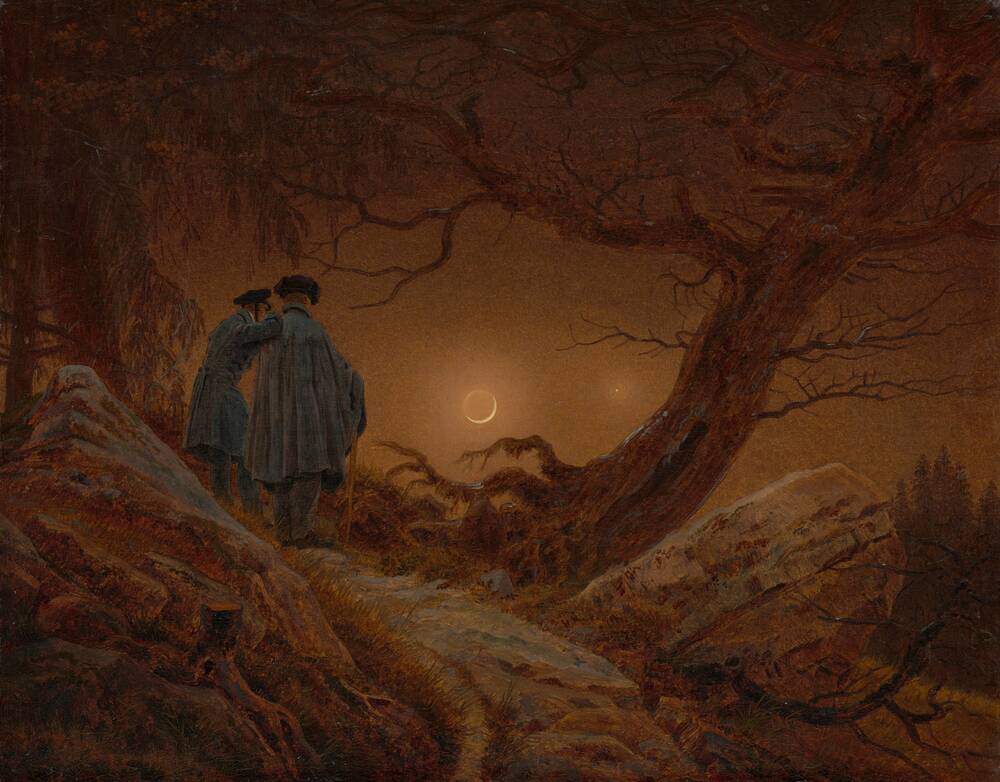
Up ahead, we can see two men on a night-time walk. The narrow, rocky path has led them through a wood. Suddenly, as the ground rises, they catch sight of this dramatic view. The moon – and next to it, the evening star!
Caspar David Friedrich carefully composed this painting around various groups of two. First, of course, the two men; then the constellation of the moon and the evening star; but also the two trees, a pine tree, and an oak. Moreover, there is also the relationship between people on Earth and the moon, so infinitely far away. Friedrich’s two men pausing on their walk to look up at the moon rather as if it could look back at them.
For years, scholars have debated whether this painting also has a political message. The two men are dressed in the ‘old German’ style’. Such traditional German costumes came to stand for resistance in the fight against Napoleon, and after 1815 were adopted by students with republican and anti-feudalist views. What’s more, this work dates from 1819 – the year when wearing the ‘old German’ costume was banned. Let’s hear from curator Holger Birkholz:
“...scholars have been constantly debating whether this work has a political message – some claiming Friedrich is first and foremost political, while others argue he is religious. Interestingly, the political and religious weren’t necessarily two separate spheres in the Romantic period. With its utopian vision – the idea of salvation or, if you like, liberation through Christ – Christianity addresses a thoroughly political idea. This waxing moon could then also be read as a symbol of hope in a political situation where precisely striving for freedom held out the promise of progress and advancement.”
But such hopes were not to be realised during Friedrich’s lifetime. Across Europe, the monarchies reinstated after Napoleon’s final defeat in 1815 and the Congress of Vienna suppressed all republican movements.
Sledujeme dva muže při jejich noční procházce. Po úzké, skalnaté stezce lesem došli až k místu, kde se před nimi najednou otevírá pohled na noční nebe a - na měsíc! A hned vedle, malá večernice!
Caspar David Friedrich pracoval při kompozici tohoto obrazu vždy se dvěma prvky: Vidíme tu dva muže, dále měsíc a večernici stejně jako dva stromy - smrk a dub. Navíc je tu znázorněn vztah mezi oběma muži zde na Zemi a nesmírně vzdáleným měsícem. Dívají se na něj a trochu to vypadá, jakoby měsíc jejich pohled opětoval.
Již od vzniku obrazu se diskutovalo o tom, zda je na obraze skryto také nějaké politické poselství. Oba muži jsou odděni do "staroněmeckého kroje", který tenkrát nosili svobodomyslně smýšlející studenti. Tento kroj byl v roce, ve kterém obraz vznikl, tedy roku 1819, zakázán. Kurátor Holger Birkholz se k tomu vyjádřil:
"a odborníci skutečně často vedli kontroverzní diskuze. Existují také strany, které zastávají názor, že Friedrichovo dílo je především politické, jiní naopak tvrdí, že je především náboženské, ale zajímavé je vlastně to, že v době romantismu není nutné oba póly bezpodmínečně posuzovat odděleně: Náboženství se svým utopickým názorem, tedy myšlenkou spasení člověka nebo také osvobozením skrze Kristovu smrt, je rozhodně také politickým tématem. Proto můžeme přibývající měsíc interpretovat jako symbol naděje v dané politické situaci, která se díky snaze o svobodu myšlení jistě zlepší."
Tyto naděje se však za Friedrichova života nesplnily. Monarchie, které byly po Vídeňském kongresu znovu obnoveny, potlačovaly veškeré svobodomyslné úsilí v celé Evropě.
- Ort & Datierung
- 1819/20
- Material & Technik
- Öl auf Leinwand
- Dimenions
- 33 x 44,5 cm
- Museum
- Galerie Neue Meister
- Inventarnummer
- Gal.-Nr. 2194