
Düster und geheimnisvoll erscheint uns die Szene, aus der im Vordergrund ein Bildstock ragt. Fast meint man, die feuchte Kühle zu spüren und das Murmeln der betenden Mönche zu hören. Ein paar Augenblicke noch und die Prozession wird im Nebel verschwunden sein, das Kreuz an der Spitze ist jetzt schon kaum mehr zu sehen. Und doch gibt es Hoffnung. Ein zartes Blau und erste Sonnenstrahlen schieben sich durch das Grau, schon lassen sich die hohen Bäume im Dunst erahnen und mit ihnen das Versprechen auf einen neuen Tag.
Ernst Ferdinand Oehme war gerade 31 Jahre alt, als ihm diese stimmungsvolle Darstellung eines nebelverhangenen Morgens gelang. Das Motiv ist typisch für die Dresdner Romantik. Oehme bezieht sich dabei sehr direkt auf sein Vorbild Caspar David Friedrich, der die Landschaftsmalerei als Ausdruck von Gefühlen verstand. Auch in dessen „Abtei im Eichwald“ sieht man eine Gruppe von Mönchen in einer Landschaft, die von einer dunklen Nebelbank hinterfangen ist. Oehme findet jedoch zu einer sehr eigenständigen Neuinterpretation dieses Motivs, indem er die Unschärfe zum Thema des Bildes macht. Für die Romantiker hat sie eine religiöse Bedeutung: Sie verweist darauf, dass letztendlich hinter der Welt der Erscheinungen Gott steht.
Aber die Unschärfe ist auch malerisch eine Herausforderung, die darin besteht, etwas anzudeuten und es damit in Bewegung zu versetzen. Deshalb ist für Kurator Holger Birkholz auch der Vergleich mit einem zeitgenössischen Künstler im Albertinum sehr interessant, mit Gerhard Richter.
„Die Unschärfe bei Richter betrifft immer das ganze Bild, das heißt, die Unschärfe entsteht durch Verziehen der feuchten Malsubstanz, mit Rakel oder Pinsel. Bei den Malern der Dresdner Romantik gibt es immer eine Mischung aus Bereichen, die noch zeichnerischer angelegt sind, in denen man noch Konturen sehen kann, das ist oft im Vordergrund, wodurch auch Tiefe entsteht. Hier sind es die Büsche im Vordergrund, die kann man noch gut und haptisch sehen, auch die Vögel. Er entwickelte dann einen tiefen Raum durch schon unscharf gemalte Aspekte…“
Weitere Medien
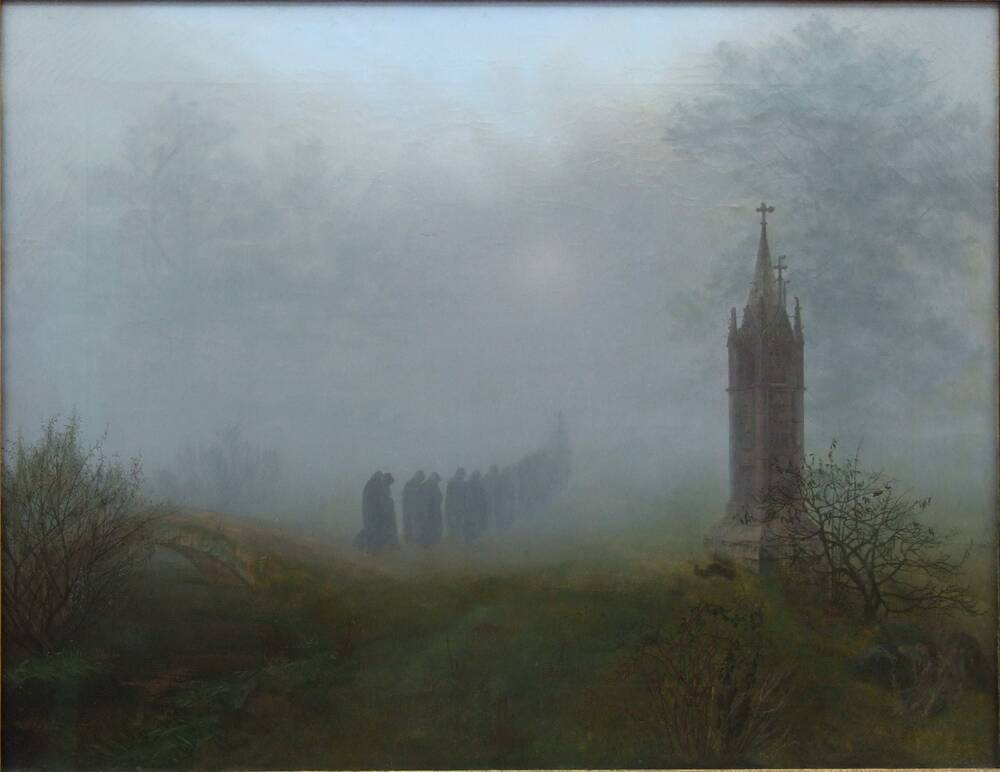
A wayside shrine in the foreground and figures vanishing into a misty background – a scene with a mysterious, sombre quality. You almost seem to feel the damp, chilly air and hear the murmur of the monks as they chant their prayers. In a few moments, the procession will be swallowed by the mist – and already the cross carried at the head of the column is hardly discernible. But this is not a scene without hope. The first rays of sun cut through the misty greyness, hints of shimmering blue sky appear, and the crowns of tall trees emerge – all signalling the promise of new day.
Ernst Ferdinand Oehme was just 31 years old when he successfully captured this atmospheric depiction of a misty morning – a subject much loved by the Dresden Romantic painters. Here, Oehme directly references Caspar David Friedrich, his great artistic inspiration, who viewed landscape painting as a vehicle to express emotions. In Friedrich’s Abbey in the Oak Wood, for instance, there is also a group of monks in a landscape set against a dark bank of fog. Yet by taking the misty blur as the subject of his work, Oehme gives the topic a very new interpretation all his own. For Romantic artists, this blurring also had a religious significance, alluding to the ultimate divine presence of God behind the world of appearances.
But in terms of painting, a blurred image is a challenge, sketching in something, alluding to it and, in this way, bringing it alive. For curator Holger Birkholz, this offers a very interesting comparison with one of the contemporary artists on show in the Albertinum – none other than Gerhard Richter.
“In Richter’s case, the blurring always runs across the entire image. To produce that effect, he drags a squeegee or a dry brush over the wet surface. The Dresden Romantic painters always combined areas. The foreground was often composed as a drawing with the contours of objects still visible, creating a sense of perspective. In this work, for instance, the bushes in the foreground are still well delineated, as are the birds, and they have a haptic quality. Oehme’s blurred painted elements then allow him to develop a sense of spatial depth…“
Zasmušile a tajuplně na nás působí scéna, na níž v popředí vynikají Boží muka. Skoro se zdá, jako by až k nám pronikal ten vlhký chlad a jako bychom slyšeli tiché mumlání modlících se mnichů. Ještě pár okamžiků a průvod zmizí v mlze, kříž v čele procesí je ještě sotva vidět. A přece scéna vyzařuje naději: Jemná modř a první sluneční paprsky se prodírají šedými mraky. V mlžném oparu již tušíme košaté stromy a s nimi příslib nového dne.
Ernestu Ferdinandu Oehmeovi bylo pouhých 31 let, když se mu podařilo vytvořit toto působivé vyobrazení mlhavého rána – typického motivu pro drážďanský romantismus. Oehme se zde staví do přímé linie se svým vzorem Casparem Davidem Friedrichem, který chápal krajinomalbu jako vyjádření malířových pocitů. Také na Friedrichově obraze „Opatství v Eichwaldu“ vidíme skupinu mnichů v krajině, kterou halí temný závoj mlhy. Oehme však dochází ke zcela vlastní, nové interpretaci tohoto motivu a jako hlavní námět zde volí právě nezaostřený pohled na krajinu. Pro romantiky to má spirituální význam, neboť poukazuje na skutečnost, že krajina je pouhým božím otiskem a za vším zdáním stojí Bůh.
Nezaostřený pohled však z hlediska malířské techniky vyžaduje značnou dovednost: motiv je pouze naznačen a tím vyvolává dojem pohybu. Proto je pro kurátora Holgera Birkholze velmi zajímavé srovnání s jedním současným umělcem zastoupeným v Albertinu: s Gerhardem Richterem.
„Nezaostřenost v Richterově díle postihuje vždy celý obraz, to znamená, že nezaostřený pohled vzniká narušením ještě mokré barvy – buď stěrkou nebo štětcem. U drážďanských romantiků se ale na obrazech ještě střídají části, které jsou malířsky přesnější, na kterých jsou viditelné jednotlivé kontury – to bývá většinou v popředí, a tím malíři dosahují hloubky na obraze. Zde jsou takto zobrazeny keře vepředu, které jsou téměř hmatatelné a jsou dobře vidět, nebo také ptáci. Vedle toho Oehme prohloubil prostor prostřednictvím prvků, které vidíme nezaostřeně.“
- Ort & Datierung
- 1828
- Material & Technik
- Öl auf Leinwand
- Dimenions
- 81 x 105,5 cm (Katalogmaß 2010) 83 x 106,3 cm (Inventurmaß, 26.04.2010) 95,7 x 119,7 x 9 cm (Rahmenmaß, Tobias Lange, 26.04.2010)
- Museum
- Galerie Neue Meister
- Inventarnummer
- Gal.-Nr. 2219 C