
Welche Pracht! Für dieses barocke Panorama ist Dresden in der ganzen Welt berühmt: jenseits der Elbe reihen sich die Türme der Altstadt aneinander: links hinter der Augustusbrücke die steinerne Kuppel der Frauenkirche, es folgen rechts die schlanken Türme der Kreuz- und der Hofkirche. Letztere wird überragt vom Hausmannsturm des Dresdner Schlosses.
Der Maler dieses Bildes, der Norweger Johan Christian Dahl, war nicht der erste, der Dresden von diesem Punkt aus zeigte. Er hatte einen berühmten Vorgänger, den Venezianer Bernardo Bellotto, nach dessen Gemälden aus dem 18. Jahrhundert diese ganz spezielle Ansicht als „Bellotto-Blick“ bekannt ist.
Doch Dahls Darstellung unterscheidet sich in einem wichtigen Punkt: Bellotto hatte die Stadt bei Tageslicht gemalt – Dahl entschied sich für die Nacht. Feierlich inszenierte er den mondbeschienenen nächtlichen Himmel mit seinen Wolken. Hier legte er ein überraschend reiches Farbenspiel offen – vom durchscheinenden Gelb bis zu Blau- und Violetttönen. Der Mond ist nicht die einzige Lichtquelle im Bild, wie Kurator Holger Birkholz bemerkt:
„Wir haben zwei maßgebliche Licht-Temperaturen, wenn man so will, das eine ist eben das kalte Mondlicht, was von Blautönen bestimmt ist, und das andere sind die warmen Töne des Feuers, also im Vordergrund auf dem Neustädter Ufer, da sieht man beispielsweise zwei Feuer, die so bei den Segelbooten am Ufer entzündet sind, und auf der Seite des Altstädter Ufers haben wir im Bereich des sogenannten ‚Italienischen Dörfchens’ fast so etwas wie Illuminationen in den Fenstern.“
Mit solchen stimmungsvollen Ansichten wurde Dahl zum wichtigsten Vertreter der Dresdner Romantik – neben Caspar David Friedrich, mit dem er eng befreundet war, und der sogar im selben Haus lebte.
Weitere Medien
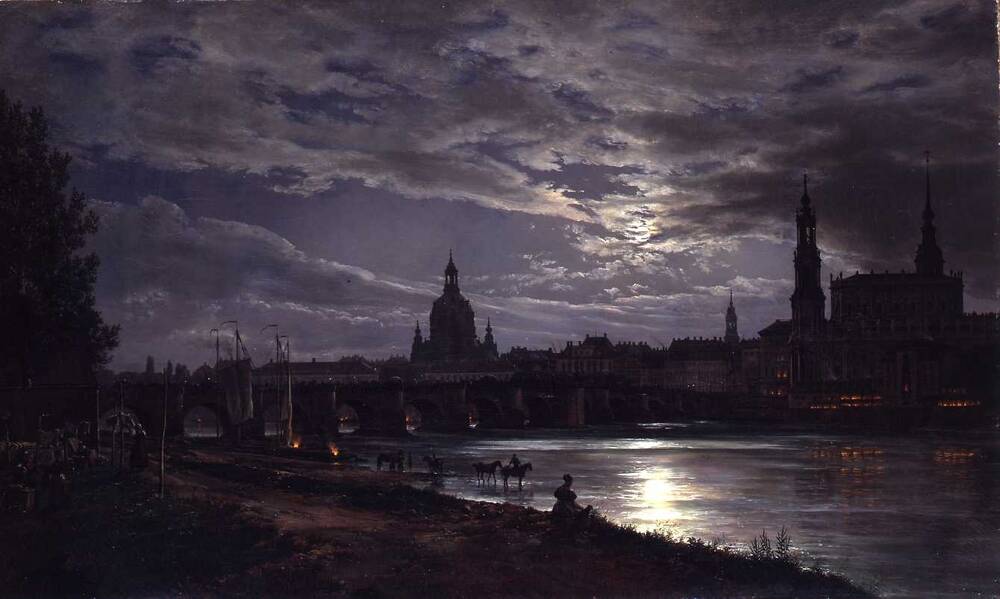
What a magnificent view! Dresden is renowned the world over for this impressive baroque panorama. On the far side of the River Elbe, a series of towers and spires in the old city soar upwards: to the left behind the Augustus Bridge, the stone dome of the Frauenkirche, the Church of our Lady; then on the right, the slender spires of the Kreuzkirche – the Church of the Holy Cross. Finally, there is the Hofkirche – formerly the Court Church, now Dresden Cathedral, dominated by the Royal Palace tower – the Hausmannsturm.
When Norwegian artist Johan Christian Dahl composed this work, he was not the first to show Dresden from just this perspective. This was also the standpoint favoured by his famous predecessor in the eighteenth century – Venetian artist, Bernardo Bellotto. Thanks to Bellotto’s paintings of Dresden from the right-hand bank of the River Elbe, this vista became known as the ‘Bellotto view’.
Yet in one point, Dahl’s composition differs decisively. Bellotto set his city in daylight – while Dahl shows Dresden at night. He lends his night sky set with clouds in the light of the full moon a sublime grandeur – rendered in a surprisingly rich play of colours, from transparent yellow to blue and violet tones. As curator Holger Birkholz explains, the moon is not the only source of light in the painting:
“We have two determining temperatures of light, as you might say – one is the cold moonlight, dominated by blue tones, and the other is the warmer tones of the fires. For instance, along the riverbank in the foreground, you can see two fires lit close to the sailing boats. On the city side, there’s also something which almost looks like lights in the windows in the area known as the ‘Italian village’.”
With atmospheric views such as this, Dahl advanced to become the leading representative of Dresden Romanticism – together with Caspar David Friedrich. These two artist were not only close friends, but also even lived in the same house.
Jaká nádhera! Díky tomuto baroknímu panoramatu jsou Drážďany známé na celém světě: Na protějším břehu Labe se tyčí věže starého města, uprostřed obrazu za Augustovým mostem vidíme kamennou kupoli kostela Frauenkirche - česky kostela Panny Marie - a vpravo štíhlé věže kostela Svatého Kříže a katedrály Nejsvětější Trojice, kterou vedle převyšuje nejstarší dochovaná část Rezidenčního zámku, tzv. věž Hausmannsturm.
Malíř této veduty, tedy přesného malířského zachycení pohledu na krajinu s městem, je Nor Johan Christian Dahl. Nebyl však prvním malířem, který maloval Drážďany z tohoto pohledu. Již před ním stejné panorama zachytil benátský umělec Bernardo Bellotto, podle jehož obrazů z 18. století se tomuto speciálnímu pohledu říká "Bellottův pohled".
Ale Dahlovo zobrazení se v jednom důležitém bodě od Bellottova podání liší: Bellotto zachytil Drážďany za denního světla - Dahl se však rozhodl pro noční pohled. Téměř slavnostním způsobem inscenoval noční oblohu s prosvítajícím měsícem a mraky. Všimněte si jeho překvapivě bohaté hry s barvami: od průsvitných jemných žlutých tónů až po tmavě modrou a fialovou. Jediným zdrojem světla je tu měsíc, jak poznamenává kurátor Holger Birkholz:
"Dahl na svém obraze pracuje se dvěma různými teplotami světla. Na jedné straně to je právě chladný svit měsíce s odstíny modré a na straně druhé teplé světlo sálajícího ohně v popředí na Novoměstském břehu. Tam u plachetnic hoří dva malé ohně, jejichž světlo jakoby se na druhém, staroměstském břehu odráželo v oknech domů tzv. "Italské vesnice"."
Díky takovým působivým krajinám se Dahl stal nejdůležitějším představitelem drážďanského romantismu - vedle Caspara Davida Friedricha, se kterým byl úzce spřátelen a který dokonce žil ve stejném domě.
- Ort & Datierung
- 1839
- Material & Technik
- Öl auf Leinwand
- Dimenions
- 78 x 130 cm
- Museum
- Galerie Neue Meister
- Inventarnummer
- Gal.-Nr. 2206 D