
Frisch verheiratet ist die junge Gräfin Thekla von Ludolf aus dem Baltikum mit ihrem Mann an den Golf von Neapel gereist. Um die Erinnerungen an das Gesehene festzuhalten – das blaue Meer, den rauchenden Vesuv, die pittoresken Küstenorte – zeichnet sie. Schließlich gibt es damals noch keine Fotos.
Und so zeigt das Gemälde die junge Gräfin mit Zeichenstift und Mappe. Der Maler Carl Christian Vogel von Vogelstein erweckt den Eindruck, als habe er sie überrascht, was durch die Wendung ihres Kopfes angedeutet wird. Als wolle er zeigen, dass sie soeben noch die Aussicht aus dem Fenster skizziert hat. Viel Aufmerksamkeit schenkte Vogel von Vogelstein der Darstellung des standesgemäß luxuriösen Lebens. Von Geld und Geschmack zeugen der prächtig verzierte Empire-Sessel, das samtene, an den Ärmeln geschlitzte und von einer Brosche zusammengehaltene Kleid, die spitzen Schuhe und die elegante Frisur.
Der Maler, geboren als Carl Christian Vogel, spielte im Dresdner Kunstleben des frühen 19. Jahrhunderts eine herausragende Rolle. Vor allem als Porträtist machte er sich einen Namen. 1824 wurde er zum Hofmaler ernannt und sieben Jahre später in den Adelsstand erhoben.
Das Porträt wird zunächst im Besitz des jungen Paares gewesen sein. Bis 1938 gehörte es den drei jüdischen Schwestern Jenny, Malvine und Bertha Rosauer in Wien. Vom nationalsozialistischen Staat wurden sie ihres gesamten Eigentums beraubt und ermordet. Wenig später kaufte es das Dresdner Museum bei einem Münchner Kunsthändler. Als diese Geschichte des Bildes bekannt wurde, gab das Albertinum das Porträt 2011 an die Familie zurück, bemühte sich aber um einen Ankauf. So gelangte das Gemälde, diesmal rechtmäßig, wieder ins Museum.
Weitere Medien
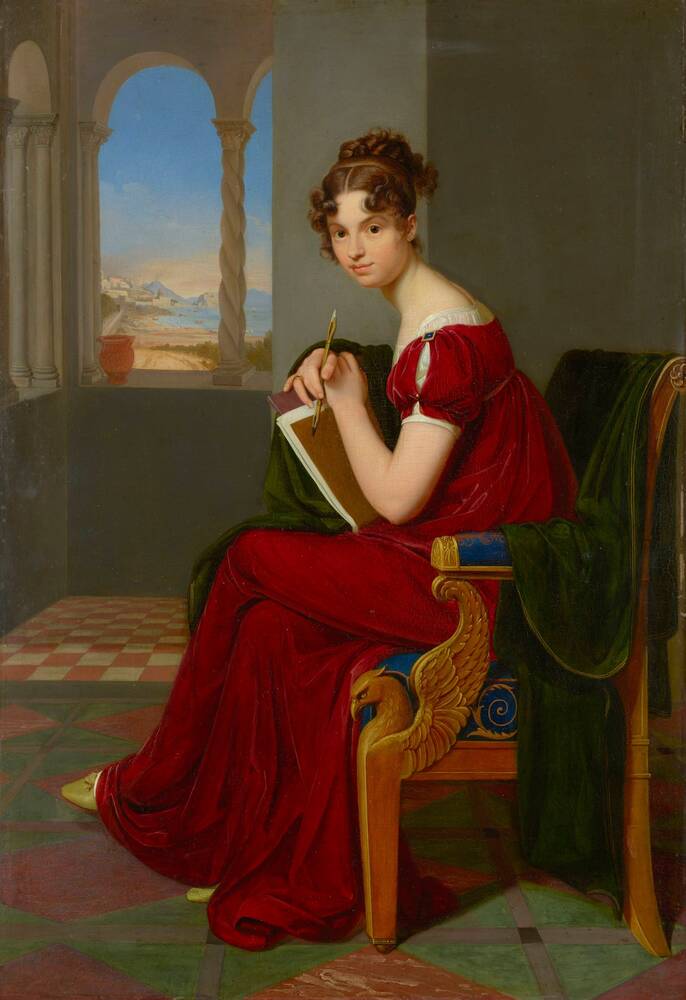
Lange Zeit wusste man nicht, wer die „Junge Dame mit Zeichengerät“ eigentlich war. Und das war kein Ausnahmefall:
„Es ist eben in der Kunstgeschichte oft so, dass im Gegenzug zu männlichen Bildnissen man sich bei weiblichen Bildnissen, gerade älteren Bildnissen, weniger dafür interessiert, WER dargestellt ist, als für die, in Anführungszeichen, „Schönheit“ der Dargestellten.“
Kurator Holger Birkholz fand heraus, dass wir hier die Gräfin Thekla Ludolf, geborene Weyssenhoff, vor uns haben:
„Hier in dem Fall war es tatsächlich 'ne lange Recherche und dann am Ende 'n Glücksfund, dass ich in Washington in einer Sammlung auf ein Freundschaftsalbum gestoßen bin, in dem eine Kopie dieses Gemäldes als Aquarell enthalten ist. Und bei diesem Aquarell stand unten der Name der Dargestellten.“
Der Maler hat die Gräfin mit ihren Zeichenutensilien dargestellt, als „Dilettantin“, wie man im 19. Jahrhundert sagte – heute würde man sie eine Amateurin nennen. Zur Ausbildung junger adliger Frauen gehörte damals der Unterricht im Zeichnen. Waren die Frauen dann auf Reisen, konnten sie mit dem Zeichenstift Ansichten von unterwegs festhalten. Außerdem war es üblich, die damals beliebten Stammbücher mit Zeichnungen zu schmücken:
„Das waren Bücher, in denen man quasi Freundschaft bekundete, man trug sich dort ein mit Gedichten, und da gab's aber auch immer die Möglichkeit, oder wurde auch immer erwartet, dass dort kleinere Zeichnungen, Aquarelle mit eingebracht wurden. Also eines eben dieser Stammbücher war dann ja auch der Schlüssel zur Bestimmung des Namens der Dargestellten.“
Es gab zur Zeit der Romantik nicht wenige Frauen, die die Malerei als Beruf ausübten; dennoch finden sich unter den 600 romantischen Gemälden der Dresdner Sammlung nur drei Werke von Künstlerinnen:
„Und zwar von Therese Richter, zwei Stillleben, und ein Gemälde ist ein Kinderporträt von Emilie Lachaud de Loqueyssie. Das ist ein ziemlich heftiges Missverhältnis, auch wenn man bedenkt, dass bei den Ausstellungen der Akademie hier in Dresden in der ersten Hälfte des 19. Jahrhunderts der Anteil der ausstellenden Künstler:innen im Bereich der Frauen bei 20 Prozent lag.“
Ein Grund für dieses Missverhältnis liegt an den damals gültigen Kriterien der Kunstgeschichte. Kurator Holger Birkholz:
„In der Kunstgeschichte spielt die Hierarchie der Gattungen eine wichtige Rolle, an erster Stelle steht die Historie, und an niederster Stelle steht im Grunde genommen das Stillleben oder einfache Porträts. Und wenn man die Akademiekataloge anschaut und sich eben anschaut, welche Themen haben Frauen realisiert in ihren Kunstwerken, dann sind es eben oft die Themen gewesen, die innerhalb der Gattungshierarchie weiter unten standen.“
Hinter dem Gemälde der jungen Dame mit Zeichengerät verbirgt sich eine tragische Geschichte. Claudia Müller, Provenienzforscherin am Albertinum, konnte sie zusammen mit ihren Kolleginnen aufdecken:
„Also ein Fall, der mir auch immer ganz wichtig ist, das ist die Dame mit Zeichengerät von Vogel von Vogelstein, wo wir eben auch sehr genau das nachverfolgen konnten. Dieses Gemälde ist 1940 angekauft worden für die Galerie, damals noch unter Hans Posse –“
Posse, der damalige Direktor der Gemäldegalerie, erwarb das Gemälde 1940 von einem Münchner Kunsthändler. Dessen Archiv enthielt weitere Informationen: Er hatte es zuvor bei einer Kunsthändlerin in Wien erworben:
„Die wiederum hatte bei solchen Wohnungsauflösungen jüdischer Familien mitgewirkt oder hatte eben diese Kunstgegenstände übernommen und dann verkauft.“
Durch weitere Recherchen fanden die Forscherinnen heraus, dass das Bild den hochbetagten jüdischen Schwestern Jenny, Malvine und Bertha Rosauer gehört hatte, die gemeinsam in einer Wohnung in Wien gelebt hatten. Wie alle Jüdinnen und Juden hatten auch sie 1938 auf Anordnung der Nationalsozialisten eine Liste über ihr gesamtes Vermögen anfertigen müssen, die erhalten geblieben ist,
„wo die Bilder aus ihrem Besitz alle aufgeführt sind. Und da ist unter der Nummer 59 „Carl von Vogelstein, Bild einer Künstlerin mit Ausblick auf Neapel“ verzeichnet.“
Die Schwestern wurden damals aus ihrer Wohnung vertrieben und in einer Sammelunterkunft untergebracht, wo eine von ihnen starb; die beiden anderen wurden im Konzentrationslager Treblinka ermordet.
Als Hans Posse das Gemälde 1940 für die Dresdner Galerie erwarb, mag er geahnt haben, dass es aus jüdischem Besitz stammte. Denn Posse kannte sich aus. Er war nicht nur Direktor in Dresden, sondern seit 1938 aus NS-Sonderbeauftragter für Hitlers Museumsprojekt in Linz. Ausstellen konnte er es zu Kriegszeiten nicht mehr. Es wurde wie so viele Kunstschätze Dresdens auf Schloss Weesenstein in der Nähe von Pirna ausgelagert. Bis in die 1970er Jahre blieb das Bild dort als Leihgabe, dann kehrte es zurück ins Albertinum. Nachdem seine Geschichte bekannt geworden war, wurde das Gemälde 2011 der Familie Rosauer zurückerstattet und konnte vom Museum rechtmäßig angekauft werden.
Recently married, the young Countess Thekla von Ludolf from the Baltic States is travelling with her husband to the Bay of Naples. As a memento of her trip, she is just going to sketch the scene outside – the blue sea, a trail of smoke rising from Vesuvius and the picturesque coastal town. After all, at that time, she could not take a souvenir photo.
So in this painting, we see the young countess with her sketch pad and pencil. By turning the Countess’s head towards us, the artist Carl Christian Vogel von Vogelstein almost makes it seem as if she was taken unawares, as if she had just been busy sketching the view from the window. The artist has taken considerable pains over those items indicating the luxurious lifestyle commensurate with her noble status. The magnificently carved Empire chair, the countess’s velvet robe with puffed, slit sleeves held by a broach, her pointed shoes and elegant hairstyle are all signs of her wealth and taste.
The artist, born Carl Christian Vogel, played a leading role in Dresden’s art scene in the early nineteenth century, making a name above all as a portrait painter. In 1824, he was appointed as the Dresden court painter and seven years later was raised to the nobility.
This portrait would initially have been owned by the young couple. Until 1938, it belonged to Jenny, Malvine and Bertha Rosauer, three sisters living in Vienna. After the invasion of Austria, as the Nazi regime stripped Jewish citizens of their rights and assets, the sisters were robbed of all their property and murdered. A little later the Dresden museum bought the work from an art dealer in Munich. When the provenance of this painting became known, the Albertinum restituted the portrait to the family in 2011. The museum's efforts to then purchase the painting from the family were rewarded, and so the work can again be shown in the museum – this time legally.
For a long time, no one knew the name of this young woman with her with her sketch pad and pencil – and that was nothing unusual for a woman’s portrait.
“In the history of art, in contrast to male portraits, there was often far less interest in exactly WHO was portrayed in women’s portraits, especially in older paintings, than in the – in inverted commas – ‘beauty’ of the woman portrayed.”
Thanks to curator Holger Birkholz, we now know the woman portrayed in this work is Countess Thekla Ludolf, née Weyssenhoff:
“In this case, identifying this figure required a long period of research and, ultimately, a stroke of luck. In a collection in Washington, I came across a friendship album with a copy of this painting in watercolours – and underneath it had the name of the woman depicted.”
The artist painted the countess with her sketching things – as a “dilettante” in nineteenth-century usage, the equivalent of today’s “amateur artist”. In those days, drawing lessons were part of the education of aristocratic and well-situated young women. If they travelled, they could draw the views on their journey. At that time, friendship and commonplace books were very popular, and entries were often accompanied by sketches:
“By writing some suitable poem or epigram into a friendship book, you demonstrated publicly, as it were, your friendship with the book’s owner. And you could always add – or were expected to add – little sketches or watercolours. So one of these friendship books held the key to the name of the woman in this painting.”
In the era of Romanticism quite a few women were professional artists. Yet although the Dresden Collections hold 600 paintings from this period, only three works are by women.
“Two are still lifes by Therese Richter, and the other painting is a portrait of a child by Emilie Lachaud de Loqueyssie. This low number is a fairly glaring disparity, especially when you consider that women artists accounted for 20 per cent of works in the Dresden art academy exhibitions in the first half of the nineteenth century.”
One reason for the under-representation of women artists can be found in traditional art history with its emphasis on the hierarchy of genres. As curator Holger Birkholz explains:
“For many years, the hierarchy of genres was central to art history. In this ranking of the aesthetic value of styles of art, history painting was first, while still lifes or simple portraits were at the bottom. We still have the catalogues from the state academy of art from those days. If you look the women artists listed there, you often find they were painting subjects in the lower ranks of the hierarchy of genres.”
There is a tragic story to the painting of this young woman with her sketch pad and pencil. The story was uncovered by Claudia Müller, a provenance researcher at the Albertinum, together with her colleagues:
“For me, the case of the lady with the drawing pad and pencil by Carl Christian Vogel von Vogelstein is very important, since we could precisely trace the provenance of the work. The painting was acquired in 1940 by the Dresden gallery, then still under Hans Posse –”
Posse, then the Director of the Paintings Gallery, bought the work from a Munich art dealer in 1940. The art dealer’s archive also documented the painting’s previous owner – an art dealer in Vienna.
“So that pointed to a Viennese art dealer involved in the Nazi clearances of homes belonging to Jewish families, or taking this painting from such a clearance to sell it.”
Through further research, the provenance team could trace the painting to Jenny, Malvine and Bertha Rosauer. In the late 1930s, these three elderly sisters from a Jewish family were living together in an apartment in Vienna. In 1938, after Austria’s annexation into the German Reich, the Nazi authorities ordered all Jews in the country to submit a list of all their assets – and the list compiled by the three sisters has survived.
“The list includes the paintings they owned, and under number 59, we found ‘Carl von Vogelstein, Picture of a woman artist with a view of Naples’.
The sisters were driven out of their apartment and into a ghetto house where one of them died; the other two sisters were murdered in the Treblinka concentration camp.
When Hans Posse acquired this painting in 1940 for the Dresden Paintings Gallery, he may well have suspected it had been previously been owned by a Jewish family. After all, Posse knew a lot about what was going on. Not only was he Director of the Dresden Paintings Gallery, but in 1939 he was appointed Special Envoy for Hitler’s planned museum project in Linz.
In the war years, Posse was unable to put Carl von Vogelstein’s painting on display. Like so many of Dresden’s art treasures, it was taken to Weesenstein Palace near Pirna for safe storage. It remained there as a loan well into the 1970s, and was then returned to the Albertinum. In 2011, after the painting’s provenance had been traced, it was restituted to the Rosauer family and was then acquired legally by the museum.
Krátce po svatbě cestoval mladý manželský pár - hraběnka Thekla Ludolf a její manžel - do Neapolského zálivu. Své vzpomínky - na modré moře, kouřící Vesuv a malebná pobřežní města - zachycuje hraběnka na kresbách. Koneckonců tenkrát ještě neexistovaly fotografie.
Na obraze tudíž vidíme mladou hraběnku s tužkou a deskami s papíry. Malířem obrazu je Carl Christian Vogel von Vogelstein. Hraběnčin výraz a její pohyb hlavou v nás vyvolávají dojem, jakoby ji malíř překvapil v okamžiku, kdy právě kreslila malebný výhled z okna. Vogel von Vogelstein věnoval velkou pozornost zobrazení tehdejšího luxusního života a detailně zachytil skvostně zdobené empírové křeslo stejně jako hraběnčiny sametové šaty s malými výstřihy a broží na rukávech, její špičaté boty a elegantní účes.
Carl Christian Vogel dosáhl v drážďanském uměleckém životě raného 19. století významného postavení - především jako malíř portrétů. Roku 1824 byl jmenován dvorním malířem. Sedm let později byl povýšen do šlechtického stavu a od té doby vystupoval pod jménem Carl Christian Vogel von Vogelstein.
Hraběnčin portrét jistě nejdříve vlastnil mladý manželský pár. Do roku 1938 patřil třem židovským sestrám Jenny, Malvine a Bertě Rosaouerovým, žijícím ve Vídni. Nacisté jejich celý majetek zkonfiskovali a sestry zavraždili. O něco později obraz zakoupilo drážďanské muzeum od jednoho mnichovského obchodníka s uměním. Po objasnění jeho původu Albertinum obraz roku 2011 vrátilo pozůstalé rodině a nabídlo jí, obraz od nich opět odkoupit. Tak se obraz - tentokrát legitimě - mohl do muzea opět vrátit.
Dlouho nebylo známo, kdo vlastně „Mladá žena s pisátkem“ je. A nejednalo se zde o výjimečný případ:
„Skutečností v dějinách umění je, že se – na rozdíl od mužských portrétů – u ženských portrétů a především u těch starších nikdo příliš nezajímal o to, KDO je na obraze znázorněn, nýbrž spíše o to, jak – v uvozovkách – „krásná“ je portrétovaná žena.“
Kurátor Holger Birkholz zjistil, že na zdejším obraze vidíme hraběnku Theklu Ludolf, rozenou Weyssehoffovou.
„V tomto případě jsme museli opravdu dlouho pátrat a nakonec jsme měli štěstí, protože jsem v jedné washingtonské sbírce narazil na jeden památník, ve kterém se nachází malá akvarelová kopie tohoto obrazu. A pod tímto akvarelem bylo uvedeno jméno zobrazené dámy.“
Malíř hraběnku zobrazil s kreslícími potřebami, jako „diletantku“, jak se tenkrát v 19. století říkalo. Dnes bychom jistě použili spíše výraz „amatérka“. V tehdejší době patřila výuka kreslení ke vzdělání mladých šlechtičen. Na cestách pak mohly tužkou zachytit různé pohledy a dojmy z cest. Zvykem navíc bylo také kresbami zdobit památníky:
„Jednalo se o knížky, v nichž si lidé navzájem vyjadřovali své přátelství. Zapisovali se do nich básně, ale zároveň se také většinou očekávalo, že zapisující osoba památník vyzdobí menší kresbou či akvarelem. A právě díky jednomu takovému památníku se podařilo rozluštit tajemství, kdo je zde zobrazená žena.“
V období romantismu se malířství profesionálně věnovalo poměrně hodně žen, přesto najdeme v drážďanské sbírce mezi šesti sty romantickými obrazy pouze tři díla od žen:
„A sice dvě zátiší od Therese Richterové a jeden dětský portrét od Emilie Lachaud de Loqueyssie. Je to velmi velký nepoměr, když si uvědomíme, že dvacet procent vystavujících umělců na výstavách drážďanské akademie v první polovině 19. století bylo ženského pohlaví.“
Jedním z důvodů pro tento nepoměr byla tehdy platná kritéria v oboru dějin umění. Kurátor Holger Birkholz:
„V dějinách umění hraje důležitou roli hierarchie jednotlivých žánrů. Na prvním místě stojí historické malby a v podstatě na posledním místě se nacházejí zátiší a jednoduché portréty. A když nahlédneme do katalogů akademií umění a podíváme se, jakým žánrům se malířky tenkrát věnovaly, tak zjistíme, že se jedná především o témata, která stála právě v hierarchii žánrů dole.“
Obraz mladé ženy s pisátkem je spjat s jedním tragickým příběhem. Claudii Müllerové, badatelce provenience v Albertinu, se podařilo tento příběh odhalit a objasnit:
„K případům, které jsou pro mě velmi důležité, patří také právě obraz ženy s pisátkem od Vogela von Vogelstein, jehož původ se nám podařilo velmi přesně vysledovat. Obraz byl pro galerii zakoupen roku 1940, tenkrát ještě pod vedením Hanse Posseho –“
Posse, tehdejší ředitel Galerie starých mistrů, získal obraz roku 1940 od mnichovského obchodníka s uměním. V jeho archívu byly objeveny další informace: On sám obraz zakoupil od jedné vídeňské obchodnice s uměním:
„Ta se tehdy podílela na výprodeji zkonfiskovaných bytových zařízení od židovských rodin, při nichž získala právě různé umělecké předměty, které pak prodávala.“
Díky dalším rešerším naše odbornice zjistily, že obraz původně patřil tenkrát již starým židovským sestrám Jenny, Malvine a Bertě Rosauerovým, které společně žily v jednom vídeňském bytě. Stejně jako všichni Židé museli roku 1938 na příkaz nacistů sepsat seznam svého veškerého majetku. A tento seznam se dochoval …
„a jsou na něm uvedeny všechny obrazy, které sestry vlastnily. Pod číslem 59 je tam uvedeno: Carl von Vogelstein, obraz umělkyně s výhledem na Neapol.“
Sestry byly tenkrát z bytu vyhnány a ubytovány v hromadném ubytovacím zařízení, kde z nich jedna zemřela. Další dvě byly zavražděny v koncentračním táboře Treblinka.
Když Hans Posse roku 1940 obraz pro drážďanskou galerii získal, pravděpodobně tušil, že obraz pochází z židovského majetku, neboť se na trhu vyznal. Byl nejen ředitelem v Drážďanech, nýbrž od roku 1939 také zvláštním nacistickým poradcem a zplnomocněncem pro Hitlerův projekt muzea v Linci. Obraz během války vystavit už ale nemohl. Obraz byl – stejně jako mnoho dalších uměleckých skvostů z Drážďan – převezen na zámek Weesenstein nedaleko města Pirny. Zde zůstal jako výpůjčka až do 70tých let 20. století, kdy byl navrácen do Albertina. Když byl původ obrazu objasněn a zveřejněn, byl rodině Rosauerových roku 2011 vrácen a muzeum ho poté mohlo legálně zakoupit.
- Ort & Datierung
- 1816
- Material & Technik
- Öl auf Nussbaumholz
- Dimenions
- 70 x 48,5 cm
- Museum
- Galerie Neue Meister
- Inventarnummer
- Inv.-Nr. 2011/16