
Aus dem tiefen Wald tritt die Hochzeitsgesellschaft ins Freie eines herrlichen Frühlingstages – an der Spitze das junge Paar, dahinter die Eltern und die Hochzeitsgäste. Weiter oben am Hang lugt die pittoreske Kapelle heraus, in der gerade der Bund fürs Leben geschlossen wurde. Dem Zug voran läuft eine Gruppe fröhlicher Kinder mit dem Hochzeitskranz auf einem Stecken. Alles hier erzählt von einem hoffnungsvollen Anfang, von Freude und von Zuversicht. Jedes Detail fügt sich in die symbolträchtige Erzählung des Bildes ein, wie Kurator Holger Birkholz am Beispiel des Weges erklärt:
„Man kann in diesem Bild auf Wanderschaft gehen. Also das Wandern spielt in der Romantik ja eine wichtige Rolle, man ist eben nicht mit dem Zug schnell unterwegs, oder mit dem Auto fährt man von A nach B, sondern die Strecke und das Erlebnis des Naturraums auf der Wanderung, wo es eben ganz viel zu entdecken gibt, wo man auch die Zeit dafür hatte, das zu sehen, spielte eben eine wichtige Rolle. Und so ist eben hier auch der Weg als Wanderweg und wiederum auch als Lebensweg, also in seiner symbolischen Bedeutung, zu erfahren und zu ergründen.“
Der Dresdner Ludwig Richter war einer der beliebtesten Künstler des 19. Jahrhunderts: Unbeirrt von den modernen Strömungen seiner Zeit hielt er an seiner idyllischen Motivwelt und an seiner feinen Malweise fest. Als er dieses meisterlich komponierte, träumerische Gemälde schuf, war die deutsche Revolution von 1848 nur noch ein Jahr entfernt. Das Bild ist wie ein Blick in ein goldenes Zeitalter, das als verlorenes Ideal in der Vergangenheit liegt und doch zugleich die Sehnsucht erweckt nach einem Leben in Freiheit und im Einklang mit der Natur.
Weitere Medien
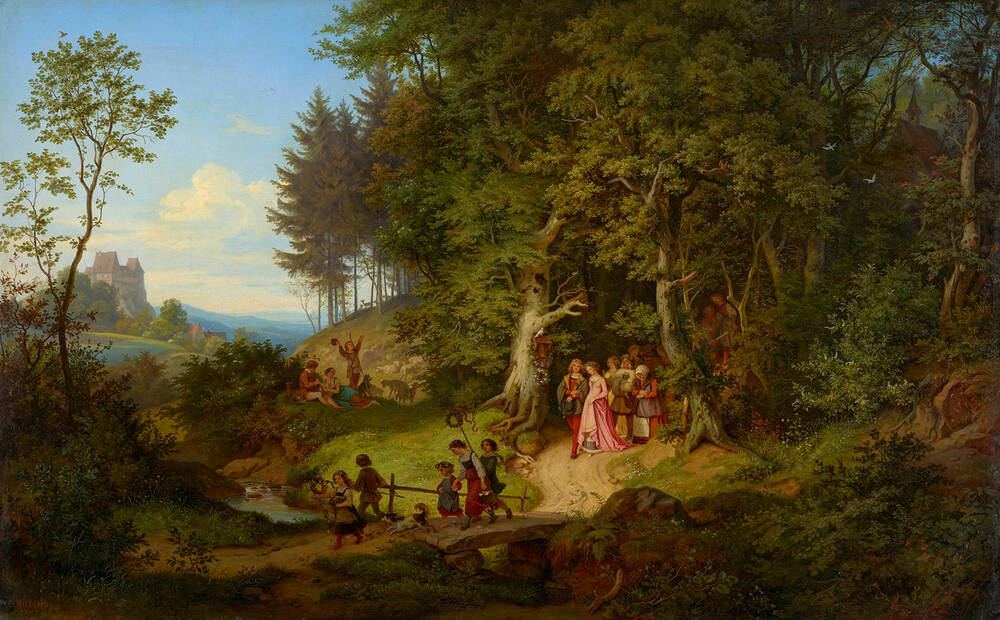
Led by the young couple, followed by their parents and wedding guests, the wedding party emerges from the dark woods, out into the bright light of a wonderful spring day. High up above, the picturesque chapel where the couple exchanged their marriage vows can just be seen through the trees. A group of happy children runs ahead, bearing the bridal wreath on a pole. Everything here tells of a future full of hope, joy, and optimism. Every detail plays its part in the composition’s highly symbolic narrative – as curator Holger Birkholz explains taking the path as an example:
“This picture invites you to take a stroll through the scene. In Romanticism, walking or hiking played a crucial role. At that time, you couldn’t simply travel somewhere quickly by train – and driving from A to B by car was just a pipe dream. Instead, walking was important, allowing you to directly experience the natural world as you walked – and out in the countryside, you had time to look around, and discover the richness of nature. So, here too, the path is not just a country trail – but, at the same time, to be explored and experienced, in its symbolic meaning, as a path through life.”
In nineteenth-century Germany, Dresden artist Ludwig Richter was one of the most popular painters. Unimpressed by the modern art movements in his day, he steadfastly kept to his world of idyllic subjects rendered in the traditional fine painting style. When he created this masterfully composed, dream-like work, the revolutions which swept Germany and Europe in 1848 were just a year away. This painting is like a vision of a golden age, an ideal lost in the past, yet one which awakens a longing for a life in freedom and in harmony with nature.
Za krásného jarního počasí vycházejí z hlubokého lesa svatebčané - vepředu mladý pár a hned za ním rodiče a další svatební hosté. Vlevo v pozadí vykukuje malá kaple, ve které si před chvílí nevěsta a ženich dali své slovo na celý budoucí život. Před průvodem svatebčanů skotačí skupina dětí se svatebním věncem na dřevené tyči. Celá scéna je výrazem nadějného počátku nového života, výrazem radosti a důvěry. Každý detail souvisí se symbolickým významem obrazu, jak kurátor Holger Birkholz na příkladu cesty vysvětluje:
"Tento obraz nás vyzývá vydat se na cestu po jeho motivech. Putování a motiv cesty hrají v rámci romantismu důležitou roli. Lidé se tenkrát nepohybovali rychle z místa na místo vlakem nebo autem. Cesta sama a zážitek okolní přírody hrály důležitou roli, neboť na cestách měl člověk čas objevovat krásy a tajemství přírody. A tudíž můžeme právě u tohoto obrazu cestu chápat jednak jako pěší cestu, po které průvod právě jde, ale také symbolicky jako cestu životem."
Ludwig Richter, drážďanský rodák, byl jedním z nejoblíbenějších umělců 19. století: Bez ohledu na moderní hnutí své doby zůstal věrný svému idylickému světu a svému subtilnímu malířskému stylu. Když roku 1847 maloval tento zasněný obraz, který se vyznačuje mistrovskou kompozicí, stála německá revoluce z roku 1848 více méně přede dveřmi. Obraz se tak stává pohledem do zlatého věku, který leží v daleké minulosti jako ztracený ideál a zároveň budí touhu po svobodném životě v souladu s přírodou.
- Ort & Datierung
- 1847
- Material & Technik
- Öl auf Leinwand
- Dimenions
- 93 x 150 cm
- Museum
- Galerie Neue Meister
- Inventarnummer
- Gal.-Nr. 2230