
Gleich geht es auf die Bühne. Die beiden Tänzerinnen in den leuchtend orangenen Tutus machen ihre Dehnübungen und halten noch ein kleines Schwätzchen. Die Rechte hält ihren Fuß in der Hand und dehnt mit vorgebeugtem Oberkörper ihr Bein, Die Linke hat den Kopf auf den Arm gestützt.
Der gewählte unspektakuläre Moment ist charakteristisch für den französischen Maler Edgar Degas. Er zeigt nicht den glanzvollen Auftritt, sondern mit dem Blick hinter die Kulissen eine Welt, die dem Publikum normalerweise vorenthalten ist: Szenen während der Proben, beim Ankleiden oder eben bei Gesprächen. Für die Darstellung der beiden Tänzerinnen bediente er sich wie so oft der Pastell-Technik, die er meisterhaft beherrschte. Fast meint man, die raschelnden Bewegungen der Tutus zu hören.
Die Kunst der Moderne strebte nach Befreiung – der Befreiung von Konventionen, die die Künstler hemmten. Gerade in Paris wollten Künstler wie die Impressionisten Grenzen überwinden und die förmliche akademische Malerei durch eine neue, unmittelbare Sichtweise der Welt ablösen.
Eine Inspirationsquelle dafür waren farbige Holzschnitte aus Japan. Für Degas und seine Zeitgenossen kam es einer Revolution gleich, dass dort Figuren vom Rand des Bildes angeschnitten und Motive in extremer Nahsicht gezeigt wurden, oder farbige Flächen die Komposition bestimmten: Stilmittel, die auch Degas in seinen berühmten Ballettszenen anwandte.
Weitere Medien
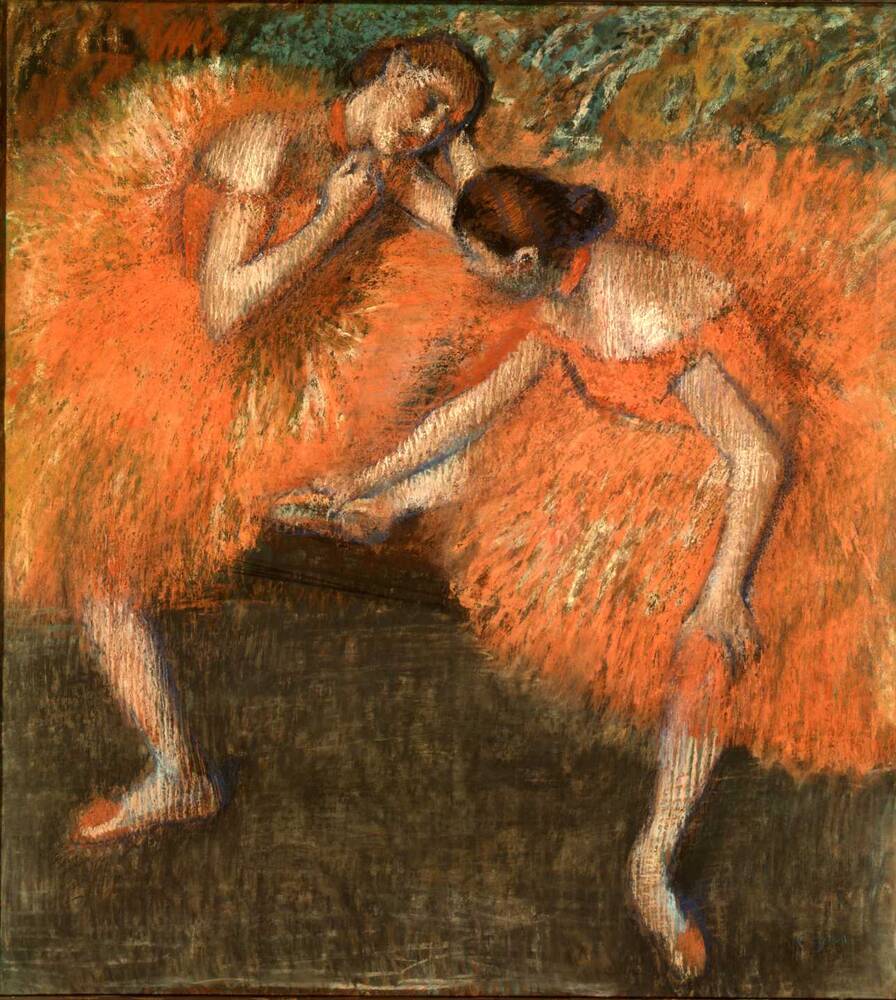
Soon, they will hear the call ‘to the stage, please!’ The two ballet dancers in their bright orange tutus are busy with their warm-up exercises – and taking the chance to have a chat. The dancer on the right is holding one foot in her hand, bending her upper body forward to stretch her leg. The dancer on the left is warming up the muscles in her neck.
In his works, French artist Edgar Degas frequently took such unspectacular moments as his subjects. Rather than showing the glittering performance, he takes us behind the scenes. We enter a world normally removed from the public gaze, witnessing moments during rehearsals, in the dressing rooms – or here – casual conversations. As so often in his works, Degas has depicted these two dancers in pastels, a medium in which he excelled. You can almost hear how the tutus rustle as the dancers move.
Modern art was driven by a longing for freedom – a desire to break free from the straitjacket of accepted artistic conventions. In Paris in particular, artists such as the Impressionists sought to transcend such limits, replacing the formal art principles taught in the state art academies by a new way of directly depicting their visual experience of the world.
Here, Japanese coloured woodblock prints were a major source of inspiration. For Degas and his contemporaries, the way Japanese prints simply cropped figures at the edge of the picture, rendered motifs in extreme close-up, or built compositions around areas of colour were nothing short of revolutionary – and Degas also used all these stylistic devices in his famous ballet scenes.
Představení hned začíná. Obě baletky ve svítivě oranžových tutu se protahují a ještě si krátce povídají. Baletka vpravo protahuje své svaly s předkloněným tělem, tanečnice vlevo opírá hlavu o svou paži.
Na obraze je zachycen všední a obyčejný okamžik, který je tak typický pro francouzského malíře Edgara Degase. Degas zde nezobrazuje obdivuhodné vystoupení obou baletek, nýbrž nám otevírá pohled do zákulisí a světa, který je pro běžné publikum neznámý a nedostupný: Na jeho obrazech jsme svědky scén během zkoušek v tanečních sálech, při oblékání nebo jednoduše během rozhovorů. Pro zobrazení obou zdejších tanečnic použil techniku pastelu, kterou mistrovsky ovládal. Dokázal vyvolat dojem, že divák slyší dokonce i šustivý pohyb tutu.
Moderní umělci usilovali o osvobození - osvobození od uměleckých konvencí, které jim bránily volně pracovat. Zejména v Paříži se umělci - jako například právě impresionisté - snažili novým, přímým pohledem na svět překonat hranice a formální akademické malířství.
Jako inspirace jim sloužily také barevné dřevoryty z Japonska. Pro Degase a jeho současníky byla jejich kompozice téměř revolucí, neboť postavy zobrazené na okraji dřevorytů byly naříznuty, motivy byly zachycené v extrémních detailech a velmi zblízka a kompozice se řídila barevnými plochami: To vše jsou stilistické prostředky, které Degas také používal na svých slavných obrazech baletních scén.
- Ort & Datierung
- Um 1898
- Material & Technik
- Pastell auf Papier
- Dimenions
- 95,5 x 87 cm (Katalogmaß 2010) 95,5 x 87 cm (Inventurmaß, 10.05.2010) 128 x 120,5 x 13 cm (Rahmenmaß, Tobias Lange, 10.05.2010)
- Museum
- Galerie Neue Meister
- Inventarnummer
- Gal.-Nr. 2586