
Auch wenn wir nichts über Kapwani Kiwanga und ihre Skulpturen wissen, sehen wir sofort – es gibt eine enge Beziehung zu den Gemälden an der Wand, die Max Slevogt 1914 während der Kolonialzeit auf einer Reise entlang des Nils gemalt hatte: das gleiche kühle Morgenblau, das gleiche weiche Weiß der Wüste, das geheimnisvolle Dunkel der Frauenkleider.
Die in Kanada geborene zeitgenössische Künstlerin forscht schon lange über Farben, ihre Wirkung und Bedeutung. Für die Skulptur „Oriental Studies: Morgen“ wählte sie elf Farbtöne aus Slevogts „Morgen bei Luxor“. Restauratorinnen des Albertinum bestimmten die Farben am Original mit Hilfe eines standardisierten Systems, des NCS-Farbfächers. Danach wurden die Baumwohlstoffe gefärbt, über die Metallgestelle drapiert und so positioniert, dass sie in Beziehung zu den Gemälden treten, sich aber auch gegenseitig beeinflussen – je nach Tageszeit und Position beim Betrachten.
Das Licht spielt in diesem zeitenübergreifenden Dialog viele Rollen. Max Slevogt hatte seine Bilder unter freiem Himmel gemalt und wartete manchmal lange auf den idealen Lichteinfall. Wir sehen die Gemälde nun im eher kühlen Dresdner Tageslicht, das durch das Oberlicht fällt, und sich ständig wandelt. Der leuchtende Sockel der „Morgen-Skulptur“ zitiert optisch dieses Oberlicht, taucht die Stoffe aber in das warme Licht des Südens.
Wie nehmen wir Farben auf einem Gemälde wahr und wie auf einer schlichten Stoffbahn? Wie verändert sich ein Werk, wenn es in ein anderes Land transportiert und dort in einem Museum gezeigt wird? Und welche Machtverhältnisse in der Geschichte des Sehens und Gesehenwerdens werden dadurch aufgerufen? Solche Fragen interessieren die 1978 geborene Künstlerin. Sicher scheint, dass wir die Szenen vom Nil mit anderen Augen sehen können, seit Kapwani Kiwanga ihnen 2019 ihre „orientalischen Studien“ gegenübergestellt hat.
Weitere Medien
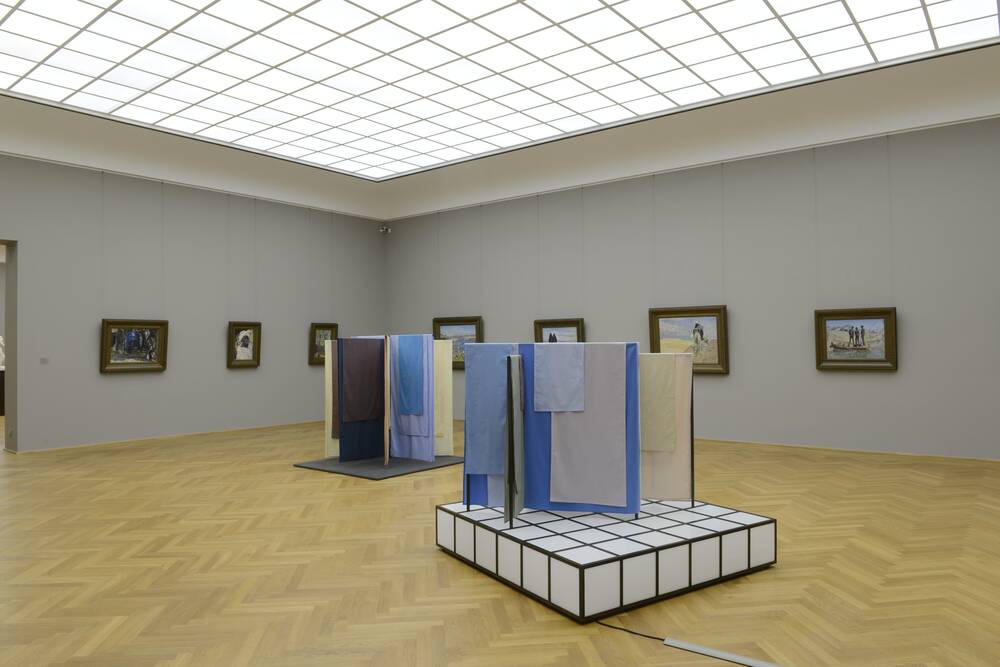
Even if we know nothing about contemporary artist Kapwani Kiwanga and her sculptures, we can immediately see the intimate connections to the paintings displayed on the wall. The paintings date from 1914, and are the work of German artist Max Slevogt on a trip down the Nile during the colonial period. Kiwanga’s sculpture evokes the same cool blue of the morning, the same soft white of the desert sand, and the same mysterious dark colours of the women’s garments.
Born in Canada in 1978, the artist has long researched into the history of colours, their effect and meaning. For her Oriental Studies: Morgen sculpture, she chose eleven colour tones from Slevogt’s Morgen bei Luxor – “Morning near Luxor”. Working with the standardised Natural Colour System, conservators at the Albertinum scientifically defined the colours to produce dyes for the cotton fabrics in exactly the same tones as Slevogt’s originals. The dyed cotton fabrics were then positioned over the metal frames to enter into a dialogue with the paintings. Yet at the same time, the fabrics and paintings mutually influence one another – depending on the time of day and the beholder’s position.
In this dialogue transcending time, light is important in a variety of ways. Max Slevogt painted his scenes plein air – out of doors –, sometimes waiting a long time for the ideal light conditions. And we are now viewing the paintings in Dresden’s rather cool and changeable daylight from the skylight above. The skylight is quoted in the sculpture’s illuminated base, though this also bathes the fabric in a warm southern light.
In her work, Kapwani Kiwanga is interested in exploring such questions as: How do we see colours in a painting and in simple lengths of dyed fabric? How does a work change when it is taken to a different country and exhibited there in a museum? And what power relations in the history of seeing and being seen does this evoke? Certainly, since Kapwani Kiwanga juxtaposed Slevogt’s works with her Oriental Studies from 2019, we can see these scenes painted along the Nile with different eyes.
I když o Kapwani Kiwanga a jejím díle nic nevíme, je na první pohled zřetelné, že se její instalace přímo vztahují na obrazy Maxe Slevogta, které vznikly na jeho cestě podél Nilu roku 1914 ještě v období britské kolonizace Egypta: stejně chladná ranní modř, stejně jemná bílá jako Slevogtova poušť, tajemné temné barvy odpovídající ženským šatům na obrazech.
Kiwanga se narodila v Kanadě a již dlouho se zabývá významem a účinkem barev. Pro svou instalaci „Orientalistika: Ráno“ zvolila jedenáct barevných tónů ze Slevogtova „Rána v Luxoru“. Restaurátorky v Albertinu definovaly barvy originálu pomocí standardizovaného systému barevných karet NCS. Poté byly bavlněné látky obarveny, pověšeny přes kovové rámy a umístěny tak, aby byl jejich vztah k obrazům jasný, ale také aby se navzájem ovlivňovaly – v závislosti na denní době a místa, ze kterého si je divák prohlíží.
V tomto dialogu, který tvoří časový most mezi oběma obdobími, hraje důležitou roli světlo. Max Slevogt maloval své obrazy pod širým nebem a často čekal i několik hodin na ideální světlo. Dnes si jeho obrazy prohlížíme v poměrně chladném drážďanském denním světle, které sem dopadá střešním oknem a neustále se mění. Světelný podstavec Kiwangovy instalace „Ráno“ toto denní světlo opticky imituje, ale zároveň je halí do teplého jižního světla.
Jak vlastně vnímáme barvy na obraze a jak na obyčejném pruhu látky? Jak se změní vnímání uměleckého díla, když je převezeno do jiné země a tam vystaveno v muzeu? A jak tato skutečnost obráží mocenské vztahy v dějinách vidění a chápání různých kultur? Těmito a podobnými otázkami se zabývá Kapwani Kiwanga, narozená roku 1978. Po té, co Kiwanga své „orientální studie“ postavila proti scenériím na Nilu, vnímáme Slevogtovy obrazy určitě jinýma očima.
- Ort & Datierung
- 2019
- Material & Technik
- Stahl, gefärbte Baumwolle, Plexiglas, LED
- Dimenions
- 145 x 164 x 164 cm
- Museum
- Skulpturensammlung
- Inventarnummer
- ZV 4375