
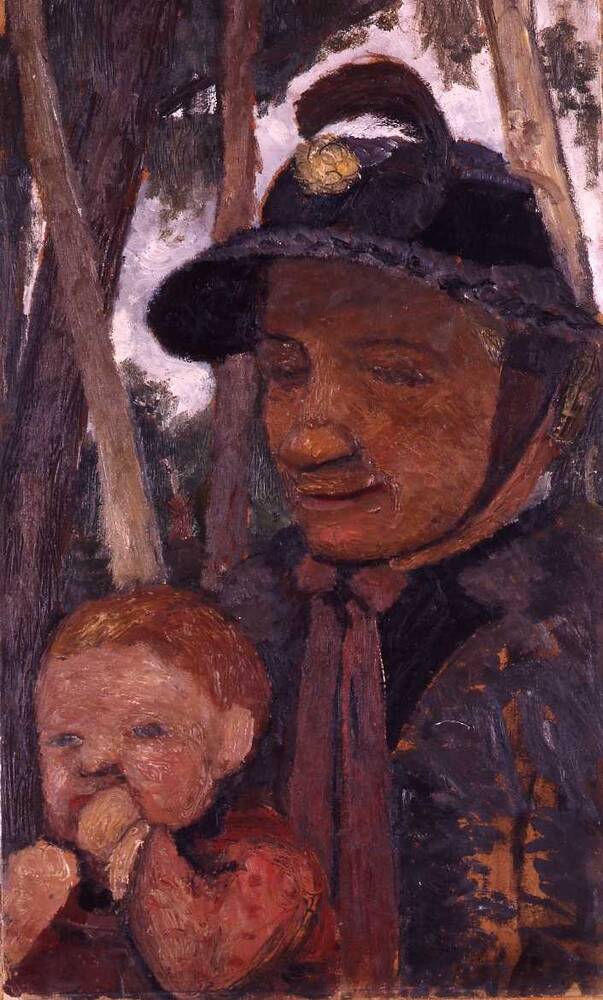
"Paula Modersohn-Becker hat ja in Worpswede in einer Landschaft gewohnt, die von einer einfachen bäuerlichen Umgebung geprägt war. Die Frauen und Kinder in der Nachbarschaft waren für sie wichtige Modelle und sie stellt eine alte Frau in einer offenbar üblichen Tracht dar mit einem kleinen Kind und rückt diese Figuren ganz an den Betrachter heran! Sie sind ganz eng in den Bildrahmen gestellt. Und so sind diese beiden Figuren ganz präsent."
Die Kuratorin Birgit Dalbajewa zählt Modersohn-Beckers Gemälde "Alte Frau mit Hut" zu den besonders typischen Werken der Malerin. Sie schuf es 1905 in Worpswede, als sie bereits sieben Jahre in der Künstlerkolonie bei Bremen lebte. Eine Bremerin war sie übrigens nicht: Paula Becker wurde 1876 hier in Dresden geboren, und zu ihren frühen Kunsterlebnissen zählten die Besuche in der Dresdner Galerie.
In Worpswede, wo sie den Maler Otto Modersohn heiratete, entwickelte sie ihren unverwechselbaren Malstil. Betrachten Sie die "Alte Frau mit Hut" und das Kind einmal genauer: Modersohn-Becker malt die Figuren vereinfacht, beinahe archaisch, und in ähnlichen Farbtönen wie die Natur. Die Malerin will das Wesen ihrer Figuren zum Ausdruck bringen, die Fürsorge der Frau für das Kind, die wache Aufmerksamkeit des Kleinen, die Geborgenheit in der Umgebung. Mit ihrer eigenwilligen Maltechnik schafft sie eine lebendige Oberfläche. Hören Sie den Kurator Andreas Dehmer:
"Und wenn man ganz nah davorsteht, sieht man, wie expressiv sie schon die Malerei betreibt, also sie setzt die Farben ganz locker nebeneinander, aber auch, wo es notwendig ist, scheut sie sich nicht, den Pinsel umzudrehen und statt mit den Borsten mit dem Stiel reinzukratzen."
Weitere Medien
Eine Frau, die in Deutschland künstlerisch arbeiten und davon leben wollte, hatte es um 1900 nicht leicht. Kreativität und Schöpfertum galten als Männersache. Frauen, so schrieb der Kunstkritiker Karl Scheffler, hätten:
„nur als Modell oder Mutter Existenzberechtigung. Qua Geschlecht unfähig, unproduktiv, kann eine Frau niemals Künstler – das hieße 'männlich' – werden.“
Dennoch schlugen viele Frauen eine Laufbahn als Künstlerin ein – obwohl ihnen das Studium an den Kunstakademien verwehrt war. Der Kurator Andreas Dehmer:
„Was in der Geschichte der sogenannten "Frauenkunst" des 19. Jahrhunderts noch nicht so bekannt ist, ist, dass es durchaus schon viele Organisationsformen gab und Frauen versuchten, sich durch diese Art und Weise ihr Recht zu erstreiten, auch Kunst auszuüben –“
Frauen besuchten auf eigene Kosten private Malschulen, nahmen Einzelunterricht und gründeten Vereine, um ihre Interessen zu vertreten. Als die Weimarer Verfassung 1919 festschrieb, dass Frauen und Männer rechtlich gleichgestellt waren, erhielten sie schließlich auch Zugang zum akademischen Studium. Dennoch machten Künstlerinnen auch vorher schon von sich reden:
„Schon vor 1919 gab es in Dresden eine riesengroße Ausstellung hier im Lipsius-Bau, in dem über 400 Künstlerinnen gezeigt worden sind.“
Schirmherrin der Ausstellung, die 1912 unter dem Titel „Frauenkunst“ gezeigt wurde, war Prinzessin Mathilde, Herzogin von Sachsen und selbst eine begabte Malerin.
„Das Wichtige von solchen raren Ausstellungen war vor allen Dingen die erhöhte Resonanz in den Kunstzeitschriften, und infolgedessen auch – so läuft der Kunstmarkt ja bis heute – dann in den Kunsthandlungen, die halt eben auch dann entsprechend sich für Künstlerinnen interessierten, die immer wieder mal genannt worden sind. Heute sind die alle nochmal wiederzuentdecken.“
“Living in the artists’ colony in the village of Worpswede, Paula Modersohn-Becker was surrounded by a moorland landscape shaped by the simple rhythms of farming life. The local women and children were important models in her work. She depicts this old woman in what is evidently traditional costume and carrying a toddler – and sets them both very close to the viewer! They almost fill the entire space, right to the edges of the frame – and so these two figures have a vibrant presence.”
For curator Birgit Dalbajewa, Old Woman with Hat is especially characteristic of Modersohn-Becker’s works. It was painted in 1905 in Worpswede near Bremen – when the artist had already been living in the village for seven years. Incidentally, although people sometimes think Paula Modersohn-Becker was from Bremen, she was actually born in Dresden in 1876 as Paula Becker. Her visits to the Dresden collections were an integral part of her early encounters with art.
In Worpswede, where she married the artist Otto Modersohn, she developed her own distinctive style of painting. Take a closer look at the old woman with her hat and the child. Modersohn-Becker has painted the figures in simplified, almost archaic forms, rendering them in a similar palette to the natural world around them. She wants to express the essential being of her figures, the woman caring for the child, the child’s keen attentiveness, the familiar security of their surroundings. With her unconventional painting technique, Paula Modersohn-Becker creates a lively surface – as curator Andreas Dehmer explains:
"Standing in front of the work, you can see just how expressive her painting style is, how she loosely juxtaposes the colours – and also, when necessary, does not hesitate to turn the brush around and use the handle rather than the bristles to scratch into the paint.”
Around 1900 in Germany, any woman hoping to work as an artist and live from their career choice had a hard time. Innovation and creativity were gendered male, and viewed purely as the reserve of men. As art critic Karl Scheffler wrote, women purely had...
“...a raison d`être as a model or a mother. By virtue of their gender incapable and unproductive, a woman can never become an artist – which, by definition, is ‘male’.”
Nonetheless, many women did launch careers as artists – even though they were not admitted to the courses at the state art academies. As curator Andreas Dehmer explains:
“One lesser-known fact in the history of so-called “women’s art” in the nineteenth century is just how many forms of organisations existed and how many women tried, in this way, to fight for their right to become artists as well –”
At their own cost, women attended private painting schools, took individual instruction, and founded associations to represent their interests. In 1919, with gender equality legally enshrined in the Weimar constitution, women were finally admitted to study at and graduate from state art academies. Nonetheless, women artists had also managed to gain a public profile previously:
“Even before 1919, Dresden had held a vast exhibition here in the Lipsius Building, showing works by over 400 women artists.”
The patron of the exhibition “Women’s Art” shown in 1912 was Princess Mathilde, Duchess of Saxony, herself a talented painter.
“Most importantly, the crucial thing about such rare exhibitions was the increased publicity for women artists in art journals and magazines. Just as with the art market now, the publicity triggered an interest among art dealers for the artists most often mentioned in these reports. Today, they all need to be rediscovered.”
"Paula Modersohn-Beckerová žila ve Worpswede uprostřed jednoduché krajiny poznamenané zemědělstvím; ženy a děti ze sousedství jí často stály modelem. Na našem obraze maluje starou ženu v očividně tradičním kroji s malým dítětem a obě postavy staví do popředí přímo před diváka! Stojí úplně vepředu na kraji rámu, čímž se prezence obou postav ještě zvyšuje."
Kurátorka Birgit Dalbajewa považuje obraz "Stará žena s kloboukem" za jeden z obzvlášť typických obrazů Pauly Modersohn-Beckerové. Obraz vznikl roku 1905 ve Worpswede, umělecké kolonii nedaleko Brém, kde malířka žila již sedmým rokem. Z Brém avšak nepocházela: Narodila se roku 1876 v Drážďanech a k jejím ranným uměleckým zážitkům patřily také návštěvy Drážďanské galerie.
Ve Worpswede, kde se vdala za malíře Otto Modersohna, vyvinula Paula Modersohn-Beckerová svůj jedinečný malířský styl. Prohlédněte si "Starou ženu s kloboukem" a dítě pozorněji: Maluje obě postavy velmi zjednodušeným, téměř archaickým způsobem a v téměř stejných barvách jako přírodu okolo. Chce zachytit charakter svých postav, ženinu starost o dítě, jeho čilou pozornost, bezpečí, které vyzařuje okolí. Svým zvláštním, svéhlavým malířským stylem se ji daří vytvořit živý dojem. Poslechněte si kurátora Andrease Dehmera:
"A když si člověk obraz prohlíží zblízka, vidí, s jak expresívním výrazem maluje. Skládá barvy úplně volně vedle sebe, a tam, kde to považuje za nutné, nemá strach štětec jednoduše otočit a namísto štětinami do nanešené barvy škrábat."
Ženy, které se v Německu na přelomu 19. a 20. století chtěly věnovat umělecké tvorbě a živit se uměním, to neměly jednoduché. Kreativita a tvořivost byly považovány za mužské vlastnosti. Ženy, jak napsal kritik umění Karl Scheffler, měly:
„právo na existenci pouze jako modelky nebo matky. Díky svému pohlaví neschopné, neproduktivní; žena se nikdy nemůže stát umělkyní – to by znamenalo, že by se stala mužem.“
Přesto se mnoho žen rozhodlo pro uměleckou dráhu – ačkoli nesměly studovat na akademiích umění. Kurátor Andreas Dehmer:
„V dějinách tzv. „ženského umění“ 19. století ještě není příliš známé, že již tehdy existovalo mnoho různých organizací a že ženy tenkrát bojovaly za právo provozovat také umění –“
Ženy na vlastní náklady navštěvovaly soukromé malířské školy, braly soukromé lekce a zakládaly spolky, které zastupovaly jejich zájmy. Když bylo ve výmarské ústavě roku 1919 stanoveno, že ženy a muži jsou si právně rovni, byl jim konečně umožněn přístup ke studiu na akademiích. Přesto se ženy jako umělkyně proslavily již dříve:
„Již před rokem 1919 se zde v Drážďanech konala v domě Lipsiusbau velká výstava, na které se představilo více než 400 umělkyň.“
Patronát výstavy, která se v roce 1912 konala pod názvem „Ženské umění“, převzala princezna Matylda Saská, která byla sama talentovanou malířkou.
„Důležité bylo především, že tyto výjimečné výstavy měly velkou odezvu v uměleckých časopisech. V důsledku toho – a tak funguje trh s uměním dodnes – se o umělkyně, jejichž jména časopisy opakovaně zmiňovaly, začaly také zajímat obchody s uměním. Dnes se jejich jména opět pomalu vrací do povědomí odborníků a milovníků umění.“
- Ort & Datierung
- Um 1905
- Material & Technik
- Mischtechnik auf Pappe auf Hartfaserplatte
- Dimenions
- 64,5 x 40 cm (Katalogmaß 2010) 64,5 x 39,6 cm (Inventurmaß, 03.05.2010) 77,6 x 52,8 x 4,5 cm (Rahmenmaß, Tobias Lange, 03.05.2010)
- Museum
- Galerie Neue Meister
- Inventarnummer
- Leih-Nr. L 160