
In liebevoller Umarmung liegt das Paar auf einer Decke, die Augen geschlossen – vielleicht sind die beiden kurz weggedämmert. Die Zärtlichkeit der Szene tritt auf eine ganz eigene Weise hervor, denn die Körper der beiden wirken etwas grob. Mit dieser stilisierten und monumentalen Darstellung seiner Figuren bewegt sich der Maler Rudolf Bergander ganz am Puls der damaligen Zeit. Oder folgt er schon der Formensprache, die die Nationalsozialisten verlangen?
Als Schüler von Otto Dix hatte Bergander gelernt, das Charakteristische seiner Figuren herauszuarbeiten, um es schließlich zu steigern, ja fast zu überzeichnen. 1931 malte er ein schwindsüchtiges Mädchen im blauen Kleid. In der Dargestellten dürfen wir eine Angehörige der Arbeiterklasse vermuten, das Bild gehört in den Kanon der proletarisch-revolutionären Kunst. Damals war Bergander noch Mitglied der Kommunistischen Partei. 1933 ging er wieder in seine Heimat nach Meißen. In dieser Phase entstand das liegende Paar. Spricht das von Anpassung an eine nun geforderte heroische Monumentalität oder nicht? Man schaut anders darauf, wenn man weiß, dass Bergander 1939 in die NSDAP eintrat und klar propagandistische Bilder von fahnenschwenkenden und trommelnden Hitlerjungen malte.
Nach dem Krieg wurde Rudolf Bergander allerdings Mitglied der SED, stieg auf zum Direktor der Dresdner Kunstakademie und schuf 1952 eine Ikone des Sozialistischen Realismus: das „Hausfriedenskomitee“, das sich ebenfalls im Bestand des Albertinum befindet.
Weitere Medien
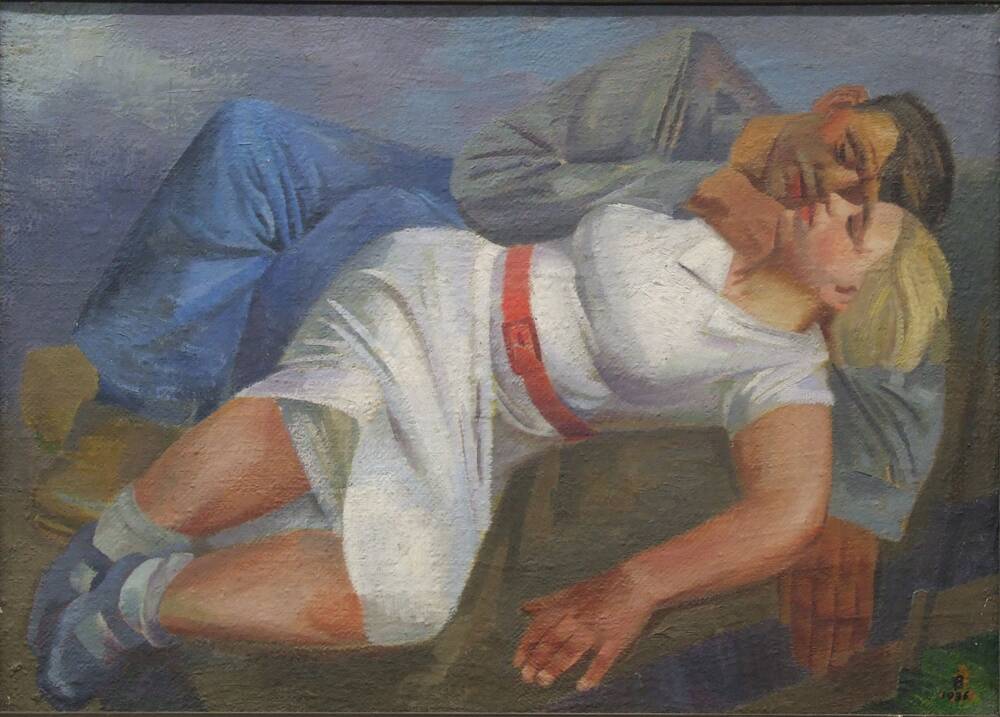
Their eyes closed, the couple are lying in a loving embrace on a blanket – and may even dropped off to sleep momentarily. With their seemingly rough and coarse bodies, the sense of tenderness between them only appears more pronounced. In his stylised and monumental depiction of figures, artist Rudolf Bergander was very much in tune with the zeitgeist of his day – or was he already adopting the formal language favoured by the Nazis?
As a student of Otto Dix, Bergander had learnt how to elaborate his figures’ characteristic qualities and then intensify them – or almost exaggerate them. In 1931, he painted a young woman suffering from tuberculosis, wearing a blue dress. The reclining couple in this work could well be read as working class, locating the painting in the canon of proletarian revolutionary art. At that time, Bergander was still a member of the German Communist Party. In 1933, he returned to his hometown of Meißen – the phase when he painted this couple. So does this style tell of his adoption of those heroic monumental figures so favoured by the Nazi regime? You certainly look at this work differently knowing Bergander joined the Nazi Party in 1939 and painted explicit propaganda pictures of Hitler Youth groups with waving flags and drummers.
After the war, though, Richard Bergander became a member of the SED, the ruling party in the GDR. He went on to become the Rector of the Dresden Art Academy. In 1952, he painted an icon of Socialist Realism – the House Peace Committee, a work also in the Albertinum collection.
Muž a žena, v láskyplném objetí ležící na dece se zavřenýma očima – možná si oba jen na chvilku zdřímli. Něžnost scény zde autor Rudolf Bergander dosáhl ojedinělým způsobem, neboť obě těla působí poněkud těžce. Malíř je ztvárnil stylizovaným a monumentálním způsobem, který odpovídal tehdejšímu pulsu času. Nebo snad již Bergander pracoval formálním jazykem požadovaným národními socialisty?
Jako žák Otty Dixe se Bergander naučil vypracovávat především charakteristické rysy svých postav, které nakonec ještě zvýraznil, někdy téměř přeháněl. Roku 1931 namaloval dívku v modrých šatech trpící souchotinami, která pravděpodobně pocházela z dělnické třídy. Tento obraz se řadí k dílům namalovaným v kánonu proletářského revolučního umění. Bergander byl tenkrát ještě členem komunistické strany. Roku 1933 se vrátil do svého rodného městě Míšně a právě v této době obraz ležícího páru vznikl. Přizpůsobil zde malíř svůj styl malby požadované heroické monumentalitě nebo ne? Abychom mohli jeho postoj posoudit, musíme vědět, že Bergander roku 1939 vstoupil do NSDAP a maloval jasně propagandistické obrazy mladých lidí z Hitlerjugend – česky Hitlerovy mládeže – mávající vlajkami a bubnující na bubny.
Po válce se však Rudolf Bergander stal členem SED, komunistické strany NDR, vypracoval se na ředitele drážďanské Akademie umění a v roce 1952 vytvořil jedno z nejznámějších děl socialistického realismu: „Domácí mírový výbor“, který se rovněž nachází ve sbírce Albertina.
- Ort & Datierung
- 1936
- Material & Technik
- Öl auf Jute
- Dimenions
- 50 x 70 cm (Katalogmaß 2010) 50 x 70 cm (Katalogmaß 1987) 49,7 x 70 cm (Lilian Groß, 30.6.2010) 70 x 90 x 5 cm (Rahmenmaß, Zentralkartei) 69,5 x 89,9 x 4,5 cm (Rahmenmaß, Lilian Groß, 30.6.2010) 50 x 70,5 cm (Inventurmaß, Tobias Lange, 28.01.2011) 69,7 x 89,9 x 4,5 cm (Rahmenmaß, Tobias Lange, 28.01.2011)
- Museum
- Galerie Neue Meister
- Inventarnummer
- Inv.-Nr. 79/34