
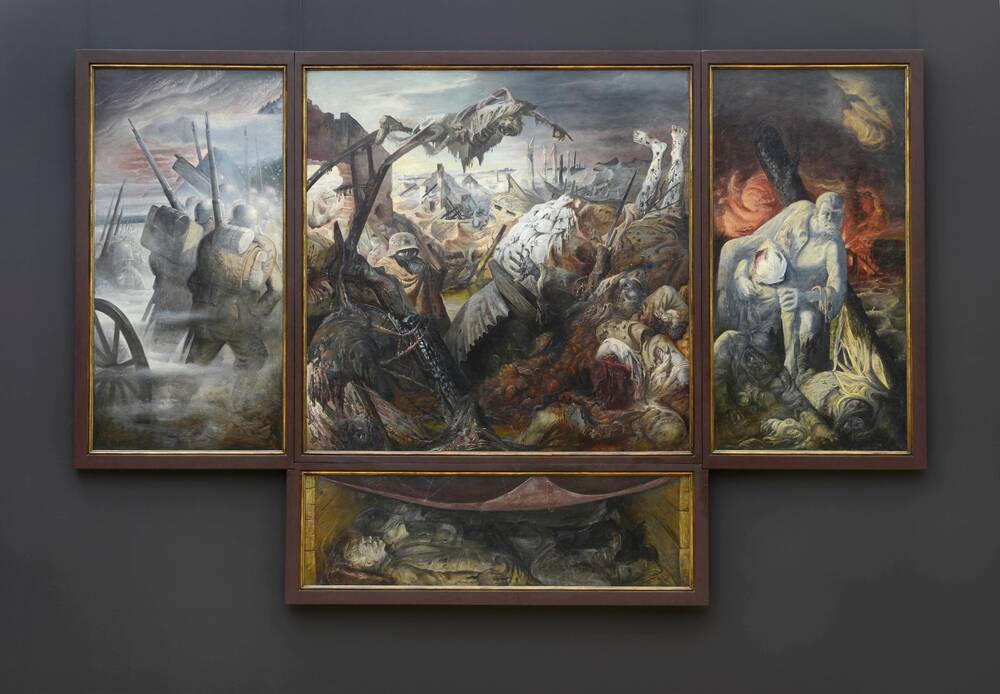
Schonungslos zeigt uns Otto Dix einen ewigen Kreislauf des Grauens: Soldaten marschieren in den Kampf, in eine apokalyptische Landschaft. Wer nicht umkommt, schleppt andere Verwundete aus der Schusslinie. Danach geht es hinunter in den Schützengraben, in den mit Brettern befestigten Unterstand, wo sie wie Todgeweihte schlafen. Nach wenigen Stunden geht es wieder hinaus und das Grauen beginnt von neuem.
Der junge Otto Dix hatte sich 1914 nach seinem Einberufungsbefehl freiwillig an die vorderste Front gemeldet. Er war damals 23 und wollte den Krieg mit eigenen Augen sehen. In der Augenzeugenschaft und in der Sachlichkeit seiner Schilderung liegt die enorme Wucht des Bildes, wie Kuratorin Birgit Dalbajewa betont:
„Er schafft letzten Endes ein großes Antikriegsdenkmal, aber es ist nichts, was mit dem erhobenen Zeigefinger eine Moral mit Symbolik zum Ausdruck bringt. Das Bild ist vielleicht in der Kunstgeschichte, in der deutschen Kunstgeschichte so wichtig wie das Bild ‚Guernica’ von Picasso, was wenige Jahre später entstanden ist, arbeitet aber ganz anders, nicht mit einer Symbolik, sondern mit einer scheinbaren Schilderung einer Situation, die wirkt selbst.“
Otto Dix entschied sich für ein sehr traditionelles Format – das sogenannte Triptychon, das aus einer breiten Mitteltafel und zwei Seitenflügel sowie der unten angesetzten Predella besteht. So erinnert das Gemälde bewusst an einen spätmittelalterlichen Flügelaltar. Doch anders als dort wird hier keine Erlösung versprochen.
Dass dieses Bild mit seiner pazifistischen Botschaft den Bildersturm des Dritten Reiches überstehen konnte, ist ein Wunder. Dix selbst versteckte es vor den Nationalsozialisten, und so konnte es 1946 bei der Ersten Allgemeinen Deutschen Kunstausstellung in Dresden gezeigt werden.
1968 wurde es von Dix für Dresden erworben. Um die dazu nötigen Mittel aufzubringen, mussten zahlreiche Stücke aus dem Historischen Museum, der Porzellansammlung und aus der Gemäldegalerie Neue Meister verkauft werden – eine widerspruchsvolle, mit Gewinn und Verlust verbundene Erwerbungsgeschichte.
Weitere Medien
1933 hatte Otto Dix das Kriegstriptychon mit Hilfe von Freunden außerhalb von Dresden versteckt. Nach dem Krieg wurden die Tafeln rasch geborgen; 1946 waren sie auf der Allgemeinen Deutschen Kunstausstellung in Dresden ein Publikumsmagnet.
Schon damals bemühen sich die Staatlichen Kunstsammlungen um den Erwerb des Triptychons. Verkaufen will Dix damals noch nicht, zu einer Leihgabe ist er jedoch bereit. Seit 1957 ist das Triptychon in Dresden zu sehen – bis Dix 1967 den Leihvertrag kündigt. Daraufhin nehmen die Kunstsammlungen einen zweiten Anlauf, um die Tafeln zu erwerben. Diesmal ist Dix einverstanden, verlangt aber einen für die DDR schmerzhaft hohen Preis: 500.000 Mark – in Valuta, also in der Währung der Bundesrepublik. Valutamittel sind in der DDR jedoch knapp. Das Ministerium für Kultur der DDR erklärt, dass es keine Sondermittel gibt, man aber dennoch einen Weg zum Erwerb des so wichtigen, realistischen Anti-Kriegs-Werkes suchen kann. Dieser Weg besteht darin, Objekte aus den Sammlungsdepots zu verkaufen: Objekte aus der Rüstkammer, der Porzellansammlung, dem Grünen Gewölbe und der Galerie Neue Meister werden im westlichen Kunsthandel veräußert. Der Erlös deckt die Kosten, um das Triptychon zu kaufen.
Der gesamte Vorgang soll eigentlich geheim bleiben. Im März 1970 berichtet jedoch die Presse in London über eine Auktion bei Sotheby's: Ein barocker Prunkdegen aus den Beständen der Dresdner Rüstkammer hat einen Rekordpreis erzielt! Mit der Geheimhaltung ist es von nun an vorbei, die Zeitungen berichten über die Verkäufe und vermuten – zu Recht, wie sich zeigen sollte –, dass der Erlös dem Ankauf einer hochkarätigen Leihgabe dienen solle.
Bis heute ist es eine Streitfrage, ob Museen für Neuerwerbungen Objekte aus ihren Beständen verkaufen dürfen.
In stark, unsparing detail, Otto Dix presents an eternal cycle of horror. Soldiers march off to do battle in an apocalyptic landscape; those surviving drag wounded comrades out of the line of fire. Afterwards, they retreat into the trenches, lying in dugouts reinforced with boards where they sleep like the doomed. After a few hours, they make ready to be sent over the top again, and the nightmare begins again.
In 1914, the young Otto Dix was called up and volunteered to fight on the fight line. At that time, he was 23 years old and wanted to experience the war at first hand. As curator Birgit Dalbajewa explains, the enormous power of this work lies in the objectivity of the images and their force as an eyewitness account.
“In the final analysis, Dix has created a magnificent anti-war memorial. But this neither has a wagging finger, nor couches its moral in symbolic terms. In German art history, this triptych can be regarded as ranked alongside Picasso’s ‘Guernica’, painted a few years later. But in contrast to Picasso, Dix took a quite different approach, not working with symbolism, but with seemingly realistic depictions of a situation affecting us in its own right.”
Otto Dix opted for a very traditional format – a triptych, commonly used in the late middle ages for winged altarpieces. So with its central panel and two side wings, as well as a predella – the scene along the base – the painting deliberately evokes such religious works. But here, there is no promise of salvation.
It is, though, something of a miracle that this work with its pacifist message managed to survive the Nazi regime’s iconoclast policies. Dix hid it from the Nazis, and so it could be shown at the First General German Art Exhibition in Dresden in 1946.
In 1968, it was acquired from the artist for the Dresden collections. The funds for the purchase were raised by selling numerous pieces from the Historical Museum, the Porcelain Collection and nineteenth and twentieth century works from the Galerie Neue Meister collections. So this work has a contradictory acquisition history connected with losses and gains.
In 1933, with the help of friends, Otto Dix hid his War triptych outside Dresden. After the war, the panels were quickly recovered. In 1946, the work was a major attraction for visitors to the First General German Art Exhibition in Dresden.
Even in those early post-war years, the State Art Collections attempted to acquire the triptych. Dix was not yet prepared to sell the work, but he was willing to lend it. From 1957, his War triptych was on show in Dresden – but ten years later, Dix gave notice to the loan agreement. Then the State Art Collections made a second attempt to acquire this panel painting – and now Dix was willing to sell. But his price was painfully high for the GDR – 500,000 marks – to be paid in Deutchmarks, the West German currency. The GDR only had very limited reserves of western foreign currencies. East Germany’s Ministry of Culture declared there were no special funds available – but agreed to looking for another way to acquire this important, realistic anti-war painting. And that other way lay in selling various pieces in the Dresden Collections kept in storage. So works from the Armoury, Porcelain Collection, Historic Green Vault, and the New Masters Gallery were auctioned in the western art trade. The proceeds covered the cost of buying the triptych.
The entire process was supposed to remain secret. However, in March 1970, reports about a Sotheby’s auction appeared in the London press – a baroque rapier lavishly decorated in silver had been sold for a record price, and it came from the holdings of the Dresden Armoury! The secret was out. Newspaper articles discussed the sales and assumed – quite rightly, as it turned out – the proceeds would go to buy an outstanding work then on loan.
Even today, this is a hotly debated issue – should museums sell pieces from their holdings to obtain funds for new acquisitions?
Válka jako krutý, bezohledný a neustále se opakující cyklus hrůzy - to je téma triptychonu od Otto Dixe: Vojácí pochodují do bitvy, do apokalyptické krajiny. Ti, kteří přežijí, se snaží zachránit zraněné a táhnou je do bezpečí. Pak se vrací zpět dolů do zákopů, do přístřešku, vyhrabaného v podzemí a upevněného prkny, který připomíná rakve a kde spí. Po několika hodinách musí zpět do bitvy a děsivý boj začíná od začátku.
Mladý Otto Dix se na začátku války roku 1914 dobrovolně a s nadšením přihlásil na frontu. Bylo mu tenkrát 23 let a chtěl válku vidět a zažít na vlastní oči. A právě díky jeho přímému a nezkreslenému svědectví a díky jeho objektivnímu zobrazení této hrůzy na nás obraz působí tak silně, jak zdůrazňuje kurátorka Birgit Dalbajewa:
"Vytvořil zde velký protiválečný pomník, který nás však nepoučuje se zvednutým ukazováčkem a nesnaží se ukazovat symbolickou morálku. Tento obraz je možná v dějinách umění, tedy v dějinách německého umění stejně důležitý jako Picassovo dílo "Guernica", které vzniklo o několik let později. Dix tu pracuje ale úplně jinak, nevyužívá symbolů, nýbrž vlastně "pouze" popisuje jednu situaci a ta na nás působí sama o sobě."
Otto Dix se rozhodl pracovat s velmi tradičním formátem - triptychonem, který se skládá z velké desky uprostřed, dvou bočních křídel a tzv. predely, tedy dolní částí pod hlavní deskou obrazu. Dixovo dílo má záměrně připomínat středověký oltář, ale jinak než oltáře nám Dixovo dílo neslibuje žádné spasení.
Je téměř zázrakem, že triptychon se svým pacifickým, protiválečným poselstvím nebyl nacisty během jejich ničivého tahu proti nepohodlnému umění ve Třetí říši zničen. Dix jej sám schoval, a proto mohl být obraz roku 1946 vystaven na První všeobecné výstavě německého umění v Drážďanech.
Město Drážďany obraz zakoupilo od Dixe roku 1968. Potřebné finanční prostředky byly získány prodejem četných exponátů z Historického muzea, sbírky porcelánu a z Galerie nových mistrů - tedy protichůdná historie zisku a ztráty.
Otto Dix spolu s přáteli ukryl svůj válečný triptych roku 1933 nedaleko Drážďan. Hned po skončení války všechny části vyzvedl, a proto mohl být triptych hned roku 1946 vystaven na První všeobecné výstavě německého umění v Drážďanech, kde se stal magnetem publika.
Již tenkrát se Státní umělecké sbírky snažily triptych získat, ale Dix jej ještě nechtěl prodat. Byl však ochoten ho galerii zapůjčit, a tak byl od roku 1957 v Drážďanech vystaven – až do roku 1967, kdy Dix smlouvu o výpůjčce vypověděl. Státní umělecké sbírky se znovu pokusily triptych zakoupit a Dix tentokrát s prodejem souhlasil, ale požadoval cenu, která byla pro tehdejší NDR bolestivě vysoká: 500.000 marek – a sice devisových, tedy západních marek. Devizové prostředky jsou však v NDR omezené a východoněmecké ministerstvo kultury odpovědělo, že pro koupi sice neexistují žádné zvláštní finanční fondy, ale že se pokusí najít jinou cestu, jak toto důležité, realistické protiválečné dílo získat. Tato cesta vede přes prodej předmětů z depozitářů Státní umělecké sbírky, a tak byly na západ prodány objekty ze zbrojnice, sbírky porcelánu, Zelené klenby a Sbírky nových mistrů. Výtěžek pokryl náklady na nákup Dixova triptychu.
Tento neobvyklý postup měl vlastně zůstat v naprosté tajnosti. V březnu roku 1970 však londýnský tisk informoval o aukci u Sotheby's: Nádherný barokní kord ze sbírky drážďanské zbrojnice docílil rekordní ceny! Od této chvíle již prodejní akci nebylo možné utajovat. Noviny referují o prodeji a domnívají se – a jak se také ukázalo, právem –, že výtěžek bude použit na nákup vzácného díla, které dosud bylo pouze zapůjčené.
Dodnes se vedou spory o tom, zda muzea můžou prodávat umělecké předměty ze svých sbírek, aby mohla nakoupit nová díla.
- Ort & Datierung
- 1929/32
- Material & Technik
- Mischtechnik auf Holz
- Dimenions
- (4-teilig): Mitteltafel 204 x 204 cm; linker und rechter Flügel je: 204 x 102 cm; Predella: 60 x 204 cm (Katalogmaß 2010) linker Flügel: 222,2 x 117,3 x 6,3 cm; Mitteltafel: 219 x 215,9 x 8 cm; rechter Flügel: 222,5 x 117 x 6,3 cm; Predella: 75 x 123 x 6,3 cm (Rahmenmaß, Tobias Lange, 28.04.2010)
- Museum
- Galerie Neue Meister
- Inventarnummer
- Gal.-Nr. 3754