
2005, kurz vor dem Abriss, wird im Palast der Republik in Berlin noch eine Ausstellung organisiert. Birgit Dieker ist eingeladen, ein Werk zum Thema Tod zu zeigen. Sie schaut sich die Räume an und hat sofort das Gefühl, in einem ausgeschlachteten Tanker zu stehen. Aus diesem Gefühl heraus entwickelt sie die monumentale Skulptur aus alten Rettungsringen und Tauwerk: „Seelenfänger“. Erinnerung an Treibgut, verfangen in alten Netzen, an den Strand geschwemmt. Aber auch an Bilder geflüchteter Menschen, die im Meer treiben und sich verzweifelt an einen Rettungsring klammern.
Die Arbeit entstand aber schon Jahre bevor sich Tausende Menschen auf die gefährliche Route über das Mittelmeer wagten. Birgit Dieker:
„Das ist ja wie so‘n Vorbote, im Grunde genommen, dieses Knäuel. Wenn man sich vorstellt, als ich dann auch die Bilder gesehen habe von den Flüchtlingen in den Rettungsbooten, in diesen, wie soll man sagen kleinen Schlauchbooten oder was auch immer. Voller Menschen, teilweise auch von Menschen, die diese Signalfarben anhatten… das ist genau die gleiche Farbwelt. Dieser Knoten verweist schon darauf, dass so etwas furchtbares passiert…“
Eigentlich sollen Rettungsringe ja Leben retten. Aber Dieker hat sie verknotet, verstrickt, festgezurrt, unbrauchbar gemacht:
„Also der Knoten assoziiert so viel Unterschiedliches. Im Aberglauben ist es zum Beispiel so, dass böse Mächte in einen Knoten gebunden werden können. Aber Andererseits verheißt der Knoten meistens nichts Gutes. Man hat sich verknotet, sitzt fest, man findet keinen Ausweg mehr. Es kann auch der psychische Knoten sein, Angstzustände, oder so irgendwas sitzt total fest. Aber natürlich auch physisch-körperlich als Krebsknoten zum Beispiel, wenn man irgendwelche Knötchen hat, die auch nichts Gutes verheißen…. Auf jeden Fall ist der Knoten eigentlich was Festes. Und wenn es dann auch noch so ein Knoten ist, dann findet man überhaupt keinen Ausweg mehr. Dann hat das was zu tun mit Chaos, mit etwas, das unübersichtlich ist. Wie kriege ich das wieder auf, wie komme ich raus, gibt‘s es eine Lösung?“
Diesem Unheimlichen und Bedrohlichen hat Birgit Dieker eine Form gegeben. Wie ein riesiger Krake mit langen Tentakeln kann der „Seelenfänger“ aus der Meer auftauchen und einen hinunterziehen. Die Angst des Menschen vor den Tiefen des Wassers, sagt sie, ist uralt und groß.
Weitere Medien
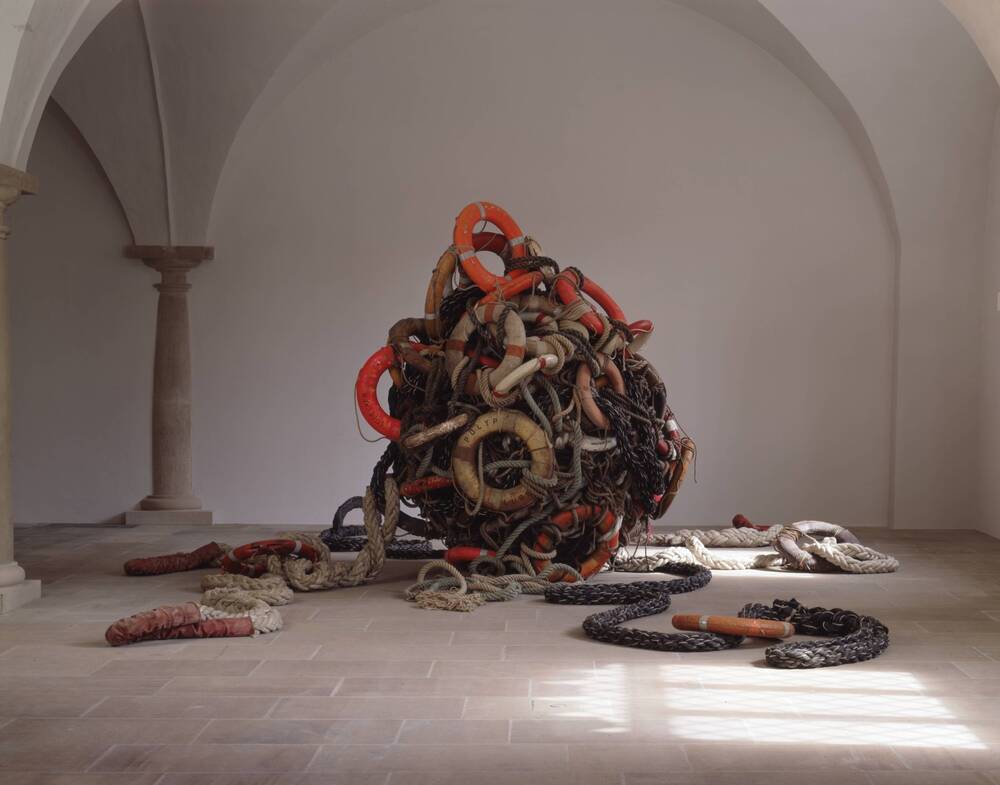
Birgit Dieker arbeitet oft mit gebrauchtem Dingen, die ihre eigenen Geschichten mitbringen. Auch die Rettungsringe und Taue haben viel erlebt, so abgenutzt, brüchig und fleckig wie sie sind. An das Material zu kommen, war extrem aufwändig:
„Ich musste sehr viel suchen. Ich lebe ja in Berlin und nicht an der Küste. Das machte die ganze Sache schon schwieriger. Aber später kam ein großer Glücksfall dazu… das ist dann wirklich lustig…“
Birgit Dieker recherchierte zunächst bei Reedereien und Schifffahrtsgesellschaften. Sie wollte unbedingt viele unterschiedliche Ringe haben. Einige Stücke bekam sie von einem Lagerplatz für ausrangiertes Material und schließlich lernte sie ganz zufällig einen Filmausstatter kennen, der für eine Produktion die ganze Atlantikküste bis nach Portugal abgeklappert hatte und nun sein Lager ausräumen musste.
„Ich kam in dieses Lager rein und sehe diese alten Kisten. Richtig alte Kisten. Dann haben wir die aufgemacht. Da waren die alten Seile drin, überall war Tauwerk und es roch nach Hafenbecken ganz hinten links. Und das war wirklich ein Wunder…“
Dieker mietete einen Arbeitsplatz, denn durch die Türe ihres Ateliers hätte der „Seelenfänger“ nicht gepasst. Außerdem brauchte sie Geräte zum Heben. Mit einem Assistenten baute sie schließlich die Skulptur:
„Und das war wirklich harte Arbeit, das war körperlich richtig anstrengend, diese schweren Taue und Seile zu knoten und festzumachen und zu zerren und durchzufädeln und so. Und das war im Sommer und das Tauwerk war furchtbar staubig und oll und wir waren völlig eingesaut und wir haben natürlich auch geschwitzt wie die Berserker, weil das so anstrengend war. Also das war ‚ne mördermäßige Arbeit“.
In 2005, the GDR’s Palace of the Republic in Berlin was scheduled for demolition. Shortly before work started, an exhibition was held in that spacious building, formerly a cultural centre and home to the East German parliament. Birgit Dieker was invited to show a work taking death as its subject. She looked around the stripped and empty rooms and had the feeling of standing in a huge tanker waiting to be broken up for spare parts – a feeling that inspired her monumental sculpture Soul Catcher made from ship’s rope and old life belts. It not only recalls the flotsam and jetsam, caught in old nets, washing up on the beach, but also images of people fleeing their homeland, swept along by the waves in the sea and desperately clinging to life belts.
In fact, Birgit Dieker created this sculpture years before thousands of people risked their lives on a dangerous voyage across the Mediterranean Sea. As the artist says:
“In essence, this vast bundle is a bit like a harbinger, especially when you think I then saw the pictures of the refugees in the rescue vessels, in those – what’d you call them – little inflatables or something like that. Packed with people, some also wearing these signal colours ... That’s exactly the same world of colour. The tangles and knots already suggest something dreadful like that has happened...”
Life belts are actually supposed to save lives. But Dieker has entangled them, tied them up and lashed them together so they are unusable.
“Knots have so many diverse associations. For instance, the superstition that you can tie knots to protect you from the evil eye. On the other hand, knots were often seen as bad luck. You can tie yourself up in knots, can’t move, and can’t find a way out. And you can also have psychological or mental knots, or fears, or be so strung up you can’t relax. Of course, there are physical knots as well, lumps on the body for example, little lumps which do not bode well …. In any case, a knot is actually something solid. If it’s that kind of knot, you might find no way out at all.
That also has something to do with chaos, something confusingly unclear. How do I undo that knot, slip out of it – and is there a solution?”
Birgit Dieker has given these uncanny and menacing feelings a particular shape. The Soul Catcher can rise out of the sea like a massive octopus with long tentacles, and pull us under. People have a huge, primaeval fear, Birgit Dieker says, of what is lurking in the depths of the oceans.
Birgit Dieker often works with used things with their own stories. As brittle, stained and worn as they are, the life belts and ship’s ropes could clearly tell a few yarns. But it proved very hard to find this material.
“I had to spend a lot of time looking for it. After all, I live in Berlin and not on the coast – which makes the whole thing more difficult. Later, though, I had a real stroke of luck ...
it’s really quite funny ...”
Birgit Dieker initially contacted various shipping lines and companies, since she knew she needed a lot of different ring-shaped life belts. She found some in a storage yard for scrap material. The breakthrough came, though, when quite by chance she met a prop maker and set designer. For one production, he had traipsed down the entire Atlantic coast collecting things, all the way to Portugal, and now had to clear out his storehouse.
“I came into the storage space and saw these old boxes – really old boxes. When we opened them, they were full of old ropes, marine ropes everywhere, and it smelt of the harbour basin, right at the back on the left. That really was a miracle....”
Dieker rented a large space where she could work, since her Soul Catcher would never have fitted through the doors to her studio. She also needed lifting equipment. Finally, working with an assistant, she built her sculpture:
“That was truly hard work, physically strenuous, knotting these heavy marine ropes, tightening and tugging at them, threading them through, and so on. It was summer and the ropes were horribly old and dusty, we were totally covered in dirt and of course also sweating like mad, since it was so strenuous. It really was “fiendishly hard work”.
Roku 2005, krátce před demolicí berlínského Paláce republiky, se zde konala výstava. Birgit Diekerová dostala pozvánku, aby zde vystavila dílo na téma smrti. Když se procházela prostory Paláce, měla okamžitě pocit, že stojí ve vykuchaném tankeru. A z tohoto pocitu vznikla monumentální socha konstruovaná ze starých záchranných kruhů a lan: Lovec duší. Představuje vzpomínky na nejrůznější předměty plavoucí v moři a zachycené ve starých sítích, vyplavené na pláž. Ale také na pohled uprchlíků, kteří plavou v moři a zoufale se drží záchranného kruhu.
Dílo však vzniklo již několik let předtím, než se tisíce lidí odvážily vydat na nebezpečnou cestu přes Středozemní moře. Birgit Diekerová:
„Uzel smotaný z různých předmětů je v podstatě něco jako předzvěst. Když si představím, že jsem později viděla obrázky uprchlíků v záchranných člunech, jak bych to vyjádřila, malých gumových člunech a jiných různých lodích. Plných lidí, přičemž někteří z nich měli na sobě tyto signální barvy ... je to vlastně úplně stejná paleta barev. Tento uzel je jakousi předpovědí toho, že se něco strašného stane ...“
Záchranné kruhy by vlastně měly zachraňovat životy. Ale Diekerová je zauzlovala, zamotala a lana zatáhla tak, že jsou kruhy nepoužitelné:
„Uzel tedy připomíná mnoho různých věcí. V pověrách se například říká, že zlé síly lze svázat do uzlu. Na druhou stranu však uzel obvykle nevěstí nic dobrého. Člověk může mít tzv. uzel v hlavě, zmotané myšlenky, ze kterých nemůže najít cestu ven. Můžeme si představit také psychický uzel ze strachu a úzkosti, ze kterého se sami nedokážeme „vymotat“. Samozřejmě se může jednat také o fyzický uzel – tedy nádor, například když člověk u sebe objeví zvětšené uzliny, které nevěstí nic dobrého ... V každém případě je uzel vlastně něco pevného. A když je příliš velký, tak je velmi těžké jej rozmotat a osvobodit se.
Situace pak má něco společného s chaosem, s něčím, co nás mate. Jak uzel rozvážu? Jak se ze zamotané situace dostanu? Existuje nějaké řešení?“
Birgit Diekerová zde ztvárnila nejistotu, hrozbu a nebezpečí. Jako obrovská chobotnice s dlouhými chapadly se může Lovec duší vynořit z moře a stáhnout vás ke dnu. Strach člověka z hlubin – jak sama říká – je prastarý a velký.
Birgit Diekerová často pracuje se starými věcmi, které už „odsloužily“ a mají vlastní příběh. Také záchranné kruhy a lana toho již mnoho zažily, když si všimneme, jak jsou opotřebované, zchátralé a špinavé. Získat tento materiál nebylo vůbec jednoduché:
„Musela jsem hodně a dlouho hledat. Bydlím v Berlíně a ne u moře, což celou věc ještě ztížilo. Později jsem ale měla velké štěstí ... to bylo opravdu legrační ...“
Birgit Diekerová nejprve zkoušela své štěstí u vodních přepravních společností. Chtěla získat pokud možno co nejvíce různých záchranných kruhů. Několik jich sehnala ve skladu s vyřazeným materiálem, a nakonec se úplnou náhodou seznámila s člověkem, který obstarává pro filmové produkce rekvizity a potřebný materiál a který kvůli jedné produkci procestoval celé pobřeží Atlantiku až do Portugalska a nyní musel vyklidit svůj sklad.
„Přišla jsem do tohoto skladu a vidím ty staré krabice. Velmi staré krabice. Ty jsme pak otevřeli. Byly tam staré provazy, ve všech ležela lana a vzadu vlevo to smrdělo jako v přístavu. A to byl opravdu zázrak ...“
Diekerová si pronajala pracovní prostor, protože Lovec duší se nevešel do dveří jejího ateliéru. Navíc potřebovala také zvedací zařízení. Sochu nakonec sestavila s pomocí jednoho asistenta:
„A to byla opravdu těžká práce. Bylo opravdu fyzicky velmi náročné vázat tato těžká lana a provazy do uzlů, utahovat a navzájem je provlékat. Navíc jsme pracovali v létě a lana byla strašně zaprášená a stará a my jsme díky tomu byli strašně špinaví a potili jsme se jako berserkové, protože to bylo strašně náročné. Byla to ohromná dřina.“
- Ort & Datierung
- 2005
- Material & Technik
- Rettungsringe, Schiffstaue
- Dimenions
- H: ca. 305 cm, Tiefe & Breite variabel
- Museum
- Skulpturensammlung
- Inventarnummer
- ZV 4306