
Der Verstand sagt: das ist eine Skulptur aus Holz. Schwer. Stabil. Statisch. Und doch: Sieht sie nicht aus, als könnte sie sich jederzeit bewegen? Sanft schwingen und um die eigene Achse drehen? Flexibel und doch im Gleichgewicht, wie ein Tänzer?
Beides, das Wissen und die intuitive Wahrnehmung, spiegelt der Titel der Werkgruppe wider, zu der auch unsere Skulptur gehört: „Tanzende Säulen“. Entstanden sind sie, nachdem sich der Bildhauer Tony Cragg jahrelang mit dem Thema „Wirbelsäule“ beschäftigt hatte.
Unser Werk besteht aus mehreren Blöcken, die Cragg leicht versetzt aufeinanderstapelte und verschraubte. Jeder Block wiederum ist aus vielen einzelnen, miteinander verleimten Schichten aus Birkenholz aufgebaut. Am Ende modellierte der Bildhauer die sanften Wellen und scharfen Kanten und verlieh der Skulptur eine samtig glänzende Oberfläche, unter der die dünnen Schichten sichtbar werden – wie die Jahresringe eines Baumes.
Wie komplex die „tanzende Säule“ wirklich ist, lässt sich nur erfahren, wenn man sie umrundet. Aus jeder Position zeigt sich ein neues Bild. Steht da nicht eine Figur mit weichen Rundungen, die sich nach vorne neigt? Dann tauchen schroffe, wie von Wind und Wetter geschliffene Felsformationen auf – und plötzlich sehen wir menschliche Gesichter im Profil. Sobald wir weitergehen, verschwinden sie wieder, wie in einem Vexierbild.
Es ist ein bekanntes Phänomen, dass Menschen Formen und Gesichter sehen, wo eigentlich keine sind: in Wolken, im Wandputz, in Gegenständen. Tony Cragg betont, dass dieses Erkennen mit Emotionen verbunden ist. In seinen Skulpturen spielt er mit unterschiedlichsten Formen – im Bewusstsein, dass sie unterschiedliche Emotionen hervorrufen. Und er glaubt, wenn er als Bildhauer neue Formen schaffen könne, die es in der Natur so nicht gibt, könne er damit auch neue Gefühle, Ideen und Begriffe hervorrufen.
Weitere Medien
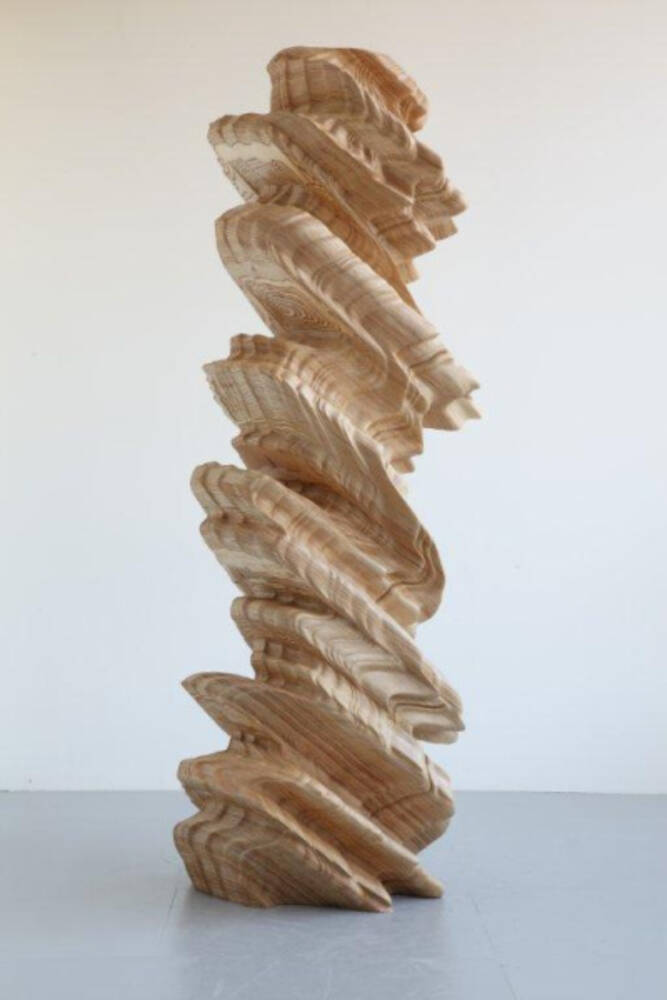
Our rational mind tells us the sculpture is made of wood. Heavy. Stable. Static. And yet... doesn’t it just look as if it could start moving any moment? Gently swaying and spinning round and round? Flexible yet balanced, rather like a dancer?
This sculpture belongs to Tony Cragg’s “Dancing Columns” series, a title embracing both rational and intuitive perception. He developed the series after spending years exploring the topic of the spinal column.
Our “Dancing Column” is a number of slightly offset blocks of wood screwed together. Each block, in turn, comprises many individual layers of birchwood glued together. In a final step, Cragg then created the soft wave-like shapes and angular edges, and gave the sculpture a bright, silky surface revealing the thin layers below – rather like tree-rings.
If you walk around this “Dancing Column”, you’ll notice just how complex it really is, and how it always looks different as your perspective changes. Perhaps it looks like a figure with soft curves, bending forwards slightly? And then a cliff’s rough rock formations shaped by the wind and weather – or suddenly, human faces in profile. But as soon as we move on, these impressions vanish again, rather like optical illusions in a riddle picture – just like that familiar phenomenon of seeing shapes and faces in clouds, on plastered walls or objects, places where we know they don’t exist.
Tony Cragg’s work highlights how this act of recognising objects also has an emotional content. His sculptures play with very different forms – well aware that these evoke diverse feelings. In his view, if he can create new forms in his sculptures which are not found in nature, these may also evoke new feelings, sentiments and ideas in the viewers.
Rozum nám říká: Zde stojí socha ze dřeva. Těžká, robustní, statická. A přesto: Nevypadá, jako by se mohla každou chvíli začít pohybovat? Jemně se houpat a otáčet kolem vlastní osy? Pružně a zároveň v rovnováze – jako tanečník?
Obojí – skutečnost a spontánní dojem – odráží také název skupiny děl, k nimž patří i naše dílo: Tančící sloupy. Vznikly poté, co se sochař Tony Cragg několik let zabýval tématem „páteře“.
Naše dílo se skládá z několika bloků, které Cragg naskládal mírně posunuté na sebe a sešrouboval je k sobě. Každý blok tvoří naopak několik jednotlivých vrstev z březového dřeva, které sklížil dohromady. Nakonec sochař vymodeloval jemné vlny a ostré hrany a dal soše sametově lesklý povrch, pod nímž jsou vidět tenké vrstvy – připomínající letokruhy stromu.
Komplexnost Tančícího sloupu chápeme až při procházce kolem něj. Z každého pohledu nám nabízí nový obraz: Nestojí zde postava s měkkými křivkami, která se naklání dopředu? A o krok dál se před námi vynoří drsné skalní útvary – vytvořené větrem a syrovým počasím – a najednou vidíme lidské tváře z profilu. A jakmile postoupíme kousek dál, opět zmizí, jako v optické hádance.
Je známo, že lidé vidí tvary a tváře tam, kde ve skutečnosti nejsou: v mracích, v omítce stěn, v předmětech. Tony Cragg zdůrazňuje, že naše představy přímo souvisí s našimi emocemi. Ve svých sochách si hraje s nejrůznějšími formami – a ví, že u nás vyvolávají různé pocity. Je toho názoru, že pokud jako sochař dokáže vytvořit nové tvary, které v přírodě neexistují, dokáže tímto způsobem vyvolat také nové pocity, myšlenky a koncepty.
- Ort & Datierung
- 2009
- Material & Technik
- Multiplex Birke, Schablonen geleimt, gefräst, verschraubt, mit Bienenwachs behandelt
- Dimenions
- H: 324,0 cm, B: 125,0 cm, T: 115,0 cm
- Museum
- Skulpturensammlung
- Inventarnummer
- ZV 4313