
Für diese weibliche Figur hat Max Klinger mehrere Steinblöcke zusammengefügt. Kopf und Brust schlug er aus weißem Marmor, die feine Stofflichkeit des Gewandes arbeitete er aus honigfarbenem Onyx-Marmor heraus.
Wie Sie im Vergleich mit der Statue nebenan sehen können, hat er sich dabei stark an der Antike orientiert. Figuren aus verschiedenfarbigem Stein galten dort als große Kostbarkeit. Trotzdem irritierte Max Klinger zu Anfang des letzten Jahrhunderts mit diesem Werk. Die Farbigkeit einer der Antike nachempfundenen Figur befremdete viele seiner Zeitgenossen. Erst langsam setzte sich die Erkenntnis durch, dass die Statuen damals nicht nur weiss, sondern, durch verschiedene Steine oder Bemalung, tatsächlich farbig waren. Ein Wegbereiter dieses Wissens war der Archäologe und frühere Direktor der Skulpturensammlung des Albertinum, Georg Treu – ein Freund Max Klingers.
Konservatorin Astrid Nielsen:
Georg Treu verfasste eine Schrift: „Sollen wir unsere Statuen bemalen?“ Und er versuchte eben auch, zeitgenössische Bildhauer zur Arbeit mit Farbe in der Skulptur zu bewegen. Es gibt eine umfangreiche Korrespondenz zwischen Georg Treu und Max Klinger in der es um die Farbigkeit in der Skulptur zu der Zeit geht. (…)
Es gab natürlich einen großen Streit darüber. Es gab Vertreter, die behaupteten: die Antike ist farbig, und genauso gab es auf der anderen Seite diejenigen, die felsenfest davon überzeugt waren, dass die Antike nur weiß gewesen sein kann. Was sich natürlich auch in der Bildhauerei des Klassizismus widerspiegelt, die davon ausgegangen sind, dass die Antike als deren großes Ideal und deren große Vorbildwirkung natürlich nur weiß gewesen sein kann.“
Weitere Medien
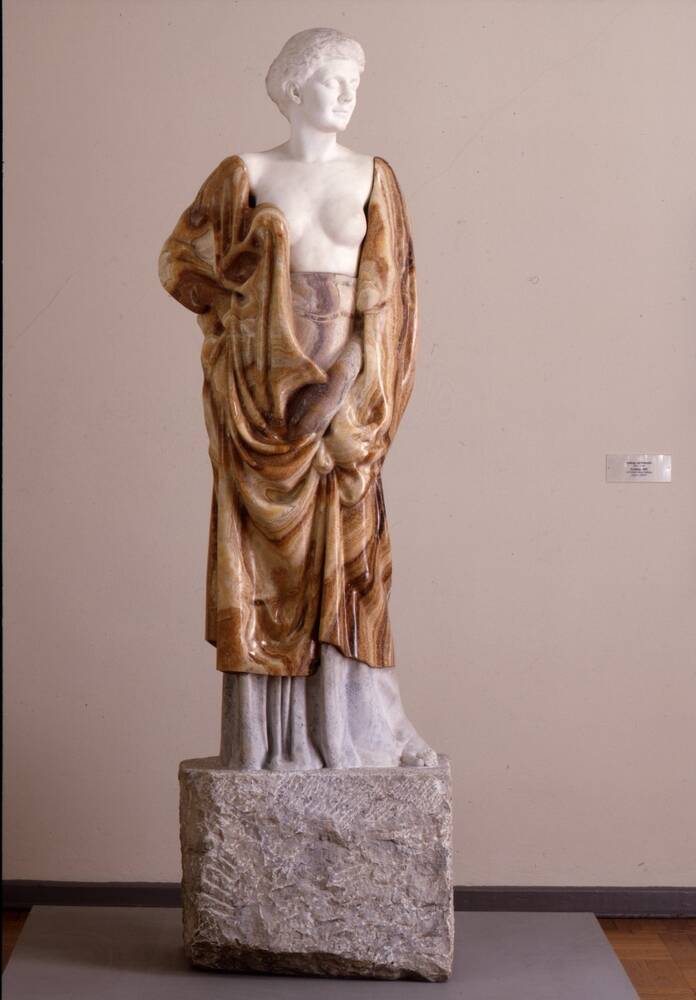
Max Klinger carved this female figure from several blocks of stone. While the head and torso are white marble, he used honey-coloured onyx marble to create the robe’s delicate material quality.
As you can tell when you compare this work with the neighbouring figure, Klinger was strongly influenced by the classical world. In antiquity, figures carved from different coloured stone were regarded as especially precious. Nonetheless, when Max Klinger unveiled this work in the early 1900s, the result was largely bewilderment. Since many of his contemporaries believed Greco-Roman statues had only ever been white, they were baffled by this colourful figure based on models from antiquity. Only gradually did people realise ancient statues were not originally white, but actually colourful – either painted or carved in coloured stone. Georg Treu, an archaeologist and the first Director of the Sculpture Collection in Dresden in the Albertinum, was a pioneer in questioning the whiteness of classical sculpture – and he was good friends with Max Klinger.
Conservator Astrid Nielsen:
“Georg Treu was at the forefront of this debate with his paper ‘Should we paint our statues?’ What’s more, he also tried to encourage contemporary sculptors to work with colour. At that time, Georg Treu and Max Klinger engaged in an extensive exchange of letters over the question of polychrome sculpture. (…)
Of course, this was a highly controversial issue. Some maintained the sculptures in antiquity were painted, while others claimed with precisely the same conviction that classical sculptures had been purely white. This latter belief was also reflected in neo-classical sculpture, since those artists assumed that in antiquity, their great ideal and role model, sculptures could only have been white.”
Pro tuto postavu ženy použil Max Klinger několik různých kamenných bloků. Hlavu a hruď vytesal z bílého mramoru a jemné řasení na jejím rouše vypracoval z onyxového mramoru medové barvy.
Jak je vidět ve srovnání s vedlejší sochou, nechal se silně ovlivnit antickým uměním. Sochy z různobarevného kamene tenkrát měly velkou hodnotu. Přesto toto dílo Maxe Klingera narazilo u publika na počátku minulého století na nepochopení. Barevná figura podle antického vzoru mnoho jeho současníků negativně podivila. Jen postupně došli historici umění k poznání, že antické sochy nebyly původně jen bílé, nýbrž opravdu barevné – díky různým použitým kamenům a různým barevným vrstvám. Jedním z prvních odborníků, kteří tuto skutečnost objevili, byl archeolog a bývalý ředitel sochařské sbírky v Albertinu Georg Treu – přítel Maxe Klingera.
Konzervátorka Astrid Nielsenová:
„Georg Treu napsal článek s názvem Měli bychom pomalovat naše sochy?. Snažil se také povzbudit tehdejší sochaře k práci s barvou v sochařství. Mezi Georgem Treuem a Maxem Klingerem existuje rozsáhlá korespondence, ve které oba diskutují o užití barvy v současném sochařství. (...)
O toto téma se samozřejmě vedly velké spory. Část odborníků tvrdila, že antická díla byla barevná, a na druhé straně stáli ti, kteří byli pevně přesvědčeni, že antické sochy mohly být pouze bílé. Tento názor se pak odrazil i v klasicistickém sochařství, jehož zástupci předpokládali, že antické sochy, které byly jejich velkým ideálem a vzorem, mohly být samozřejmě jenom bílé.“
- Ort & Datierung
- um 1912 / 1913 vollendet (vgl. AK Chemnitz 2007)
- Material & Technik
- Marmor und sog. Onyx-Marmor
- Dimenions
- Gesamt: H: 227 cm, B: 65,0 cm, T: 53,0 cm
- Museum
- Skulpturensammlung
- Inventarnummer
- ZV 3738