
Die Muskeln spannen sich. Mit aller Kraft umschließen die Hände den Ast, um ihn vom Stamm zu brechen. Völlig unberührt von seiner Anstrengung begegnen sich im Rücken des Mannes zwei Frauen. Lang ausgestreckt die eine, sitzend die andere. Ihre Gesichter nähren sich, wie kurz vor einem Kuss.
Diese Nichtbeachtung lässt den Kraftakt des Mannes einsam und verzweifelt wirken. Trotz räumlicher Nähe scheinen männliche und weibliche Sphäre Welten voneinander entfernt. Liegt darin das „Drama“, wie Max Klinger seine Figurengruppe nannte? Die Komposition ist rätselhaft. Klinger erklärte einmal, der Burenkrieg, ein militärischer Konflikt im heutigen Südafrika, hätte ihn dazu inspiriert. Später hat er jedoch auf diese Deutungsmöglichkeit wieder verzichtet. Letztendlich überließ er es uns, seine Skulptur zu interpretieren.
Max Klinger studierte Malerei und schuf ein umfangreiches Werk an Grafiken und Gemälden. Die Bildhauerei erlernte er autodidaktisch. Dieses monumentale Werk entstand auf Initiative des damaligen Direktors der Skulpturensammlung, Georg Treu.
„Es ist ein Werk, von dem gesagt wurde, dass es sich wie kein anderes deutlich mit dem französischen Bildhauer August Rodin auseinandersetzt. In der Bearbeitung des Steins und auch in der Anordnung der Figuren und auch in der Anlage dieser durchaus sehr symbolhaften Deutungsmöglichkeit dieser Skulptur. Es ist ein Messen, nicht nur mit Rodin, sondern auch mit Michelangelo, mit dem Rodin sich selbst natürlich auch auseinandergesetzt hat, im Umgang mit diesem großen Stein.“
Vergleichen Sie selbst. Werke von Auguste Rodin können Sie auch hier im Saal sehen.
Weitere Medien
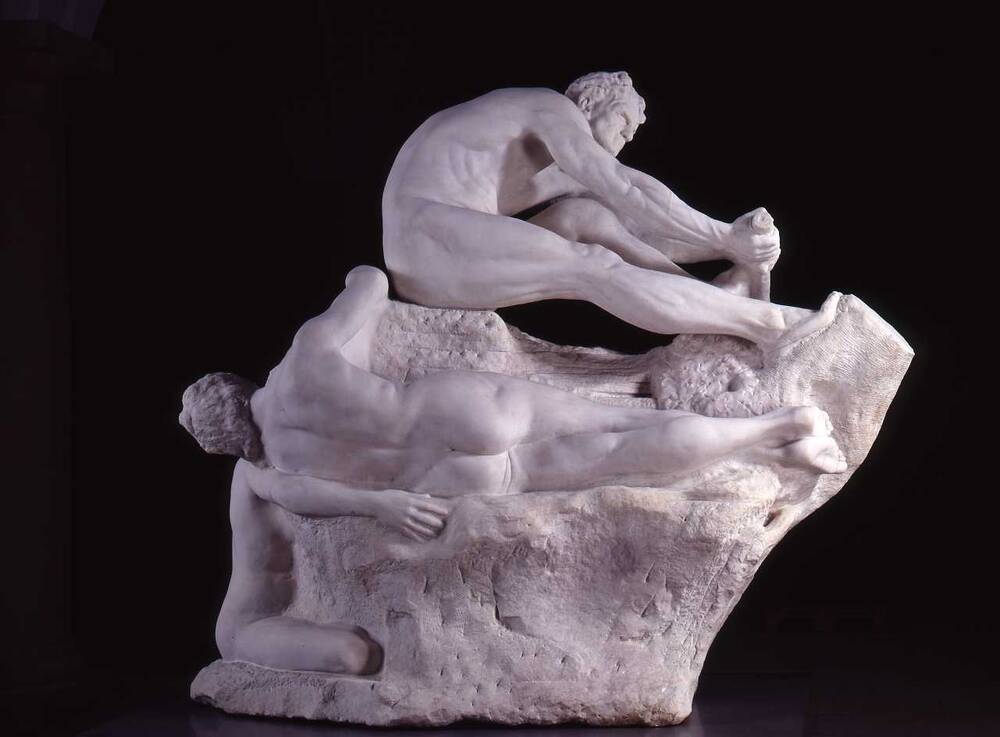
The man’s muscles tense to take the strain as his hands grip the branch, and he summons up all his strength to break it off the tree trunk. Totally unmoved by his efforts, two women meet behind the man’s back, one stretched out on her side, the other sitting. Their faces come close, as if about to kiss.
In the face of their indifference, the man’s strenuous efforts seem disconnected and forlorn. Despite their spatial proximity, the male and female spheres seems worlds apart. Could that be the “drama” referred to in the title of Max Klinger’s figural group? The composition is puzzling. Klinger once said he was inspired by the Boer War, a military conflict in today’s South Africa, but later he renounced his statement. Ultimately, he leaves it up to us to interpret his sculpture.
Max Klinger studied painting and created an extensive oeuvre of graphic works and paintings. He taught himself to sculpt. The initiative for this monumental work came from Georg Treu, then Director of the Sculpture Collection.
“It’s often been said this work clearly engages, like no other, in a critical dialogue with the French sculptor Auguste Rodin. And that is evident in how the stone is worked and the figures arranged, as well as the way the sculpture offers so many possible symbolic interpretations. But in carving this large block of marble, Klinger is not just measuring himself against Rodin, but also against Michelangelo – since of course Rodin was also responding to the works of that great Renaissance sculptor.”
Our display in this room also includes sculptures by Auguste Rodin, so you can compare works by Klinger and Rodin for yourself.
Napnuté svaly. Muž svírá vší silou větev a snaží se ji odlomit od kmene. Za jeho zády, zcela neovlivněny jeho námahou, se nachází dvě ženy: jedna ležící, druhá sedící. Jejich tváře se něžně přibližují, jako by se chtěly políbit.
Díky jejich nevšímavosti působí mužova námaha osaměle a zoufale. Navzdory prostorové blízkosti se mužský a ženský svět zdají být navzájem velmi vzdáleny. Je právě to podstatou Dramatu, jak Max Klinger své sousoší nazval? Kompozice je záhadná. Klinger jednou vysvětlil, že ho k dílu inspirovala búrská válka, vojenský konflikt na území dnešní Jihoafrické republiky. Později však od této možnosti interpretace upustil a přenechal interpretaci své sochy na nás.
Max Klinger vystudoval malířství a zanechal nám velké množství grafik a maleb. Sochařství se věnoval jako autodidakt. Toto monumentální dílo vzniklo z iniciativy tehdejšího ředitele sochařské sbírky Georga Treue.
„Jedná se o dílo, o němž se říká, že se v něm umělec zabýval uměním francouzského sochaře Auguste Rodina intenzívněji než jiná díla: opracováním kamene, ale také uspořádáním postav a širokým, symbolickým možnostem interpretace této sochy. Klinger zde měří své síly při zpracování tohoto velkého kamenného bloku nejen s Rodinem, ale také s Michelangelem, s nímž se potýkal i sám Rodin.“
Ale porovnejte díla obou umělců sami. Díla Augusta Rodina si můžete prohlédnout v hale.
- Ort & Datierung
- von 1899 bis 1904
- Material & Technik
- Marmor aus Laas in Tirol
- Dimenions
- H: 212,0 cm, B: 230,0 cm, T: 112,0 cm
- Museum
- Skulpturensammlung
- Inventarnummer
- ZV 2203