
Februar 1945: bei den schweren Bombenangriffen der Alliierten wird das Albertinum weniger zerstört als andere Museen der Stadt, aber das Treppenhaus brennt aus und mit ihm die opulente Ausstattung von Hermann Prell. Diese beiden kleinformatigen Bronzen von Aphrodite und Prometheus überleben im Besitz des Künstlers. Sie hatten ihm als Vorlage für die gut zwei Meter hohen Skulpturen gedient, die dem Brand zum Opfer fallen.
Eigentlich war Hermann Prell Maler. Doch als er 1890 den Auftrag für die Bemalung der Decke im Treppenhaus erhielt, entwickelte er ein monumentales Gesamtkunstwerk aus Wand- und Deckengemälden und Skulpturen. Als Thema wählte er Motive aus der griechischen Mythologie. Auf dem zentralen Bild an der Decke tobte der Kampf der olympischen Gottheiten gegen die auf der Erde geborenen Titanen. An den Wänden stellte er Szenen aus den Sagen um Aphrodite und Prometheus einander gegenüber. Für Prell verkörperten die beiden „Schönheit“ und „Schicksal“.
Auf alten Schwarz-Weiß-Fotografien ist noch zu sehen, dass die Marmorfigur der Aphrodite im Osten, vor der „Wand der Schönheit“, stand. Gerade dem Meer entstiegen, wringt sie die langen nassen Haare aus. An ihre Beine schmiegt sich ein Delphin. Ihr gegenüber, vor der westlichen „Wand des Schicksals“, platzierte Prell seinen Prometheus. Der hatte den Menschen das Feuer gebracht, sie in Kunst, Handwerk und Wissenschaft unterrichtet. Schließlich half er mit, seine Mutter Gaia, die Göttin der Erde, zu besiegen. Prell zeigt Prometheus erschöpft nach dem schweren Sieg der geistigen Kräfte über die Naturgewalten. Mit einem Bein stützt er sich auf dem Kopf der Mutter ab und versucht, die Fesseln um seine Brust zu lösen.
Unsere Bronze-Figur stammt direkt aus dem Nachlass von Hermann Prell, Aphrodite wurde 1994 über den Kunsthandel erworben.
Weitere Medien
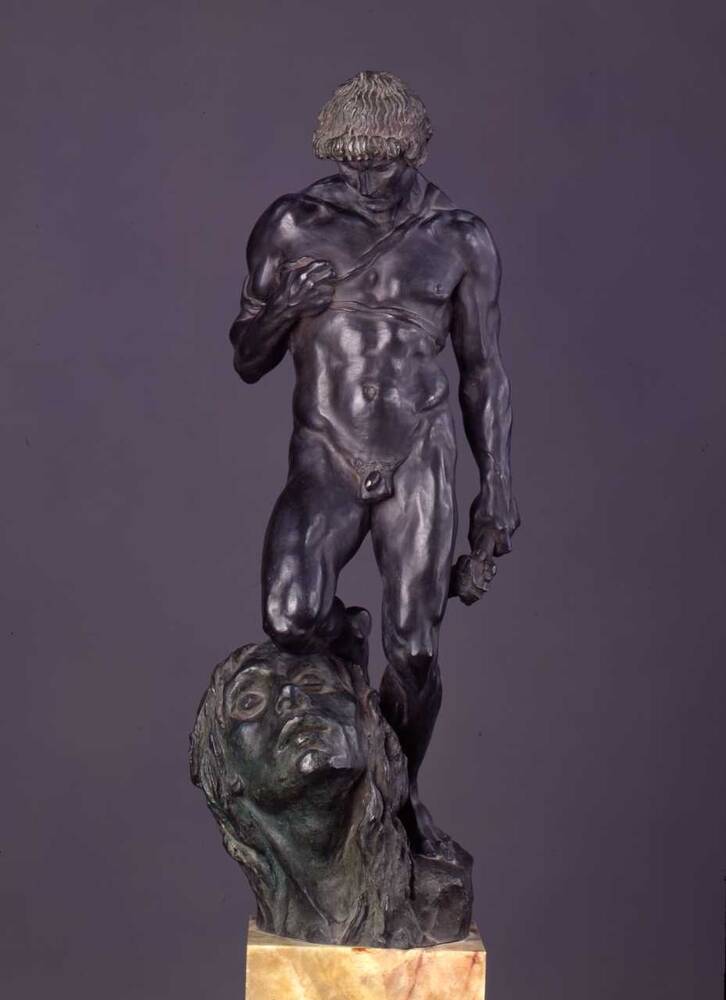
February 1945 – in the heavy Allied bombing raids, the Albertinum suffered less serious damage than other museums in the city. However, the staircase caught fire and the blaze destroyed Hermann Prell’s opulent stairwell design. These two small format bronzes of Aphrodite and Prometheus survived because Prell had kept them in his possession. They were his models for his final sculptures, both a good two metres high, lost in the fire.
Hermann Prell had actually trained as a painter. But in 1890 when he was commissioned to paint the stairwell ceiling, he developed a monumental Gesamtkunstwerk of wall and ceiling murals and sculptures. He took his inspiration for these works from Greek mythology. The central field on the ceiling showed the Olympian gods battling with the earth-born Titans. He then set scenes from the myths of Aphrodite and Prometheus on opposite walls. For Prell, these two gods symbolised “beauty” and “fate”.
From old black-and-white photographs, we know the marble figure of Aphrodite stood to the east, in front of the “wall of beauty”. Just emerging from the sea, she is wringing our her long wet hair. A dolphin rubs against her legs. Prell set up his Prometheus in front of the “wall of fate” to the west, opposite Aphrodite. In Greek mythology, Prometheus not only stole fire from the gods to give to humankind, but also taught them the arts, crafts and sciences. Ultimately, he helped to defeat his mother Gaia, the ancestral mother of the Earth. Prell shows Prometheus exhausted after the hard-won victory of the powers of the mind over natural forces. Prometheus rests one leg, bent at the knee, on his mother’s head as he tries to tear his bonds from his chest.
This bronze figure came directly from Hermann Prell’s artistic estate. Aphrodite was acquired from the art trade for the collection in 1994.
Únor roku 1945: Během těžkých spojeneckých náletů je Albertinum naštěstí zničeno méně než jiná muzea ve městě, ale schodiště přece jenom kompletně shoří a s ním i honosné vybavení od Hermanna Prella. Tyto dvě malé bronzové sošky Afrodity a Prométhea se zachovaly v jeho vlastnictví. Sloužily mu původně jako modely pro dvoumetrové sochy, které padly požáru za oběť.
Hermann Prell byl ve skutečnosti malířem. Když byl však roku 1890 pověřen výmalbou stropu nad schodištěm, vytvořil monumentální umělecký celek sestávající z nástěnných a nástropních maleb a soch. Jako námět si zvolil motivy z řecké mytologie. Na ústřední malbě na stropě zuřil boj olympských božstev proti titánům zrozeným na zemi. Na stěnách naproti sobě zobrazil výjevy z legend o Afroditě a Prométheovi. Ti dva pro Prella ztělesňovali „krásu“ a „osud“.
Na starých černobílých fotografiích je vidět, že mramorová postava Afrodity původně stála na východě před „Zdí krásy“. Afrodita se právě vynořila z moře a ždímá si dlouhé mokré vlasy a u jejích nohou se tulí delfín. Naproti ní, před západní „Zdí osudu“, Hermann Prell umístil svého Prométhea, který lidem přinesl oheň, naučil je umění, řemeslům a vědě. A nakonec pomohl porazit svou matku Gaiu, bohyni země. Prell ukazuje Prométhea vyčerpaného po těžce vybojovaném vítězství duchovních sil nad přírodními silami. Jednou nohou se opírá o hlavu své matky a snaží se uvolnit pouta kolem své hrudi.
Naše bronzová socha pochází přímo z pozůstalosti Hermanna Prella. Afrodita byla zakoupena roku 1994.
- Ort & Datierung
- 1899/1900
- Material & Technik
- Bronze auf Marmorsockel, grünliche Patina
- Dimenions
- H: 60,0 cm, B: 22,5 cm, T: 19,2 cm
- Museum
- Skulpturensammlung
- Inventarnummer
- ZV 3630