
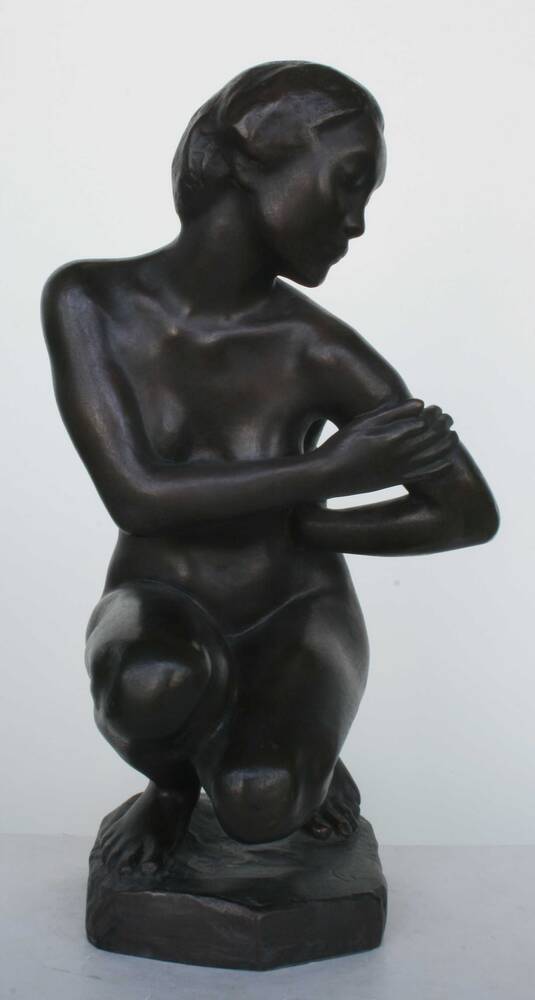
Das auffälligste Detail an dieser Mädchenfigur ist die ungewöhnliche Haltung ihres linken Armes. Probiert man es selbst aus, merkt man, dass es gar nicht schwer ist, den Arm so nach hinten zu drehen und die Hand auf die Taille zu legen. Wie von selbst, neigt sich der Kopf dabei in die gleiche Richtung. Das verleiht dem Körper etwas Leichtes, Anmutiges, Tänzerisches.
Der Bildhauer Georg Kolbe zeigte seine Akte oft in ungewöhnlichen Positionen. Sein Ziel war es, einen Ausdruck für Gefühle und Empfindungen zu finden. Sein Mittel: die reine Form. Und die sah er vor allem in den Körpern junger, schöner Mädchen. Er fand sogar einen Begriff dafür: „Ausdrucksplastik“.
Als 1912 in der Kunsthalle Mannheim eine Ausstellung stattfand, die sich zum ersten Mal mit dieser Entwicklung befasste und die den Titel „Ausdrucksplastik“ trug, schrieb Kolbe im Vorwort über die neuen Bildhauer:
„…sie schöpfen alle unmittelbar aus dem Leben…. Keine Epoche wird imitiert, kein Anatomierekord aufgestellt. Alleiniges Recht hat die Form. Sie wird zur Sprache ausgebildet, das Leben zu schildern.“
Und das konnte er, so war er überzeugt, am besten im Akt.
Unsere „Kauernde Japanerin“ ist eine seiner erfolgreichsten Plastiken. Den Kopf leicht gesenkt, die Augenlider niedergeschlagen, bedeckt sie mit dem rechten Arm ihre nackten Oberkörper. Sie wirkt zurückhaltend, aber nicht scheu, sondern ganz bei sich. 1911, im Jahr ihrer Entstehung, wurde die Figur zum ersten Mal ausgestellt: bei der Herbstausstellung der Berliner Secession. Galerist Paul Cassirer, der Georg Kolbe vertrat, ließ zehn Bronzegüsse herstellen, die sich alle in den nächsten Jahren verkauften. So kam dieser Abguss in unsere Skulpturensammlung.
Nach dem tragischen Tod seiner Frau im Jahr 1927 schuf Georg Kolbe keine anmutigen, heiteren Mädchenakte mehr. Nun tauchten Männerfiguren auf, die von Trauer und Einsamkeit erzählen.
Weitere Medien
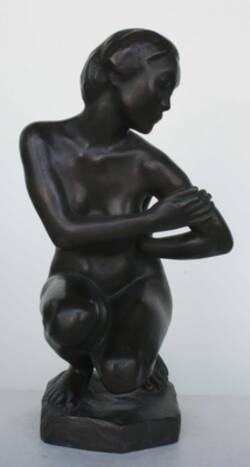
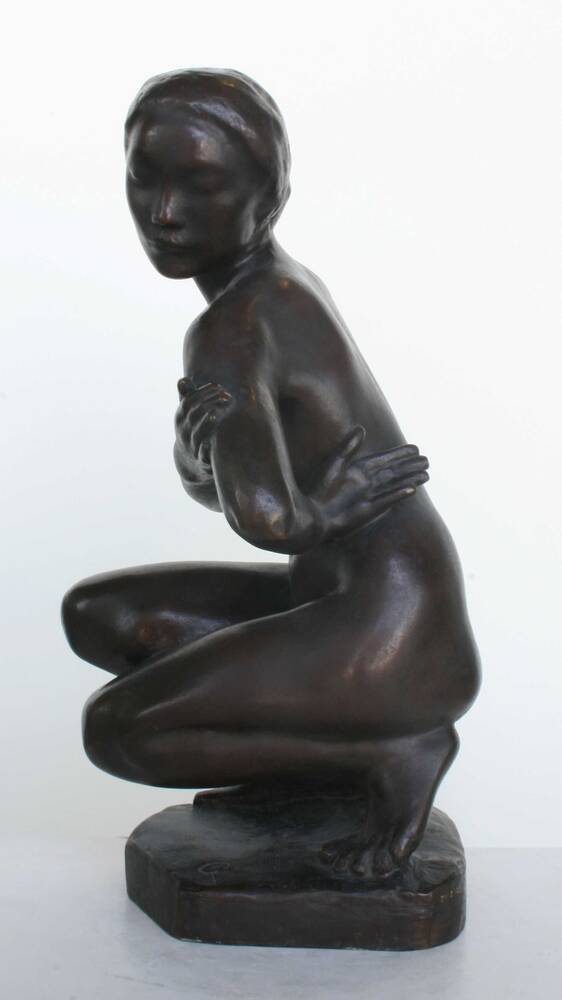
In this figure of a Japanese woman, the most eye-catching detail is the unusual position of her left arm. If you want to try to copy the movement yourself, you’ll find it’s relatively easy to turn your arm so the back of your hand is resting on your waist. – and then, as if of its own accord, your head bends slightly in the same direction. As you see here, the posture lends the body something light, graceful, almost dance-like.
Sculptor Georg Kolbe often portrayed his nudes in unusual positions, part of his quest to find a means of expressing feelings and the inner life through sheer form. For Kolbe, pure form could be found, first and foremost, in the bodies of young, beautiful women. He even coined the term “expressive sculpture” to describe a form conveying the harmony of body and spirit.
In 1912, the Kunsthalle Mannheim held an exhibition called “Expressive Sculpture”, the first show dedicated to this development. In a foreword to the exhibition, Kolbe wrote of the new sculptors:
“…they all take their inspiration directly from life…. No era is copied, no anatomical record established. Form alone is the sole authority. It is developed into a language to depict life.”
Kolbe was convinced this language could express itself best through the nude.
Our Crouching Japanese Woman is one of his most successful sculptures. With eyelids lowered and her head slightly tilted, she covers her naked torso with her right arm. She seems reserved, and rather than shy, very much centred in herself. In 1911, the year this figure was made, it was shown for the first time – at the Berlin Secession’s autumn exhibition. Gallerist Paul Cassirer, who represented Georg Kolbe, had ten bronze casts of the work made, and he sold them all over the next years – and one of them is the sculpture you can see here.
After the tragic death of Kolbe’s wife in 1927, his art took a very different trajectory. In place of his cheerful and graceful female nudes, his figures were now male nudes telling of grief and loneliness.
Čeho si na postavě zobrazené dívky nejprve všimneme, je neobvyklý pohyb její levé ruky. Pokud to sami vyzkoušíte, zjistíte, že otočit paži takto dozadu a položit ruku do pasu vlastně není vůbec obtížné. Dívka naprosto samozřejmě hlavu naklání stejným směrem, čímž pohyb jejího těla získává lehkost a ladnost a my máme pocit, že dívka tančí.
Sochař Georg Kolbe často zobrazoval své akty v neobvyklých pozicích. Jeho cílem bylo vyjádřit pocity a emoce prostřednictvím tzv. čisté formy. A tu nacházel především v tělech mladých, krásných dívek. Nazýval své umění „expresivním sochařstvím“.
Když se roku 1912 konala v mannheimské galerii Kunsthalle výstava s názvem Ausdrucksplastik – česky Expresívní sochařství, která se poprvé tímto vývojem zabývala, napsal Kolbe v předmluvě o nových sochařích:
„... všichni čerpají přímo ze života ... Nenapodobují žádnou epochu, nesnaží se o žádný anatomický rekord. Výhradní právo má tvar, který je novým jazykem zobrazujícím život.“
Kolbe byl přesvědčen o tom, že toho nejlépe dosáhne zobrazením aktu.
Naše Krčící se Japonka je jednou z jeho nejúspěšnějších soch. S hlavou mírně skloněnou a se sklopenými víčky si pravou rukou zakrývá nahou horní část těla. Působí zdrženlivě, ale ne stydlivě, je sama sebou. Roku 1911, kdy socha vznikla, byla také poprvé vystavena: a sice na podzimní výstavě berlínské Secese. Majitel galerie Paul Cassirer, který zastupoval Georga Kolbeho, nechal zhotovit deset bronzových odlitků, které se hned během několika následujících let všechny prodaly. A tak se tento odlitek dostal také do naší sochařské sbírky.
Po tragické smrti své ženy roku 1927 Georg Kolbe již nevytvořil žádný nový akt zobrazující půvabné a veselé dívky. Věnoval se mužským postavám, které vypovídaly o smutku a o osamělosti.
- Ort & Datierung
- 1911
- Material & Technik
- Bronze
- Dimenions
- H: 45,8 cm, B: 25,0 cm, T: 23,0 cm Gewicht: 14,2 kg
- Museum
- Skulpturensammlung
- Inventarnummer
- ZV 2506