
"Requiem" nannte der Leipziger Maler Werner Tübke dieses Gemälde, in dem kaltes Grau und Blau vorherrschen. Wie versteinert liegen mehrere Tote auf einem kahlen Boden vor einer Mauer mit vergitterten Fenstern. Weiter hinten hockt, mit dem Rücken zu ihnen, eine dunkle Gestalt, den Kopf in Trauer gesenkt. Über ihr schwebt eine Friedenstaube.
Tübke schuf das Gemälde 1965. Es ist das erste Bild eines Werkzyklus zur Gewalt der Nationalsozialisten und zur Ermordung der Juden. Auf den ersten Blick sind die Toten nicht als Opfer der Nazis erkennbar. Die Kleider mit ihren scharfen Faltenwürfen erinnern eher an Figuren auf mittelalterlichen Gemälden. Tatsächlich verwendete Tübke als Vorlage Fotografien von Ermordeten aus den Konzentrationslagern Bergen-Belsen und Auschwitz. Die Körperhaltung der gemalten Figuren entspricht der der Leichen auf den Fotografien.
Das Bild entstand zu einer Zeit, als man sich in Ost und West intensiv mit den Verbrechen der Nazizeit auseinandersetzte. In der DDR hatten vor kurzem zwei Gerichtsprozesse gegen die westdeutschen CDU-Politiker Theodor Oberländer und Hans Globke stattgefunden, die in Abwesenheit beschuldigt wurden, aktiv an Nazi-Gräueln beteiligt gewesen zu sein, und in Frankfurt am Main liefen seit 1963 die Auschwitz-Prozesse zur Aufarbeitung des Holocausts und insbesondere der NS-Verbrechen im Konzentrationslager Auschwitz. Tübke beschaffte sich damals über einen Ostberliner Anwalt Material zu dem Prozess, darunter das Buch "Der Gelbe Stern" mit den Fotografien, die er als Vorlage verwendete.
Wie in vielen anderen Werken malte Tübke hier in einem sehr eigenwilligen Stil, der auf die Alten Meister des 16. bis 18. Jahrhunderts Bezug nimmt. Das Rätselhafte und Sinnbildliche darin widersprach der Forderung der DDR-Kulturpolitik nach einer eindeutigen, realistischen Bildsprache und stieß auf heftige Kritik.
Weitere Medien
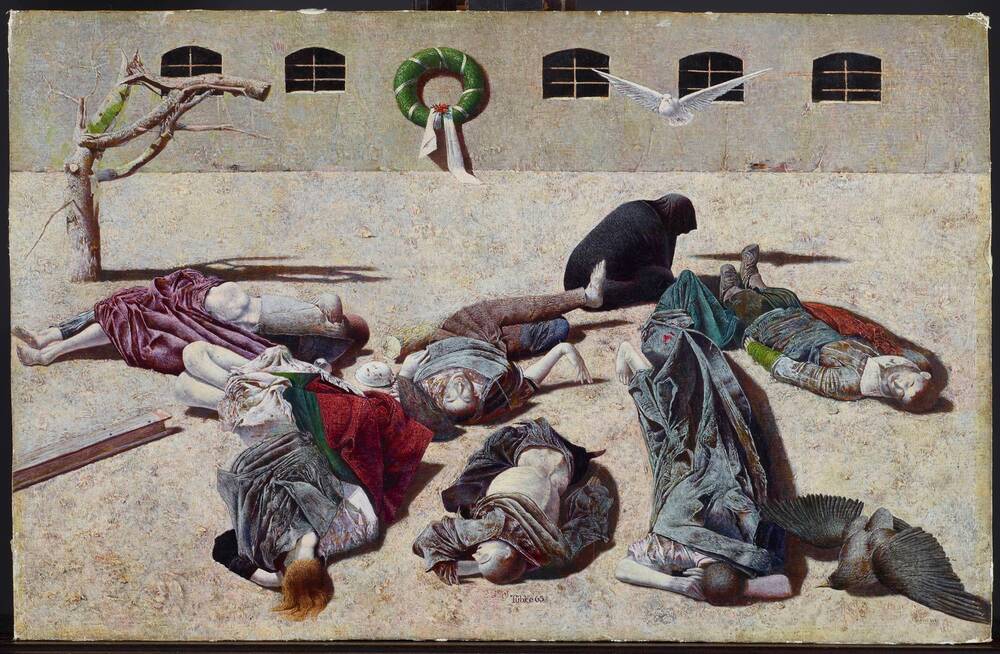
In Werner Tübke’s painting Requiem, his palette is predominately cold grey and blue tones. On the bare ground in front of a wall with barred windows, several dead bodies lie stiffly, almost as if turned to stone. Its back towards us, a dark figure kneels at the rear of the group. The figure’s head is bowed in sorrow, and a dove of peace floats above it.
Leipzig artist Werner Tübke painted this work in 1965, the first picture of his series on the violence of the Nazi regime and the murder of the Jews. At first glance, the dead are not recognisable as Nazi victims. The angular drapery folds are far more likely to call to mind figures in medieval paintings. In fact, though, Tübke based this work on photos of people murdered in the Bergen-Belsen and Auschwitz concentration camps. The position of the bodies of these painted figures corresponds to the corpses on the photographs.
This painting dates from a time when there was a movement, both in East and West Germany, to address the atrocities of the Nazi years. Shortly before, the GDR had held trials in absentia of two West German CDU politicians Theodor Oberländer and Hans Globke, both accused of actively participating in Nazi atrocities. In West Germany, the Frankfurt Auschwitz trials from 1963 on marked the start of a process of confronting the Holocaust, with a series of defendants charged with crimes in the Auschwitz concentration camp. For his work on this painting, Tübke obtained material on the Frankfurt trials from an East Berlin lawyer. The materials included the book Der Gelbe Stern – “The Yellow Star” – with the photos Tübke took as his model.
Here, as in many other paintings by Werner Tübke, he employed his own idiosyncratic style informed by the canon of art from the sixteenth to the eighteenth century. Since his use of symbolic and mysterious elements contradicted East Germany’s cultural policy of a clear, realistic pictorial language, Tübke was heavily criticised in the GDR.
Lipský malíř Werner Tübke tento obraz nazval Rekviem čili Zádušní mše. Převládají na něm studené barvy šedá a modrá. Před zdí se zamřížovanými okny leží na holé zemi několik mrtvých, kteří působí, jako by zkameněli. Vzadu za nimi, otočená zády k nim, klečí tmavá postava s truchlivě skloněnou hlavou. Nad ní se vznáší holubice míru.
Tübke vytvořil obraz roku 1965 jako první z cyklu děl věnovaných nacistickému násilí a vyvražďování Židů. Na první pohled nevidíme, že se jedná o oběti nacistů. Nařasení a záhyby oděvů připomínají spíše postavy na středověkých obrazech. Tübke však používal jako předlohu fotografie zavražděných lidí z koncentračních táborů Bergen-Belsen a Osvětim. Poloha zobrazených těl na obraze odpovídá poloze mrtvých na fotografiích.
Obraz vznikl v době, kdy se společnost ve východním i západním Německu intenzivně zabývala zločiny nacistické éry. V NDR tenkrát proběhly dva procesy se západoněmeckými politiky z CDU: Theodorem Oberländerem a Hansem Globkem. Byli v nepřítomnosti obviněni z aktivní účasti na nacistických hrůzných činech. Ve Frankfurtu nad Mohanem od roku 1963 probíhaly osvětimské procesy, jejichž cílem bylo zpracovat hrůzy spáchané v rámci holokaustu a zejména nacistické zločiny v koncentračním táboře Osvětim. Tübke si tehdy prostřednictvím východoberlínského advokáta obstaral procesní dokumenty, včetně knihy Der Gelbe Stern – česky Žlutá hvězda – s fotografiemi, které mu sloužily jako předloha.
Stejně jako v mnoha jiných dílech i zde Tübke maloval velmi svérázným stylem, který odkazuje na staré mistry 16. až 18. století. Záhadnost a alegoričnost na obraze byla v rozporu s požadavkem kulturní politiky NDR na jednoznačný, realistický výtvarný jazyk a setkala se s ostrou kritikou.
- Ort & Datierung
- 1965
- Material & Technik
- Öl auf Leinwand auf Sperrholz
- Dimenions
- 28 x 44 cm
- Museum
- Galerie Neue Meister
- Inventarnummer
- Gal.-Nr. 3636