
Erste Assoziation: Sieht aus, als wäre jemand von hinten durch den Kreis gesprungen – wie ein Akrobat im Zirkus. Der Titel weist in diese Richtung: Die „Ruine“ als Bauwerk, das nicht verfallen, sondern von äußeren Kräften zerstört ist.
Beim längeren Betrachten fallen mehr Details auf: dem großen, aufrecht stehenden Kreis fehlt ein Segment, als würde er mit dem unteren Teil fest im Sockel stecken. Das „aufgerissene“ Innere faltet sich zu einem nahezu quadratischen Relief aus unterschiedlichen, sehr genau gearbeiteten Drei- und Vierecken auf. Die exakt gleiche Struktur hat Thomas Scheibitz ein paar Jahre vorher schon einmal realisiert: als Wandrelief unter dem Titel „Carlo Crivelli“. Crivelli war ein Maler des 15. Jahrhunderts. In seinen Gemälden schuf er oft Durchblicke in die Welt hinter dem Vordergründigen – das verbindet viele Skulpturen von Scheibitz mit dem Werk des Italieners.
Die Kunst des 15. Jahrhunderts ist aber nur eine seiner vielen Interessen. Seine Sammlung von Artikeln und Fotografien ist riesig und bietet eine Fülle an Anregungen für Formen, Motive, Details, Titel. Eines Tages stieß Scheibitz auf einen dreidimensionalen Papierstern, den „Fröbelstern“, benannt nach seinem Erfinder Friedrich Fröbel. Der Bezug zu unserer Skulptur ist unverkennbar: aus einer zweidimensionalen Vorlage wird durch absolut exaktes Falten ein räumliches Objekt. Die Kunst des Origami oder die zeitgenössische Architektur könnten dem Bildhauer als Anregung gedient haben.
Je länger wir die Skulptur betrachten, umso mehr entdecken wir: wie Scheibitz mit den Grundformen Kreis, Dreieck und Viereck spielt, mit dem Thema Zerstörung und Erneuerung, mit den Materialien Holz, MDF, Stahl und Aluminium. Thomas Scheibitz wäre es am liebsten, wenn der Betrachter im ersten Moment den Eindruck hat, so etwas habe er noch nie gesehen und sich in der gleichen Sekunde an etwas erinnert fühlt.
Weitere Medien
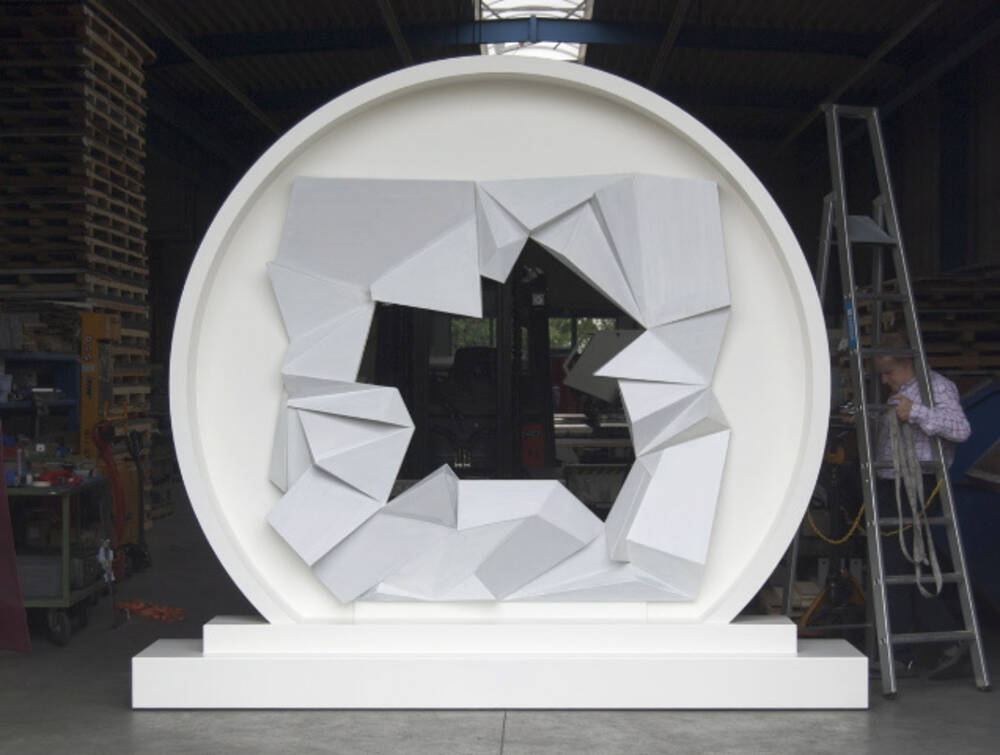
At first glance, it looks as if something had jumped through this ring from the back – just as an acrobat in a circus might. And the title Ruins points in that direction – an edifice not dilapidated so much as destroyed by outer forces.
At second glance, though, we notice more details – the large upright circle is missing a segment, as if the lower section is fixed into a pedestal. The folds of the “torn” interior create a nearly square relief, composed of different meticulously shaped triangles and rectangles. A few years before, Thomas Scheibitz had made a work with exactly the same structure – a mural relief entitled Carlo Crivelli. Crivelli was a fifteenth-century artist. In his highly decorative paintings, he often created views of elaborate settings behind the foreground figures – a style many of Scheibitz’s sculptures share with this Italian artist.
Yet fifteenth-century art is just one of Scheibitz’s many interests. He also has an extensive collection of articles and photographs, providing a wealth of ideas for forms, motifs, details and titles. One day, Scheibitz came across a three-dimensional paper star – a Christmas decoration called the “Fröbel star” in Germany after its inventor, Friedrich Fröbel. The connection to our sculpture is unmistakable – here too, precise folds create a spatial object from a two-dimensional model. Scheibitz might also have been inspired by the art of origami or contemporary architecture.
The longer we look at the sculpture, the more we discover – for instance, how the sculptor plays with the elementary forms of the circle, triangle and rectangle, with the theme of destruction and renewal, and with the materials of wood, MDF, steel and aluminium. Thomas Scheibitz would be happiest with his work if, at the very first glance, viewers feel they’ve never seen anything like it before and yet, at that same moment, think it reminds them of something.
První asociace: Vypadá to, že tu někdo zezadu proskočil kruhem – jako akrobat v cirkuse. Také název díla odkazuje tímto směrem: Ruina či Zřícenina, tedy stavba, která se nerozpadla během času, ale byla zničena vnějšími silami.
Když se na obraz podíváme přesněji, můžeme si všimnout dalších detailů: Velkému kruhu část chybí. Jako by jeho spodní část byla pevně zasazená v podstavci. Protržená vnitřní část tvoří téměř čtvercový reliéf z různých, velmi precizně vypracovaných trojúhelníků a čtverců. Naprosto stejnou strukturu vytvořil Thomas Scheibitz již několik let dříve: jako nástěnný reliéf s názvem Carlo Crivelli. Crivelli byl malířem 15. století. Na svých obrazech často zachycoval pohledy vedoucí divákův pohled do pozadí – a právě to spojuje mnoho Scheibitzových soch s dílem italského malíře.
Umění 15. století je však jen jedním z mnoha zájmů Thomas Scheibitze. Jeho sbírka článků a fotografií je obrovská a nabízí bohatou inspiraci pro formy, motivy, detaily, názvy. Scheibitz narazil jednoho dne na trojrozměrnou papírovou hvězdu Fröbelstern, pojmenovanou po Friedrichu Fröbelovi. Souvislost mezi naší sochou a Fröbelovým výtvarným dílem je jednoznačná: Z dvourozměrné předlohy vzniká pečlivým skládáním prostorový, třídimenzionální objekt. A navíc Scheibitze mohlo inspirovat také umění origami nebo současná architektura.
Čím déle se na sochu díváme, tím více toho objevujeme: Jak si autor pohrává jednak se základními tvary – kruhem, trojúhelníkem a čtvercem –, ale také s tématy destrukce a obnovy, a s různými materiály – dřevem, dřevovláknitými deskami, ocelí a hliníkem. Záměrem Thomase Scheibitze je, aby měl divák v prvním okamžiku dojem, že něco takového ještě neviděl a zároveň mu dílo ale něco připomínalo.
- Ort & Datierung
- 2010
- Material & Technik
- Holz, MDF, Lack, Stahl, Aluminium, montiert.
- Dimenions
- H: 296 cm x B: 330 cm x T: 65 cm
- Museum
- Skulpturensammlung
- Inventarnummer
- LN 051