
Ein riesiger Körper liegt lang ausgestreckt auf dem Boden. Stark abstrahiert, in ein kreidiges Weiß gehüllt und offensichtlich zu groß für den kleinen, kahlen Raum. Keine Details, keine Spur von Kleidung erkennbar. Ein weiblicher Clown? Die Gesichtszüge sind unter der Schminke nur zu erahnen. Der Vogel, die verschlossene Kiste, das Dunkel nebenan – all das deutet auf eine surreale Szene hin, die allein der Fantasie entsprungen ist.
Aber: die Frau gab es wirklich. Wir wissen, wer sie war und dass sie sich das Leben genommen hat. Christine Schlegel, die Malerin, hat sie bewundert für ihre Energie, ihre Ausstrahlung. Das traurige Schicksal der jungen Frau berührte die Dresdener Künstlerin so stark, dass sie 1982 dieses Bild malte.
Monique, so nannte sich die junge Frau, stammte aus Halle. Sie hatte Schauspiel studiert, fotografiert, gemalt, Kindertheater gemacht und war als weiblicher Clown aufgetreten. Das war etwas Besonderes in der DDR. Die Probleme mit dem Staat begannen, als ihr Vater nach Kanada auswanderte. Seine Tochter stellte einen Ausreiseantrag nach dem anderen, auch sie wollte weg aus der DDR, wollte zum Vater. Was dann passierte, schildert Christine Schlegel so:
„Das haben sie ihr dann immer verboten, haben sie überwacht, weiß man alles nicht, wie was schlimm geworden ist. Aber sie hat sich eben umgebracht. Das war für mich, weil ich sie kurze Zeit vorher hier in Dresden als Clownesse bei so einer Eröffnung erlebt hatte, war das so‘n dramatisches Erlebnis, dass diese fröhliche, zwar auch clownartig traurige Figur, aber dass sie sich umgebracht hat, das war so dieses DDR-Dilemma ja, wie Uwe Greßmann, oder so Künstler, die so besonders waren, dass die sich immer umgebracht haben wegen der Unmöglichkeit eines Lebens.“
Als das Bild entstand, fühlte sich Christine Schlegel noch stark zum Surrealismus hingezogen. In der DDR war diese Stilrichtung verpönt, aber in Ungarn konnte die Malerin Kataloge aus dem Westen kaufen. Heute sieht sie das Gemälde mit etwas anderen Augen:
„Und sehr statisch noch und sehr komponiert und gebaut, wo ich heute Probleme habe, weil ich es sehr aufgelöst mag. Aber andere finden das gerade gut“.
Weitere Medien
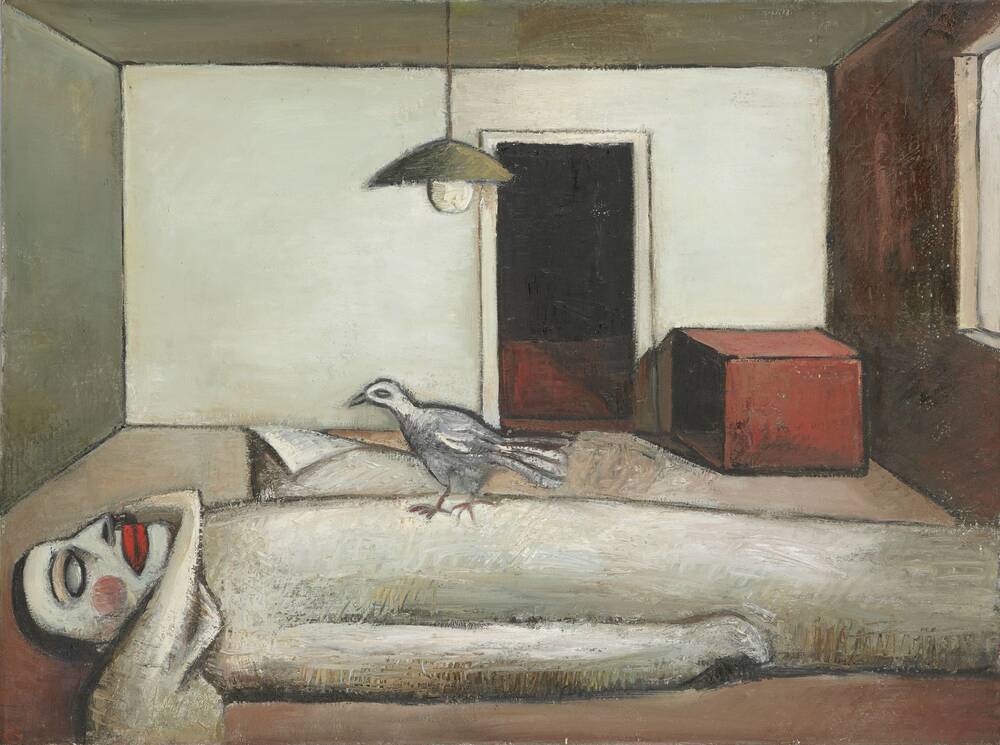
A massive body is lying stretched out on the floor – not so much representational as highly abstract, the body is chalky white and evidently far too large for the small, bare room. There are no details, and no signs of any clothes. A clowness – a woman clown? Under the make-up, the features are hard to distinguish. The bird, the closed box, the dark doorway – all things which suggest a surreal scene, solely a product of the imagination.
But the woman really did exist. We even know who she was – and that she committed suicide. Dresden artist Christine Schlegel admired her for her energy and charisma, and she painted this work in 1982 because she was so moved by the young woman’s sad fate.
The woman, who called herself Monique, came from Halle. She studied drama, painted and photographed, worked in children's theatre and performed as a clown – and a female clown was something special in the GDR. Her problems with the state apparatus began when her father emigrated to Canada. She applied for an exit visa, time and again, since she also wanted to leave East Germany and join her father. Christine Schlegel describes what happened then:
“The GDR authorities constantly refused her permission to leave, and kept her under surveillance – there’s just no way of knowing just how much she was made to suffer. In the end, though, she committed suicide. I’d seen her performing as a clown at some opening or another a little while before in Dresden. So it was really dramatic when she committed suicide, such a naturally cheerful person, though she could be sad as a clown. That was precisely the GDR dilemma, that artists like the poet Uwe Gressmann, artists who were something special, always killed themselves because of the impossibility of life.”
When she painted this work, Christine Schlegel still felt strongly drawn to Surrealism. The GDR disapproved of this style of art, but in Hungary Schlegel managed to buy some western catalogues with pictures of Surrealist works. Today, she takes a somewhat different view of her painting:
“Today I see it more critically as I prefer a more fragmentary, looser style, so I find it still very static, very composed and structured. But others like it precisely for that reason.”
Na podlaze leží natažené obrovské tělo. Silně zjednodušené, křídově bílé a očividně příliš velké pro malou a prázdnou místnost – bez detailů a bez oblečení. Je to ženský klaun? Rysy obličeje nelze téměř pod líčidly rozpoznat. Pták, zavřená truhla, tma ve vedlejším pokoji – to vše budí dojem surrealistické scény, která je dílem pouhé fantazie.
Avšak je tu jeden háček: Tato žena skutečně žila a my víme, kdo byla a že si vzala život. Malířka Christine Schlegelová ji obdivovala pro její energii a charisma. Smutný osud mladé ženy zasáhl drážďanskou umělkyni natolik, že namalovala roku 1982 tento obraz.
Monique, jak si mladá žena říkala, pocházela z Halle. Studovala herectví, fotografovala, malovala, hrála divadlo pro děti a vystupovala jako klaunka. To bylo v bývalém východním Německu něco výjimečného. Když její otec emigroval do Kanady, začala mít Monique problémy se státní mocí. Podávala jednu žádost o vycestování za druhou, chtěla opustit NDR, chtěla odejít za otcem. Co se tehdy stalo, popisuje Christine Schlegelová takto:
„Všechny její žádosti byly odmítnuty, sledovala ji státní bezpečnost. Nevíme, jak strašné to pro ni bylo, ale víme, že pak spáchala sebevraždu. Pro mě to byl velmi dramatický zážitek, protože jsem ji krátce předtím viděla tady v Drážďanech jako klaunku na vernisáži. A že si tahle veselá, a sice taky klaunsky smutná postava vzala život, to bylo jedním z dilemat v NDR. Výjimeční umělci jako například také Uwe Greßmann si vzali život, protože zde pro sebe neviděli možnost žít.“
Když obraz vznikal, byla Christine Schlegelová ještě silně ovlivněna surrealismem. V bývalé NDR byl tento umělecký směr zakázán, ale v Maďarsku si malířka mohla koupit katalogy ze Západu. Dnes se na obraz dívá trochu jinýma očima:
„Obraz je ještě velmi statický a velmi komponovaný. S tím mám dnes problémy, protože mám raději více volnosti. Ale ostatním se to líbí.“
- Ort & Datierung
- 1982
- Material & Technik
- Öl auf Leinwand
- Dimenions
- 75,5 x 100,8 cm
- Museum
- Galerie Neue Meister
- Inventarnummer
- Inv.-Nr. 2018/07