
Diese Frau hat alles im Griff: die Lanze in ihrer Rechten, ihren athletischen Körper, das Pferd, dem sie den Kopf zur Seite führt, um ihre tödliche Waffe zu schleudern.
Mit den Amazonen, einem kriegerischen Volk von Frauen aus der griechischen Mythologie, setzte sich Franz von Stuck malerisch wie auch bildhauerisch auseinander. Diese hier gestaltete er in der klaren Formensprache der Antike. Dennoch hat das Motiv für ihn auch einen zeitgenössischen Bezug:
„Ganz typisch für dieses Werk ist natürlich, dass sich nicht nur Franz von Stuck sondern auch vieler seiner Malerkollegen, Bildhauerkollegen, sich dem Kampf der Geschlechter zu der Zeit widmete, wie gerade Max Klinger auch, der dem Klingersaal seinen Namen gegeben hat und hier auch vertreten ist, und diese kleinformatige Amazone von Franz von Stuck gibt das ganz symptomatisch wieder. […] Und gibt eben auch ein Bild von Weiblichkeit in der Zeit um 1900.“
Es ist das Bild der „Femme Fatale“, das damals die Künstler umtreibt. Die unberechenbare Frau, die dem Mann durch innere Stärke, erotische Verführung und kalte Entschlossenheit zum Verhängnis werden kann.
„Das Interessante an diesem Guss von 1897, der tatsächlich zu der Zeit auch in die Sammlung gelangte, ist, dass es signiert ist, allerdings noch mit Franz Stuck, weil er zu der Zeit noch keinen Adelstitel trug.“
Diesen erhielt er später durch Prinzregent Luitpold von Bayern für seine künstlerischen Verdienste. Von Stuck residierte auch fürstlich – in einer palastähnlichen, von ihm entworfenen Villa in München. Dort steht die reitende Amazone in einer monumentalen Ausführung vor dem Eingangsportal.
Weitere Medien
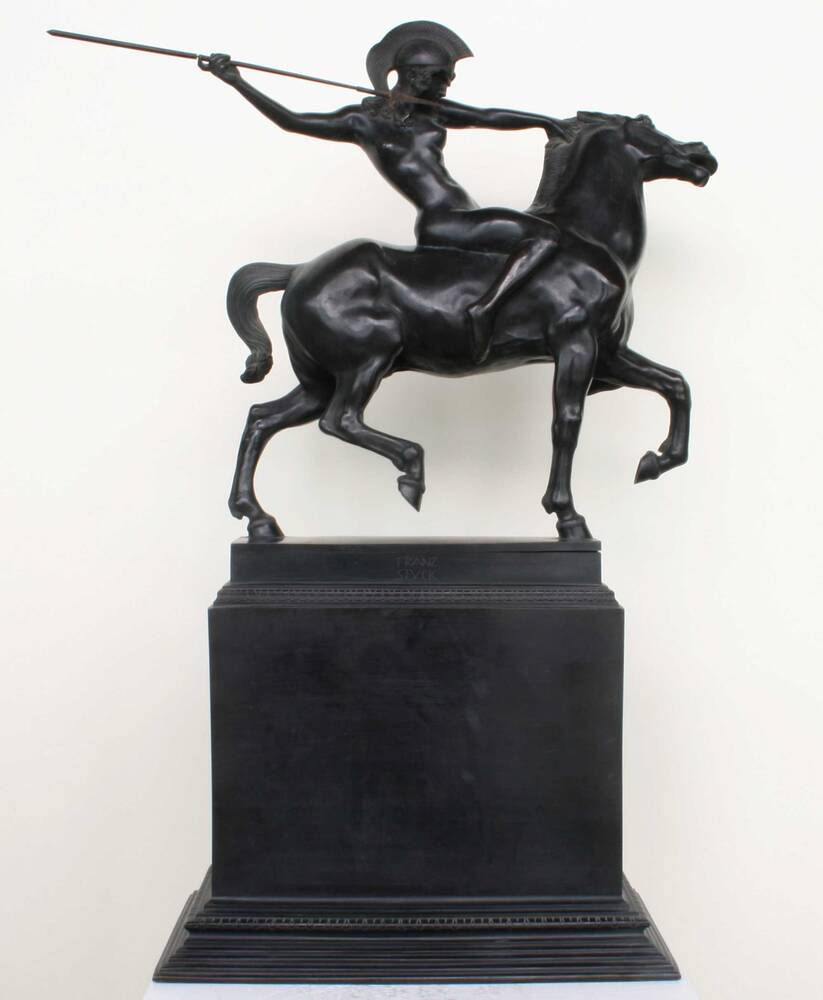
This Amazon warrior is in full control as she attacks – her athletic body tensed, and her horse’s head pulled to one side as she draws back her right arm to throw her deadly spear.
In both his paintings and sculptures, Franz von Stuck explored the subject of the Amazons, a warlike tribe of women in Greek mythology. Although he composed this work in the clear formal vocabulary of antiquity, his saw his subject as having a contemporary reference as well.
“The battle of the sexes was quite commonly taken as subject at that time, not just by Franz von Stuck, but by many of his fellow painters and sculptors as well – just like Max Klinger, who gave his name to the Klinger Hall. Some of his works are also on show here. So in terms of its subject, this small-format Amazon by Franz von Stuck is quite characteristic of its day ... […] and it also gives us a picture of how women were seen in around 1900.”
The artists of that period were fascinated by the image of the “femme fatale”, the unpredictable woman who, through inner strength, erotic attraction and cold determination, could spell ruin for any man.
“Interestingly, this bronze cast from 1897 was actually acquired by the collection at that time. It is signed just Franz Stuck, since at that point he was not yet ennobled as Franz von Stuck.”
Later, Luitpold, Prince Regent of Bavaria, raised the artist to the nobility for his services to the arts. Von Stuck also had a very noble home in Munich. He himself designed his “Villa Stuck”, a palatial town residence – with a monumental cast of his Mounted Amazon set in front of the main entrance.
Tato žena má vše pod kontrolou: kopí v pravé ruce, atletické tělo, koně, jehož hlavu lehce táhne na stranu, aby mohla mrštit svou smrtící zbraní.
Amazonkami, národem bojovných žen z řecké mytologie, se Franz von Stuck zabýval jak v malířství, tak i sochařství. Zdejší sochu vytvořil v klasickém stylu podle antického vzoru. Přesto se pro něj tento motiv vztahoval také na současnost:
„Pro toto dílo je ovšem zcela typické, že se v té době souboji obou pohlaví vedle Franze von Stucka věnovala také řada jeho kolegů – malířů a sochařů, jako například Max Klinger, podle nějž je také pojmenován zdejší sál a jehož dílo je zde také zastoupeno. Tato maloformátová plastika Amazonky od Franze von Stucka tuto tendenci jasně odráží. [...] A navíc je příkladem, jak byl obraz ženství chápán v období kolem roku 1900.“
Předmětem zájmu umělců byl tenkrát právě obraz „femme fatale“ – nezkrotitelné ženy, která se může stát mužovou zkázou díky své vnitřní síle, erotické vášni a chladnému odhodlání.
„Zajímavé na tomto odlitku z roku 1897, který tehdy obohatil zdejší sbírku, je jeho signatura: Stojí zde ještě pouze Franz Stuck, v té době totiž Stuck ještě neměl šlechtický titul.“
Ten mu až později udělil princ regent Luitpold Bavorský za umělecké zásluhy. Von Stuck v Mnichově bydlel také jako šlechtic – v palácové vile, kterou sám navrhnul. Tam stojí socha Amazonky na koni před vstupním portálem v monumentálním provedení.
- Ort & Datierung
- 1897
- Material & Technik
- Bronzeguss
- Dimenions
- H: 64,5 cm, B: 47,5 cm, T: 20,5 cm
- Museum
- Skulpturensammlung
- Inventarnummer
- ZV 1753