
Was flüstert er ihr wohl ins Ohr, der bärtige Waldgeist, der sich an die Schulter der jungen Nixe schmiegt? Elegant hat sie ihre beiden Fischschwänze übereinander geschlungen und neigt lauschend den Kopf zu ihm. Ihr Gesicht aber zeigt keine Regung, die uns etwas verraten würde. Es bleibt ein „Waldgeheimnis“.
Der Künstler Robert Diez gehörte um die Jahrhundertwende zu den renommiertesten und produktivsten Bildhauern Dresdens. Mit den Brunnen am Albertplatz oder dem Gänsediebbrunnen in der Altstadt, prägte er das Erscheinungsbild der Stadt bis heute. Als Professor für Bildhauerei unterrichtete er an der Dresdner Akademie unter anderem Ernst Barlach, der von ihm sagte, es gäbe keinen besseren Lehrer.
Diese beiden Figuren hat Robert Diez aus Lindenholz geschnitzt. Angeregt von der zeitgenössischen Diskussion, Skulpturen, wie in der Antike und im Mittelalter, farbig zu fassen, bemalte er sie. Die Farblasur trug er auf eine Grundierung von Gold und Silber auf. Dadurch erhielt die Haut des schönen Fabelwesens einen grünlich schimmernden, blassen Ton, so wie es in den Märchen und Sagen beschrieben wird. Es scheint, als sei die Nixe soeben dem Wasser entstiegen. Ihren lebendigen Blick erzeugte er durch den Einsatz von Bergkristallen.
Mit seinem phantasievollen, lyrischen Ansatz entfernte sich Robert Diez vom Klassizismus seiner Vorgänger. Seine naturverbundenen und mythischen Motive schuf er in einer Zeit, in der sich technischer Fortschritt und Industrialisierung rasant bemerkbar machten. Und so liegt in seinem Werk auch ein stiller Protest gegen die Entzauberung der Welt.
Weitere Medien
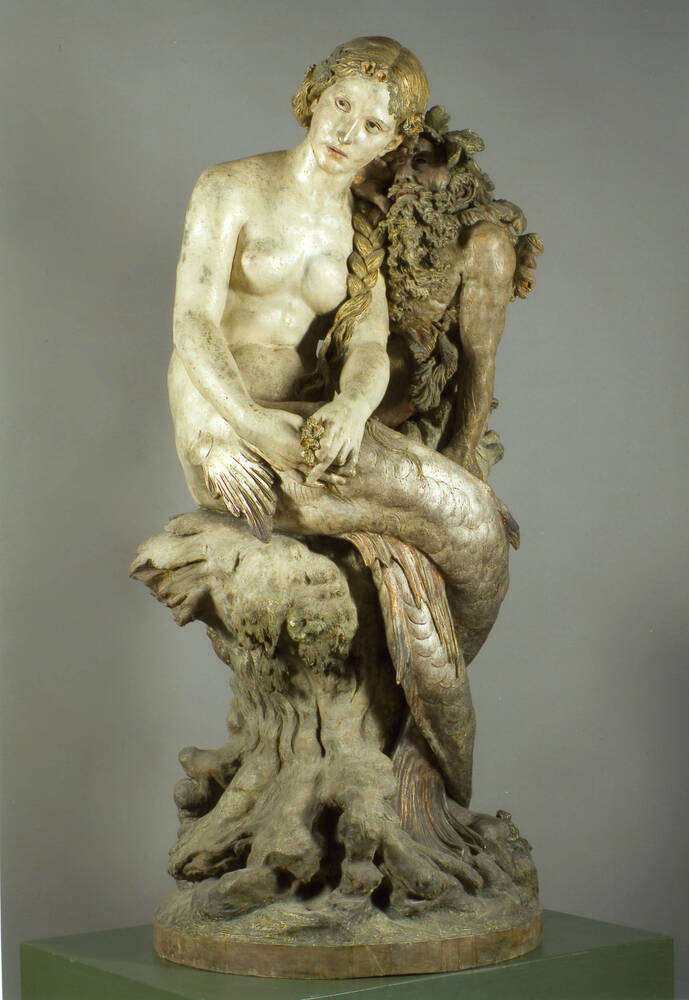
What is this bearded forest spirit whispering to the young water nymph as he nestles up to her shoulder? She leans her head slightly towards him, listening, the two parts of her fish’s tail elegantly crossed. But her face is expressionless, with no indication of her reaction – so whatever he is saying remains a “forest secret” forever.
Around the late 1800s and early 1900s, the artist Robert Diez was one Dresden’s most productive and renowned sculptors. His Albertplatz fountains or his “Goose-Thief fountain” in the old city are still landmarks in the cityscape, even today. As a professor of sculpture at the Dresden Academy of Fine Arts, his students included the sculptor Ernst Barlach, who said there was no better teacher.
Diez carved these two figures from limewood. Inspired by the contemporary discussion over the polychrome sculptures in antiquity and the Middle Ages, he decided to paint this work. In fairy tales and legends, a water nymph’s skin is described as a shimmering pale green. To achieve that effect on his beautiful water creature, Diez applied colour glazes over a gold and silver ground, and then added mountain crystal to give her eyes a lively gaze. The nymph looks as if she has just climbed out of the water.
By taking such an imaginative lyrical approach, Diez distanced himself from the neo-classicism of his predecessors. He created mythical motifs deeply rooted in nature just as technological progress and industrialisation were rapidly making themselves felt – and in this sense, his work is also a silent protest against the demystification of the world.
Co jí asi do ucha šeptá ten vousatý lesní duch, který se choulí k mladé mořské panně? Ta elegantně propletla oba rybí ocasy, sklání k němu hlavu a pozorně mu naslouchá. V jejím výrazu se však neobjevují žádné emoce, které by nám něco o obsahu prozradily. Ten zůstává „lesním tajemstvím“.
Umělec Robert Diez patřil k nejznámějším a nejproduktivnějším drážďanským sochařům na přelomu století. Jeho kašna na Albertově náměstí nebo kašna Gänsediebbrunnen – česky Zloděj hus – utváří dodnes podobu města. Jako profesor sochařství na drážďanské akademii vyučoval mimo jiné Ernsta Barlacha, který o něm prohlásil, že není lepšího učitele.
Robert Diez vyřezal obě postavy z lipového dřeva a namaloval je – inspirován dobovou diskusí o kolorování soch v antice a středověku. Barevnou lazuru nanesl na základní zlatý a stříbrný nátěr. Díky tomu získala pleť krásné pohádkové bytosti nazelenalý třpytivě bledý odstín, přesně jak je popisován v pohádkách a bájích. Vypadá to, jako by se mořská panna právě vynořila z vody. Její živý pohled vytvořil pomocí křišťálu.
Svým obrazným, lyrickým přístupem se Robert Diez vzdálil od klasicismu svých předchůdců. Své přírodymilovné a mýtické motivy zobrazoval v době, kdy se rychle prosazovaly technický pokrok a industrializace. A tak jeho dílo představuje také tichý protest proti ztrátě kouzla a fantazie na světě.
- Ort & Datierung
- Vor 1894
- Material & Technik
- Lindenholz, gefasst
- Dimenions
- H: 146,0 cm, B: 70,0 cm, T: 65,0 cm
- Museum
- Skulpturensammlung
- Inventarnummer
- ZV 1389