
Streng, fast karg und von nüchternem Ernst – so werden die beiden Figuren von Hermann Blumenthal gerne beschrieben. Der „Schreitende mit Tuch“ entstand 1934 bei Potsdam, wo der junge Bildhauer nach einem Stipendium in Rom lebte. Den „Sitzenden mit Tuch“ schuf er drei Jahre später, wieder zurück in Rom. Die antike Kunst in der „Ewigen Stadt“ beeinflusste seine Auseinandersetzung mit dem menschlichen Körper, den er immer wieder in den Grundhaltungen Gehen, Stehen oder Sitzen darstellte.
Der „Schreitende“ blickt nach vorne, aber in seiner Bewegung liegt nur wenig Dynamik, als verharre er mitten im Schritt. Die Hand auf der Schulter verstärkt den Eindruck des Statischen. Die Figur wirkt in sich gekehrt, scheint das Tuch enger um ihre Schulter zu ziehen. Bezog sich Blumenthal damit auf seine schwierige wirtschaftliche Situation? Der Titelzusatz, der auf das biblische Gleichnis vom „Verlorenen Sohn“ anspielt, könnte ein Hinweis sein. Unter den Nationalsozialisten wurde Hermann Blumenthal zwar nicht verfolgt, wegen seines Namens aber als Jude beschimpft – eine seiner Skulpturen wurde zudem als „entartet“ beschlagnahmt. Ungeachtet dessen erhielt er Preise und Stipendien.
1937, auf dem Höhepunkt seines Schaffens, modellierte er den „Sitzenden“: Ein Hirte aus der Campagna nahe Rom – für Kunstschaffende der Inbegriff ländlicher Idylle. Der Jüngling wirkt gelassen und nachdenklich. Doch was wir sehen, ist nicht das Porträt einer realen Person. Blumenthal nahm auf, was er im täglichen Leben wahrnahm – Situationen, Haltungen, Empfindungen von Menschen, für die er dann in seinen Werken nach einer allgemeingültigen Aussage suchte.
Weitere Medien
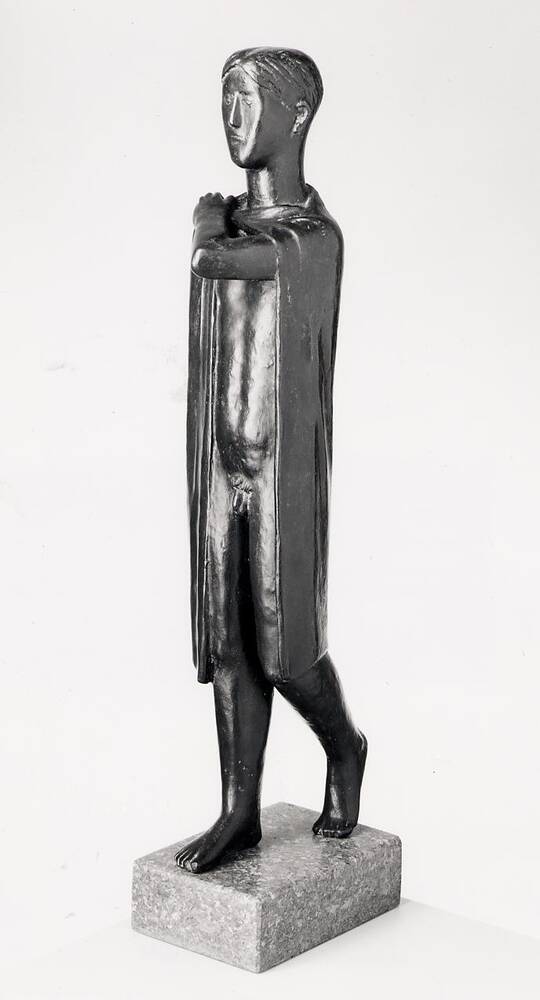
These two figures by Hermann Blumenthal are often described as solemn, serious and austere, almost bleak. The Striding Man with Cloth dates from 1934. At that time, Blumenthal was a young sculptor. After a scholarship to Rome, he was then living near Potsdam. His Seated Figure with Cloth dates from three years later, when Blumenthal had moved back to Rome. Influenced by the classical art in the ‘Eternal City’, his works constantly explored the human form in such fundamental postures as walking, standing or sitting.
Although his Striding Figure looks intently ahead, he seems listless, practically frozen in mid-stride. His hand on his shoulder further intensifies this impression of stasis. Apparently lost in thought, he pulls his blanket closer around his shoulder. Did this reflect Blumenthal’s sense of his own difficult financial situation? He added a biblical reference to the descriptive title – and perhaps the parable of the prodigal son offers a further clue. Although not directly persecuted under the Nazi regime, Hermann Blumenthal was reviled as a Jew due to his name – and his works were also confiscated as ‘degenerate art’. Despite that, he continued to receive prizes and bursaries.
In 1937, at the highpoint of his creative work, he modelled his Sitting Figure with Cloth. The figure is a shepherd from the Roman Campagna, the countryside around Rome – a region artists saw as epitomising pastoral beauty. The young man seems contemplative and composed. But this work is not a portrait of a real person. Blumenthal recorded his experiences and perceptions of daily life – people’s situations, attitudes and sentiments – and sought ways to express this universally in his work.
Strohé, střízlivé a téměř přísné – tak jsou často popisovány obě sochy Hermanna Blumenthala. „Kráčející muž se šátkem“ vznikl roku 1934 nedaleko Postupimi, kde mladý sochař žil po stipendijním pobytu v Římě. „Sedícího muže se šátkem“ vytvořil o tři roky později, po svém návratu do Říma. Antické umění v tomto tzv. „Věčném městě“ mělo velký vliv na jeho znázornění lidského těla, které opakovaně zobrazoval při chůzi, ve stoje nebo v sedě.
„Kráčející muž“ se dívá dopředu, ale jeho pohyb je málo dynamický, jako by se zastavil uprostřed kroku. Pravá ruka na rameni dojem statičnosti ještě zesiluje a jeho postoj budí dojem, že je ponořen do vlastních myšlenek. Pravou rukou si přitahuje plášť pevněji kolem ramen. Odkazuje zde Blumenthal na svou tíživou ekonomickou situaci? Poukazem je možná dodatek k názvu díla, který odkazuje na biblické podobenství o „marnotratném synovi“. Hermann Blumenthal sice nebyl za nadvlády nacistů pronásledován, ale byl díky svému jménu označován za Žida. A navíc byla jedna z jeho soch také označena jako „degenerované umění“ a zabavena. Přesto mu ale byly také za nacistů uděleny různé ceny a stipendia.
V roce 1937, na vrcholu svých tvůrčích sil, vymodeloval „Sedícího muže“: pastýře z Kampánie u Říma – pro umělce ztělesnění venkovské idyly. Mladý muž na nás působí klidně a zamyšleně, avšak nejedná se o reálný portrét skutečné osoby. Blumenthal se snažil pochytit vše, co jej obklopovalo v každodenním životě – situace, postoje a pocity lidí. A pro ty pak ve svých dílech hledal univerzálně platnou výpověď.
- Ort & Datierung
- 1934 (vor Juli) in Nowawes [lt. Werkdokumentation] Guss um 1960 (Mitt. Galerie)
- Material & Technik
- Bronze
- Dimenions
- H: 62,0 cm, B: 12,5 cm, T: 19,0 cm
- Museum
- Skulpturensammlung
- Inventarnummer
- ZV 4194