
Die Künstlerin Katharina Grosse kombiniert hier natürliche und abstrakte Formen und lässt sie in verschiedenen Farbtönen schillern: von Grün, Rot und Rosé bis Blau, Orange und Türkis. Die Farben hat sie mit Druckluft aufgesprüht: Einen Moment lang schweben die Pigmente durch die Luft, bevor sie sich auf dem Objekt niederschlagen. So entstehen feine Farbverläufe, oft ganz unvorhergesehen, was der intuitiven Arbeitsweise der Künstlerin entspricht.
Traditionell wurden Plastiken bemalt, um sie natürlicher wirken zu lassen. Katharina Grosse macht es genau anders herum: Durch die Bemalung gibt sie dem natürlichen Material des Baumes etwas Künstliches. Die Struktur des Holzes verschwindet, dafür treten die plastischen Formen deutlicher in den Vordergrund. Das Wurzelwerk wird zum Kunstwerk. Durch die Farbgebung entsteht zudem eine Verbindung mit der abstrakten Form des unteren Teils.
Konservator Holger Birkholz:
„Es handelt sich hier bei dem unteren Teil der Plastik, auf dem die Baumwurzel ruht, um ursprünglich ein Objekt, das aus Styropor geschnitten ist und dann im Metallguss in Aluminium gegossen wurde.“
Dadurch hat das Objekt sowohl Elemente einer Plastik wie auch einer Skulptur.
„Skulptur benenne ich ein Objekt, wenn ich etwas wegnehme, also man spricht von einer Marmorskulptur, von einer Holzskulptur, wenn Substanz weggenommen wird und von einer Plastik spricht man, wenn etwas aufgebaut wird, also eine Plastik ist eine keramische Plastik, oder wenn eben etwas gegossen wird, wie ein Bronzeplastik. Insofern kommen hier beide Verfahren zusammen. Also wir haben einerseits das Objekt, das ursprünglich geschnitten wurde aus Styropor, und dann in einem zweiten Verfahren tatsächlich gegossen wird, um auch tatsächlich die Tragfähigkeit zu gewährleisten für diese Baumwurzel, die darauf kommt.“
Weitere Medien
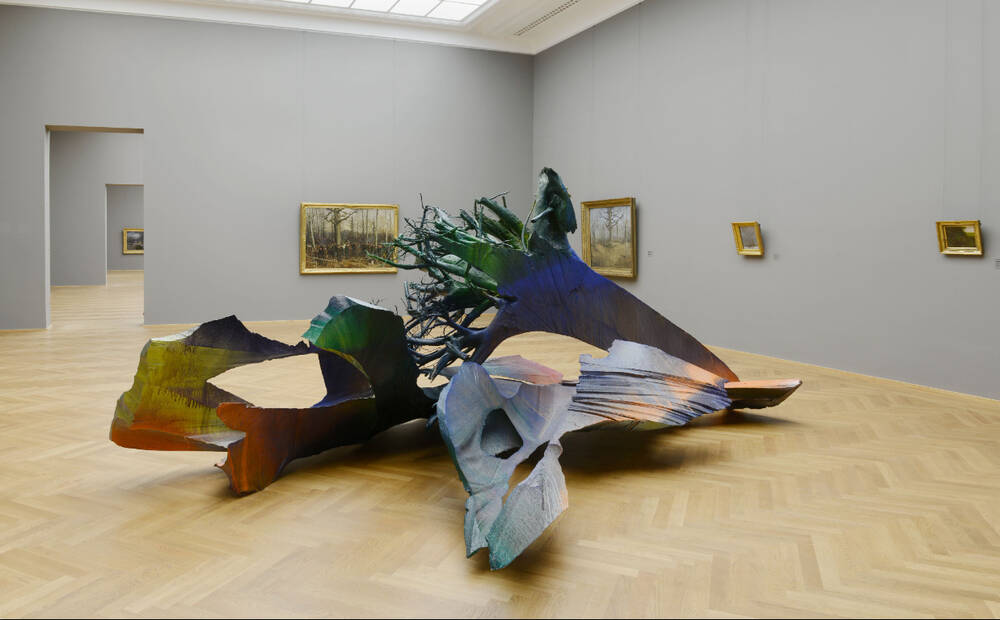
Here artist Katharina Grosse combines natural and abstract forms and has painted them in a range of bright colours – from green, red and pink to blue, orange and turquoise. She applied the colours with a spray gun, the pigments suspended in the air for a split second before they landed on the object. This technique creates subtle bands of colour, often entirely unplanned – a method which resonates with the artist’s intuitive working practices.
Traditionally, sculptures were painted to make them look more natural. But Katharina Grosse turns that idea on its head – her use of colour lends the natural material of the tree something artificial. The wood’s structure vanishes while the sculptural forms are highlighted: the root system becomes an art work. The colour scheme also creates a connection to the abstract shape of the lower section.
Conservator Holger Birkholz:
“The section on which the roots are resting was originally cut out of polystyrene and then cast in aluminium.”
As a result, this work has elements of both sculpture and statuary art.
“A sculpture can be made with various techniques or processes, but generally these are either subtractive or additive. For example, if you cut or chip away at wood or marble or some other hard material, you carve a marble or wooden sculpture. Modelling and casting are different since modelling creates a form, for example, from clay, while casting involves melting down some material – usually a metal – and pouring it into a mould, as with a bronze sculpture. Here, the artist has combined the two techniques of carving and casting. So on the one hand we have an object originally cut out of polystyrene and then, in a second process, actually cast so it can cope with the weight of the tree root placed on it.”
Umělkyně Katharina Grosseová zde kombinuje přírodní a abstraktní formy a nechává je zářit v různých barvách: od zelené, červené a růžové po modrou, oranžovou a tyrkysovou. Barvy nenanesla štětcem, nýbrž je nastříkala. Při tom se barevné pigmenty nejdříve vznášejí ve vzduchu, než se usadí na objektu. Tak vznikají jemné barevné přechody, často zcela nepředvídatelné, což odpovídá autorčině intuitivnímu způsobu práce.
Původně měla barva dodat sochám přirozenější vzhled. Přístup Kathariny Grosseové je však opačný: Malba dává přírodnímu materiálu – tedy stromu – něco umělého. Struktura dřeva mizí, ale plastický tvar vystupuje do popředí a z kořenů se stává umělecké dílo. Barvy navíc spojují strom s abstraktní formou dolní části.
Konzervátor Holger Birkholz:
„Spodní část sochy, na níž spočívá kořen stromu, byl původně objekt vyřezaný z polystyrenu a poté odlitý do hliníku.“
Díky tomuto spojení dvou částí má celý objekt prvky plastiky, ale také sochy.
„Sochou nazývám předmět, jemuž jsem něco odebral. V tomto smyslu mluvím o mramorové či o dřevěné soše – zde hmotu odebírám. O plastice mluvím, když něco postavím. Plastikou tak je například keramická plastika, nebo když dílo bylo odlito do nějakého materiálu – jako například bronzová socha. V tomto ohledu jsou zde oba procesy spojeny. Na jedné straně tedy máme objekt, který byl původně vyřezán z polystyrenu a v druhém procesu byl odlit do hliníku – také z důvodu, aby byla zaručena nosnost pro kořen stromu, který byl umístěn navrchu.“
- Ort & Datierung
- 2015
- Material & Technik
- Acryl auf Aluminium und Holz
- Dimenions
- 205 x 330 x 504 cm, 629 kg, dreiteilig
- Museum
- Skulpturensammlung
- Inventarnummer
- LN 053