
Die Skulpturenhalle: ein imposanter, 70 Meter langer Raum. Die kräftigen Säulen und die Bodenplatten aus Sandstein, über die sich elegant die Decke wölbt, erzählen vom ersten Leben des Gebäudes als Zeughaus. Heute können Sie hier durch die Geschichte der Skulptur von der zweiten Hälfte des 19. Jahrhunderts bis in die Gegenwart wandeln. Der Streifzug beginnt mit Auguste Rodin, dem Begründer der modernen Bildhauerei und seinen Zeitgenossen. Diese Sammlung verdankt unser Haus seinem ersten Direktor, Georg Treu. Seine Nachfolger setzten die Tradition fort, Werke von wichtigen zeitgenössischen Bildhauern anzukaufen – soweit es Mittel und Umstände zuließen.
Der Einfluss von Rodin lässt sich bei den deutschen Bildhauern um Wilhelm Lehmbruck und Karl Albiker nachvollziehen. Anfang des 20. Jahrhunderts wollten sie den menschlichen Empfindungen und Gefühlen eine Form geben: die „Ausdrucksplastik“ entstand. In den Werken der Nachkriegszeit bis 1989 spiegelt sich die Geschichte des geteilten Deutschlands wider. Vertreten sind auch jene Künstler der DDR, die eigene Wege abseits der Staatsdoktrin gingen. Manche dieser Arbeiten kamen aber erst nach 1989 in die Sammlung. Die Kunst im Westen, die sich nach dem Krieg mit der Abstraktion auseinandersetzte, wird auch von britischen und amerikanischen Bildhauern vertreten. Und für die Wiedereröffnung 2010 wurden einige zeitgenössische Arbeiten angekauft. Sie zeigen, wie sehr sich die Auffassung von Skulptur und die Skulpturen selbst in den vergangenen Jahrzehnten verändert haben. Die Bandbreite an Materialien und Formen ist, im Vergleich zu früher, enorm.
Weitere Medien
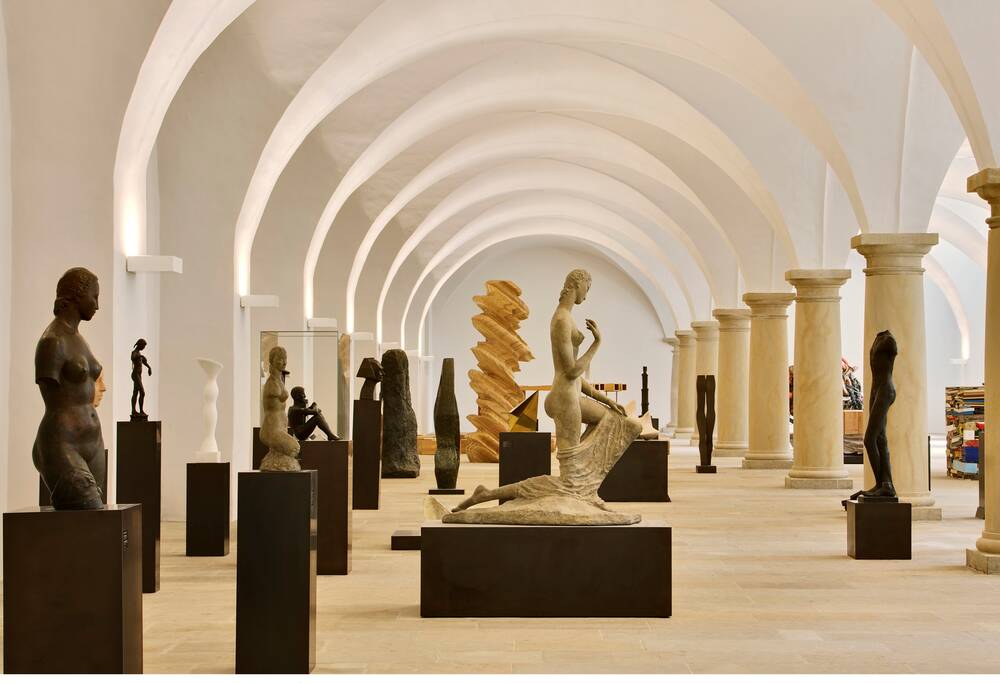
The Sculpture Hall – an impressive room, 70 metres long. With its vaulted ceiling resting on powerful columns and stretching elegantly over the sandstone slab floor, the room’s architecture tells of the building’s first life as an arsenal. In this space today, you can explore the history of sculpture from the second half of the nineteenth century to the present. The journey begins with French sculptor Auguste Rodin, the renowned founder of modern sculpture, and his contemporaries. Thanks to the museum’s first director, Georg Treu, our museum boasts a remarkable collection in this area. As far as their funds and the circumstances would allow, his successors continued the tradition of acquiring works by important contemporary sculptors.
Rodin’s influence is also evident in the circle of German sculptors around Wilhelm Lehmbruck and Karl Albiker. In the early twentieth century, they sought to convey human feelings and emotions in their works – an approach which became known as “expressionist sculpture”. The works by German sculptors from the post-war years to 1989 reflect the history of a divided country. Here, you can also find East German artists pursuing ideas away from the state prescribed canon of art, although some of these works only entered the collection after 1989. In the post-war Western Bloc, developments in sculpture were informed by a critical dialogue with abstraction, also evident here in works by British and American sculptors. When our museum re-opened in 2010, some contemporary sculptures were also acquired which illustrate how far our understanding of sculpture and the sculptures themselves have changed over the last decades. In comparison to earlier times, these works employ a far broader spectrum of materials and forms.
Sál se sochami: impozantní, sedmdesát metrů dlouhý prostor. Mohutné sloupy a dlažba z pískovce, nad níž se elegantně zdvihá klenba, vypovídají o původní funkci této budovy, která sloužila nejprve jako zbrojnice. Dnes se tu můžeme procházet mezi sochami a sledovat vývoj sochařského umění od druhé poloviny 19. století až po současnost. Prohlídka začíná díly zakladatele moderního sochařství Augusta Rodina a jeho současníků.
Za sbírku soch vděčí naše muzeum prvnímu řediteli muzea – Georgu Treuovi. Jeho nástupci se vydali po jeho stopách a – pokud to finanční prostředky a okolnosti dovolovaly – nakupovali pro muzeum další díla významných současných sochařů.
Rodinův vliv lze pozorovat na dílech německých sochařů seskupených okolo Wilhelma Lehmbrucka a Karla Albikera. Na počátku 20. století se snažili ve svých dílech vyjádřit lidské emoce a pocity: a tak se zrodilo „expresivní sochařství“.
V dílech z poválečného období až do roku 1989 se odráží historie rozděleného Německa. Zastoupeni jsou zde také umělci z bývalé NDR, kteří nebyli ochotni podřídit se ve svém díle státní doktríně. Některá z těchto děl se však do sbírky dostala až po roce 1989. Umění z tzv. Západu, které se po válce zabývalo abstrakcí, reprezentují také britští a američtí sochaři. A pro znovuotevření sbírky bylo v roce 2010 zakoupeno také několik současných děl. Je na nich možno sledovat, jak se v posledních desetiletích změnilo chápání sochařství, ale také jak se změnily sochy samotné. Škála materiálů a forem je ve srovnání s minulostí obrovská.