
Als Max Slevogt und Ludwig Thoma diese Frau in Berlin tanzen sahen, verliebte sich der eine – der Schriftsteller aus Bayern – so heftig, dass er sie heiraten wollte. Und der andere – der Künstler – wollte sie unbedingt malen.
So geschah es. Nach der Trennung von ihrem ersten Mann heirateten Marietta di Rigardo und Ludwig Thoma, er baute ihr ein Haus am Tegernsee und sie trat später nie mehr öffentlich auf.
Und Max Slevogt? Er investierte viel Arbeit in sein Porträt. 1904 notierte er, dass er acht Studien in Öl ausgearbeitet habe, bevor er an die monumentale Leinwand ging. Eine dieser Studien befindet sich in unserer Sammlung.
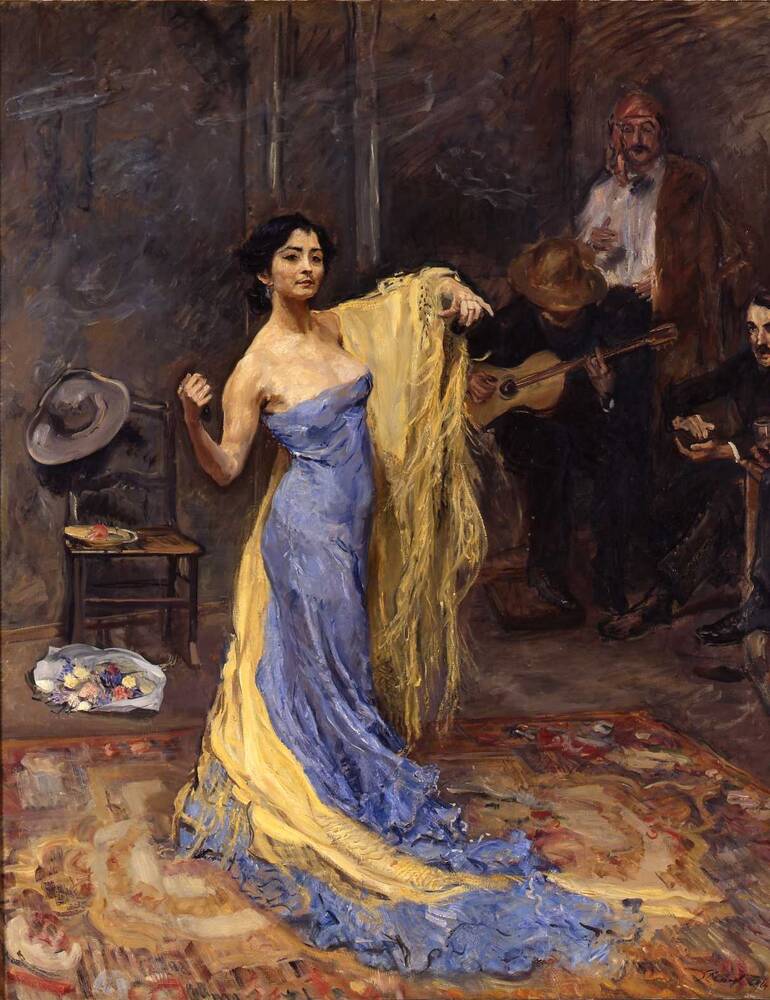
Slevogt, selbst ein begabter Pianist und Sänger, hatte ein großes Faible für die Bühne, porträtierte Sänger, Schauspieler und Tänzerinnen. Die Ausstrahlung von Marietta di Rigardo muss enorm gewesen sein. Slevogt zeigt sie als selbstbewusste Frau, voller Anmut, mit einem gelassenen, geradezu stolzen Gesichtsausdruck – aber natürlich auch dem begehrenden männlichen Blick ausgesetzt.
Ihre Bewegung inszenierte der Maler als dynamische Drehung des Körpers, die sich von der Schleppe über die Hüfte bis in die ausgebreiteten Arme und die Kastagnetten schlagenden Hände fortsetzt – und in den schwingenden Fransen des gelben Seidenschals nachhallt. Den hatte Slevogt der Tänzerin eigens für dieses Porträt geschenkt. Anders als in den Ölskizzen gestaltete der Maler ihr hier ein reiches Umfeld: mit einem Orientteppich, den dicht gedrängten Musikern und den Requisiten im Hintergrund.
Marietta di Rigardo feierte als Flamenco-Tänzerin große Erfolge. Geboren wurde die Tochter eines Schweizer Konsuls und einer Philippinin als Maria Trinidad de la Rosa in Manila. Ihre Ausbildung als Tänzerin machte sie in Europa. Sie heiratete den Berliner Schriftsteller und Komponisten Georg David Schulz und trat in seinem Kabarett „Zum siebenten Himmel“ auf. Und genau dort soll es gewesen sein, wo sie Max Slevogt und Ludwig Thoma so nachhaltig beeindruckte.
Weitere Medien
When an artist and a writer saw Marietta di Rigardo dancing in Berlin, the artist was determined to paint her, and the writer fell so desperately in love that he wanted to marry her.
The artist was Max Slevogt and the writer Ludwig Thoma – and both their wishes came true. After divorcing her first husband, Marietta di Rigardo married Ludwig Thoma, who built them a house at Tegernsee lake. Afterwards, she never performed publicly again.
And Max Slevogt? He worked extremely hard on this portrait. In 1904, he noted he had executed eight studies in oil before starting on this monumental canvas. Our collection also holds one of those studies.
A talented pianist and singer in his own right, Slevogt was extremely fond of the stage, and he painted portraits of singers, actors and dancers. Marietta di Rigardo must have been extremely charismatic and charming. Slevogt presents her as a self-confident woman, exceptionally graceful, with a very calm, almost proud expression – though, of course, also exposed to the gaze of male desire.
Her movement is staged as a dynamic spiral, originating in the train of her dress and flowing over her hips to her outspread arms and her hands holding castanets – and echoed in the fluttering fringes of her yellow silk shawl. The shawl was Slevogt’s present to Marietta di Rigardo especially for this portrait. In contrast to the preparatory oil sketches, Slevogt includes an elaborate setting with a Persian carpet, a group of musicians packed tightly together, and props in the background.
Marietta di Rigardo achieved spectacular success as a flamenco dancer. Born in Manila as Maria Trinidad de la Rosa, she was the daughter of the Swiss consul and a woman from the Philippines. She trained as a dancer in Europe. Her first husband was the Berlin writer and composer Georg David Schulz, and she appeared in his cabaret theatre ‘Zum siebenten Himmel’ – ‘Seventh Heaven’. Reputedly, she was dancing there when she so deeply impressed the writer Ludwig Thoma and the artist Max Slevogt.
Když Max Slevogt a Ludwig Thoma viděli tuto ženu tančit v Berlíně, jeden z nich – spisovatel z Bavorska – se do ní zamiloval tak silně, že se s ní chtěl oženit. A ten druhý – umělec – ji chtěl bezpodmínečně malovat. A tak se také stalo. Marietta di Rigardo opustila svého prvního manžela a provdala se za Ludwiga Thomu, který pro ni postavil dům u jezera Tegernsee. Marietta pak už nikdy nevystoupila na veřejnosti.
A Max Slevogt? Věnoval Mariettině portrétu mnoho práce. Roku 1904 napsal, že vypracoval osm studií v oleji, než začal práci na monumentálním plátně. A jedna z těchto studií se nachází v naší sbírce.
Slevogt, sám talentovaný klavírista a zpěvák, se velmi zajímal o dění na jevišti a často portrétoval zpěváky, herce a tanečnice. Marietta di Rigardo musela vyzařovat silné charisma. Vidíme ji zde jako sebevědomou ženu plnou půvabu, s klidným a téměř hrdým výrazem ve tváři – ale zároveň vystavenou toužebným mužským pohledům.
Slevogt ji zachytil v dynamickém pohybu. Celé tělo – od vlečky přes boky k nataženým pažím a rukám tlukoucím do kastanět – se otáčí a třásně jejího žlutého hedvábného šálu se v tomto pohybu houpají. Slevogt daroval šál tanečnici právě pro tento portrét. Na rozdíl od jiných olejových skic zde Marietta stojí uprostřed místnosti s pestrým vybavením: V pozadí vidíme orientální koberec, bohaté rekvizity a několik hudebníků, kteří se v rohu tak trochu mačkají.
Marietta di Rigardo slavila jako tanečnice flamenca velké úspěchy. Byla dcerou švýcarského konzula a jedné Filipínky a narodila se jako Maria Trinidad de la Rosa v Manile. Tanečnímu umění se vyučila v Evropě, kde se provdala za berlínského spisovatele a skladatele Georga Davida Schulze. Vystupovala v jeho kabaretu „V sedmém nebi“ a právě zde prý udělala veliký dojem na Maxe Slevogta a Ludwiga Thomu.
- Ort & Datierung
- 1904
- Material & Technik
- Öl auf Leinwand
- Dimenions
- 229 x 180 cm (Katalogmaß 2010) 231,5 x 181,5 cm (Inventurmaß, 17.05.2010) 264,5 x 215,5 x 9 cm (Rahmenmaß, Tobias Lange, 17.05.2010)
- Museum
- Galerie Neue Meister
- Inventarnummer
- Gal.-Nr. 2549