
Eine schlammige Landstraße, eine Bäuerin im roten Kleid, eine Kuh. Für die Landschaftsmalerei seiner Zeit ist dieses Bild von Christian Friedrich Gille ungewöhnlich. Keine idyllische Gegend mit Kirchturm, kein mondbeschienenes Wiesental, keine pittoreske Landschaft des Südens. Nicht einmal dem Wald widmet er viel Aufmerksamkeit, setzt ihn mit groben Pinselstrichen als abstrakte Andeutung in den Hintergrund. Auch die Bäuerin und die Kuh skizziert er rasch auf diese Weise. Auf das Nötigste reduziert wirken sie wie Statisten neben einer Hauptdarstellerin: der Pfütze. Von schwarzer Gülle aus einem Misthaufen am Straßenrand gefärbt, steht sie im Mittelpunkt von Gilles Studie. Etwas zugespitzt gesagt: der Maler hat hier das Portrait einer Pfütze erschaffen.
Im 19. Jahrhundert liegt in der Darstellung von so etwas Unscheinbarem eine große Radikalität. Aber Gille, der zum Malen über die Dörfer des Dresdner Umlands zog, erblickte in dieser unscheinbaren Alltäglichkeit eine Schönheit, die er festhalten wollte. Kurator Holger Birkholz:
„Gille war insgesamt ein Künstler, der an solchen nicht gesehenen, nicht sichtbaren Momenten interessiert war, also Bildmotive, die aus dem Blick geraten waren, also mal ist es eine Stubenecke, mal ist es ein Wiesenfleck, oder es ist irgendwo an der Weißeritz eine Baumgruppe, die ihn interessiert, er malt Hütten auf einem Hinterhof, wählt sich ein paar Haushaltsgegenstände, die so ein bisschen altertümlich, abgenutzt erscheinen, das waren die besonderen Themen bei Gille, also er ist fasziniert eben von dem, was anderen als grundsätzlich erstmal nicht darstellungswürdig erschien. (…) Also das besondere ist wirklich, dass Gille im kleinen Format, schnell und gekonnt hingeworfen, mit Farbe diese Momente festhält.“
Weitere Medien
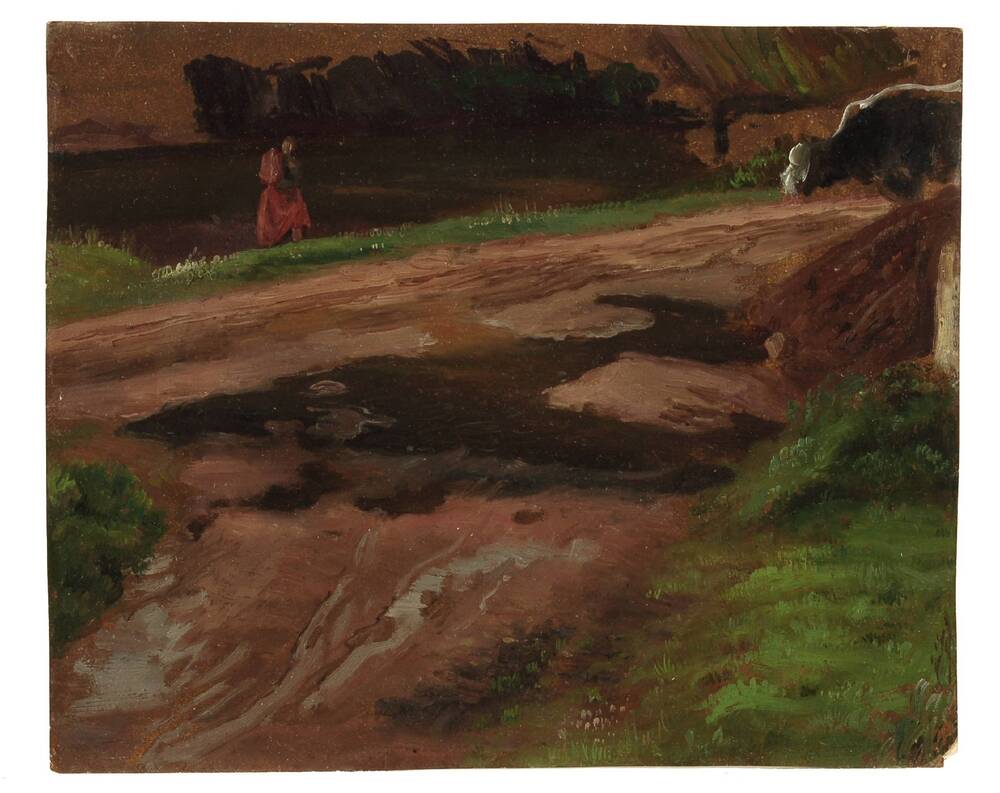
A muddy country lane, a farmwoman in a red dress, and a cow. This scene by Christian Friedrich Gille is unusual in the landscape painting of his age. This is no idyllic rural scene with a church spire nor a valley with meadows set in bright moonlight, and certainly not a picturesque Italian landscape. Gille has not even rendered the woods in detail, but painted the trees in rough brushstrokes as an abstract form in the background. In a similar way, he has quickly sketched the female figure and the cow. Reduced to essentials, they seem to be just walk-on parts next to the star of the piece – the puddle. Stained black by slurry from a muck heap at the side of the road, it lies literally at the heart of Gille’s study. In more provocative terms, you could say here he has created a portrait of a puddle.
In the nineteenth century, taking something as nondescript as a puddle as a subject for an art work was a very radical act. Gille travelled the country villages around Dresden to paint – and clearly saw this unprepossessing everyday scene as having a beauty he wanted to capture. As curator Holger Birkholz says,
"All in all, Gille was an artist attracted by such inconspicuous, almost invisible moments – pictorial subjects largely unseen or overlooked, such as the corner of a room, a piece of meadowland, or a group of trees somewhere along the Weißeritz, a tributary of the Elbe. He painted shacks in a backyard, or focused on a couple of household objects apparently rather old-fashioned and worn. Those were Gille’s particular themes – a fascination with things that others, in principle, saw as not worthy of being depicted in art. (…) So what’s special here is really how Gille could capture these moments in paint in a small-format, quickly and skilfully."
Blátivá venkovská cesta, selka v červených šatech, kráva. Pro tehdejší dobu je tato krajinomalba od Christiana Friedricha Gilleho neobvyklá. Nevidíme tu žádnou idylickou krajinu s kostelní věží, žádné údolí s loukou ozářenou měsícem, žádnou malebnou krajinu z jihu. Dokonce ani lesu nevěnuje malíř velkou pozornost, maluje ho pouze v pozadí velmi zjednodušeně hrubými tahy štětce. Stejně rychle načrtnul i selku a krávu, které – redukované na minimum – hrají pouze vedlejší roli vedle hlavního tématu: louže. Ta, zbarvená černou kejdou z hnojiště u cesty, stojí ve středu Gillesovy studie. Pokud trochu přeženeme, můžeme říct: Malíř zde vytvořil její portrét.
V 19. století bylo zobrazení něčeho tak nenápadného velmi radikální. Ale pro Gilleho, který se na svých cestách za motivy pro své obrazy toulal vesnicemi v okolí Drážďan, tento nenápadný každodenní jev v sobě skrýval krásu, kterou chtěl zachytit. Kurátor Holger Birkholz o něm říká:
„Gille byl umělcem, kterého zajímaly neviditelné, nepatrné momenty, tedy motivy, které našemu běžnému pohledu unikaly. Někdy je to kout v místnosti, jindy výsek louky nebo malá skupina stromů někde na břehu řeky Weißeritz, které ho zajímají. Gille maluje domky se dvorem nebo si vybírá pár předmětů z domácnosti, které vypadají tak trochu staromódně, opotřebovaně. To jsou jeho zvláštní témata. Je fascinován tím, co podle ostatních zpočátku nebylo jako motiv uměleckého díla vhodné. (...) Zvláštní je opravdu to, že Gille rychle a zručně tyto momenty zachycuje barvou na malém formátu.“
- Ort & Datierung
- Um 1870/80
- Material & Technik
- Öl auf Papier auf Pappe
- Dimenions
- 22,3 x 27,1 cm (Katalogmaß 2010) 22,3 x 27,1 cm (Inventurmaß, 07.05.2010) 34,5 x 39 x 5,3 cm (Rahmenmaß, Tobias Lange, 07.05.2010)
- Museum
- Galerie Neue Meister
- Inventarnummer
- Inv.-Nr. 09/418