
Zwei Freundinnen, liebevoll einander zugeneigt. Die Zartheit, die in ihrer Begegnung liegt, setzt sich in der Darstellung der Landschaft fort: äußerst fein sind die Farben aufgetragen, kein Pinselstrich ist sichtbar. Mild und weich, fast schwebend, erscheinen die Berge am Horizont, das Kloster links und die Stadt rechts. Ebenso sanft modelliert sind Haut und Gewänder der Figuren.
Es begegnen sich hier nicht nur zwei Frauen in inniger Freundschaft, sondern auch zwei Länder: die dunkelhaarige Schöne mit dem Lorbeerkranz steht für Italien, die Blonde im grünen Kleid verkörpert Deutschland. Dementsprechend ist die Landschaft hinter ihnen mit deutschen und italienischen Merkmalen gestaltet.
Das Gemälde erinnert an ein Werk der Renaissance, ist aber rund dreihundert Jahre später innerhalb der Gruppe der Nazarener entstanden. Die Nazarener waren Künstler aus dem deutschsprachigen Raum, die sich im 19. Jahrhundert in Italien niederließen, um dort an die christliche Malerei der Renaissance anzuknüpfen. Sie lebten und arbeiteten zurückgezogen in einem Kloster in Rom und sahen die Malerei als Medium religiöser Vertiefung, als Gottesdienst.
Freundschaft spielte in ihrem Kreis eine wichtige Rolle. Eine erste Version dieses Bildes wurde von Friedrich Overbeck als Geschenk für seinen Künstlerfreund Franz Pforr angefertigt. Theodor Rehbenitz, dessen Version sie hier sehen, malte es ein zweites Mal. Er war eng mit Overbeck befreundet und hatte bereits am ersten Bild mitgewirkt. Die zärtliche Zuneigung der Frauen ist daher nicht nur Symbol für die Liebe der deutschen Künstler zu Italien, sondern auch Ausdruck einer Freundschaft unter Männern.
Weitere Medien
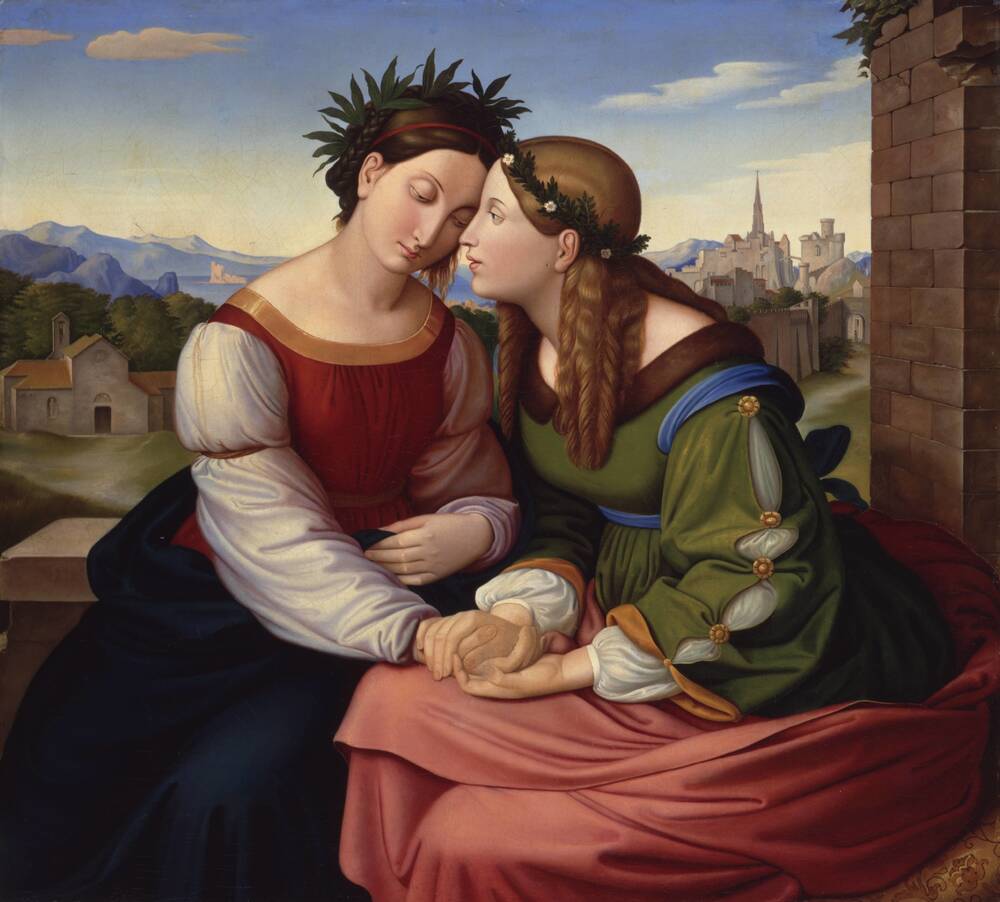
Two friends, close together, their hands lovingly clasped. The tenderness in this meeting of hearts and minds is reflected in the landscape. Rendered in colours applied in exceptionally fine glazes, there are no visible brushstrokes. The mountains on the horizon appear soft and smooth, almost as if floating, as do the monastery on the left and the town on the right. The complexion and robes of the figures are modelled in equally soft contours.
The intimate friendship depicted here is not just between two women, but two countries – the dark-haired beauty with a laurel wreath represents Italy, while the blonde figure in the green dress stands for Germany. In keeping with that friendship, the landscape is also composed of both German and Italian elements.
Although this may seem like a Renaissance painting, it was actually produced around three hundred years later by a painter in the Nazarene group of artists. In the nineteenth century, the Nazarenes, as they became known, came from German-speaking countries and settled in Italy. Largely cut off from society, the Nazarenes lived and worked in a monastery in Rome, and took Renaissance Christian art as their inspiration. In their view, painting was a medium for a more profound religiosity, as a service to God.
In the Nazarene circles, friendships played a key role. Friedrich Overbeck, one of the leading Nazarene artists, completed a first version of this work as a present for his fellow-artist Franz Pforr. The composition was then painted again by Theodor Rehbenitz – and his version is on show here. Rehbenitz was one of Overbeck’s closest friends and also helped to paint the first version. In that sense, the tenderness between these two women not only symbolises a love of Italy among German artists, but also testifies to a deep male friendship.
Dvě přítelkyně, které se k sobě láskyplně sklání. Něha, se kterou se setkávají, je možno cítit také v zobrazení krajiny: Barvy jsou na plátno naneseny mimořádně jemně, není vidět jediný tah štětcem. Hory na obzoru, klášter vlevo a město vpravo působí klidně a lehce, téměř jako by se vznášely. Stejně jemně a měkce jsou zachyceny také pleť a oděvy postav.
Důvěrné přátelství zde nespojuje jen dvě ženy, ale také dvě země: Tmavovlasá hezká dívka s vavřínovým věncem na hlavě představuje Itálii a blondýnka v zelených šatech ztělesňuje Německo. A stejně tak tvoří krajinu v pozadí německé a italské prvky.
Obraz připomíná dílo z období renesance, ale vznikl až asi o tři sta let později v rámci působení skupiny malířů Nazarénského kruhu. Tento kruh tvořili umělci z německy mluvících zemí, kteří se v 19. století usadili v Itálii, aby se zde věnovali křesťanské renesanční malbě. Žili a tvořili v ústraní kláštera v Římě a malbu chápali jako prostředek náboženského prohloubení, jako službu Bohu.
Důležitou roli v kruhu těchto umělců hrálo přátelství. První verzi tohoto obrazu vytvořil Friedrich Overbeck jako dárek pro svého přítele a malíře Franze Pforra. Theodor Rehbenitz, jehož dílo vidíte zde, namaloval druhou verzi obrazu. Podílel se už také na prvním obraze a s Overbeckem jej spojovalo úzké přátelství. Něžná náklonnost obou dívek tedy není jen symbolem lásky německých umělců k Itálii, ale také výrazem přátelství mezi muži.
- Ort & Datierung
- 1835
- Material & Technik
- Öl auf Leinwand
- Dimenions
- 95 x 105 cm
- Museum
- Galerie Neue Meister
- Inventarnummer
- Gal.-Nr. 2813