
Ein ungewöhnliches Selbstporträt: Im Mittelpunkt des Bildes – die Hände der Künstlerin, in auffallend hellem, kreidigen Weiß und wie zum Schutz nach oben gestreckt. Das Gesicht – ihr Gesicht – hat Hilde Rakebrand stark angeschnitten und an den unteren Rand gerückt. Es liegt ein wenig im Schatten, aus dem nur die weit geöffneten Augen herausleuchten. Wohin blickt die junge Malerin in diesem Moment? Wovor will sie sich schützen, wovor warnen?
Die Antwort gab sie in vier Sätzen auf der Rückseite des kleinen Bildes – 1931, zwei Jahre, bevor Hitler die Macht ergriff:
„Ein schlimmes Ende wird kommen. Wir werden überleben! Wird es einen neuen Anfang geben? Wir hoffen!“
Hilde Rakebrand bewegte sich damals in Dresden im Umfeld des Religionsphilosophen Paul Tillich, der die Nationalsozialisten schon früh kritisierte. Sie wurde nach 1933 mit einem Ausstellungsverbot belegt, ein Großteil ihres Werks wurde durch die Bombenangriffe kurz vor Kriegsende zerstört.
Die wenigen Bilder, die überlebten, beweisen, wie experimentell Hilde Rakebrand gearbeitet hat. Ihr Selbstbildnis malte sie auf eine Sperrholzplatte, die sie nicht grundiert hatte. Die Strukturen scheinen durch die Ölfarbe durch und wirken als malerisches Element mit. Den Mut und die Freude am Ausprobieren, an einer neuen Malerei, hatte sie an der Dresdener Kunstgewerbeakademie bei Carl Rade gelernt, der parallel zur Bauhausbewegung vergleichbare Ideen in seine Lehre integrierte.
Nach dem Krieg war Hilde Rakebrand für die Dresdener Kunstsammlungen tätig. Sie organisierte die Rückführung der Kunstschätze, die die Sowjets nach Moskau gebracht hatten, war Direktorin der Porzellansammlung und des Museums für Kunsthandwerk. Als Künstlerin ist sie heute zu Unrecht wenig bekannt.
Weitere Medien
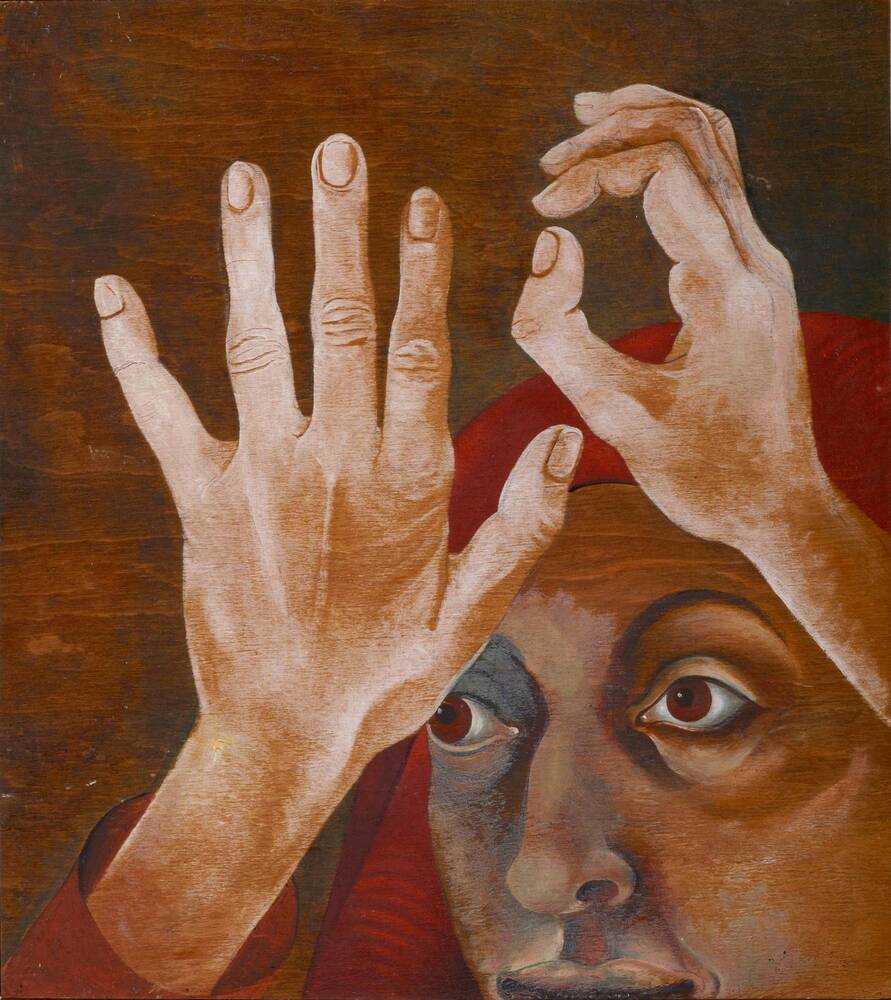
An unusual self-portrait – with the focus on the artist’s hands. Conspicuously rendered in a light chalky white, they are raised as if in a gesture of protection. The artist Hilde Rakebrand has cropped the face – her face – and placed it at the base of the painting, set slightly in shadow. The only highlights are her wide-open eyes gazing out. But what was this young artist looking at? And what did she want to protect herself from – or warn us about?
She answered those questions in four sentences on the back of this little picture in 1931, two years before Hitler seized power.
‘It will end badly. We will survive! Will there be a new beginning? We hope so!’
In Dresden in those days, Hilde Rakebrand moved in the circles around Paul Tillich, a theologian and philosopher of religion who was an early critic of the Nazi movement. After Hitler came to power in 1933, Rakebrand was banned from exhibiting her art. Many of her works were destroyed in the bombing of Dresden shortly before the end of the war.
The few paintings which have survived show just how experimental she was in her approach. Hilde Rakebrand painted her self-portrait on unprimed plywood. The plywood structure shimmers through the oil paints, contributing as a painterly element to the overall effect. At the Dresden Academy of Art, she studied under Carl Rade. At the same time as the Bauhaus movement, he introduced similar ideas into his teaching. Through her teacher, Hilde Rakebrand discovered the joy of experimentation and the courage to develop a new kind of art.
After the war, she worked for the Dresden art collections, organising the restitution of art works which the Soviets had taken to Moscow. Hilde Rakebrand went on to become the Director of the Porcelain Collection and the Museum für Kunsthandwerk – the Arts and Crafts Museum. Today, her work as an artist has been largely – and unjustly – forgotten.
Stojíme tu před neobvyklým autoportrétem. Uprostřed obrazu: ruce malířky v nápadně světlé, křídově bílé barvě a jakoby na ochranu zdvižené vzhůru. Obličej – svůj obličej – Hilde Rakebrandová zachytila pouze v malém výřezu a posunula ke spodnímu okraji, víceméně do stínu, z něhož svítí jen doširoka otevřené oči. Kam v tuto chvíli mladá malířka směřuje svůj pohled? Před čím se snaží ochránit, před čím chce varovat?
Svou odpověď zaznamenala ve čtyřech větách na zadní straně malého obrazu – roku 1931, dva roky před Hitlerovým uchopením moci:
„Špatně to skončí. My přežijeme! Budeme moct začít znovu? Doufáme!“
V té době se Hilde Rakebrandová pohybovala v Drážďanech v okruhu náboženského filozofa Paula Tillicha, který již brzy kritizoval národní socialisty. Po roce 1933 jí bylo zakázáno vystavovat a velká část jejího díla byla zničena během bombardování krátce před koncem války.
Těch několik málo obrazů, které se dochovaly, dokládá, jak experimentálně Hilde Rakebrandová pracovala. Svůj autoportrét namalovala na překližkovou desku bez základního nátěru. Struktura desky prosvítá skrz olejovou barvu a stává se tak malířským prvkem. Odvaze a radosti experimentovat a zkoušet nové způsoby malby se naučila na drážďanské Akademii užitého umění od Carla Radeho, který ve svých přednáškách a výuce propagoval podobné myšlenky jako výtvarná škola Bauhaus.
Po válce Hilde Rakebrandová pracovala pro Drážďanské umělecké sbírky. Organizovala repatriaci uměleckých děl, které sovětští vojáci odvezli do Moskvy, a byla ředitelkou sbírky porcelánu a Muzea umění a řemesel. Jako umělkyně je dnes neprávem málo známá.
- Ort & Datierung
- 1931
- Material & Technik
- Öl auf Sperrholz
- Dimenions
- 29 x 26 cm
- Museum
- Galerie Neue Meister
- Inventarnummer
- Inv.-Nr. 2016/05