
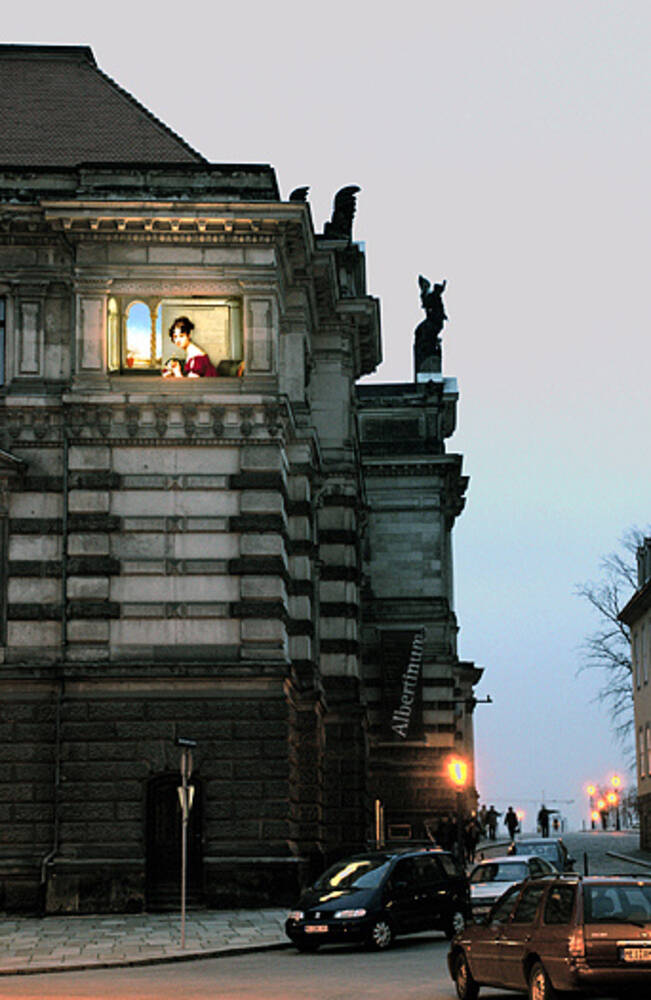
Tagsüber sieht man sie kaum, aber sobald es dunkel wird, beginnen sie zu leuchten: die Gesichter von fünf Bewohnerinnen und Bewohnern des Albertinums. Seit 2002 blicken sie aus dem zweiten Stock auf die Vorrübergehenden. Unter ihnen der Maler Curt Querner mit eher skeptischem Gesicht und ein älterer Mann – gemalt von Anton Graff – mit altersweisem Blick. Wilhelm Trübners „Mädchen mit gefalteten Händen“ dagegen schaut etwas gelangweilt herab.
Die Idee zu „Keep in View“ hatte Ulrich Bischoff, damals Direktor des Hauses. Sein Wunsch: das Museum sichtbarer zu machen. Die Gebäude im Umkreis waren angestrahlt, nur das Albertinum am Ende der Brühlschen Terrasse lag nachts im Dunkel und nichts wies auf die Schätze im Inneren hin. Bischoffs Wahl fiel auf Elisabeth Brockmann. Die Künstlerin erinnert sich:
„Mein Auftrag hieß: das Albertinum soll leuchten. Aber nicht dekorativ angestrahlt werden. Beim ersten Besuch führte mich der Hausherr durchs Museum. Seine Begeisterung wirkte ansteckend. Ich wollte Teile dieses Reichtums als Lockvögel benutzen, um Passanten zur Neugier zu verführen. Aber wie verführt man unauffällig? Indem man sich zuerst selbst verführen lässt. Ich fotografierte alle Porträts der Gemäldesammlung und achtete darauf, welche mich beim Blick durch die Kamera berührten. Das passierte dann, wenn sie mich unvermittelt anschauten…“
Als sechstes Bild bearbeitete Brockmann ein Puppengesicht so stark digital, dass wir uns nicht sicher sein können, ob wir eine Frau oder doch einen Avatar sehen. Als Standorte wählte sie sechs freie Felder in der Fassade, fotografierte sie und verschmolz die Bilder am Rechner mit den jeweiligen Porträts, die sie mehr oder weniger stark beschnitten hatte. Diese Doppelbilder wurden hochauflösend auf durchscheinende Spanntücher gedruckt, in Rahmen montiert und mit Lichtmodulen hinterlegt.
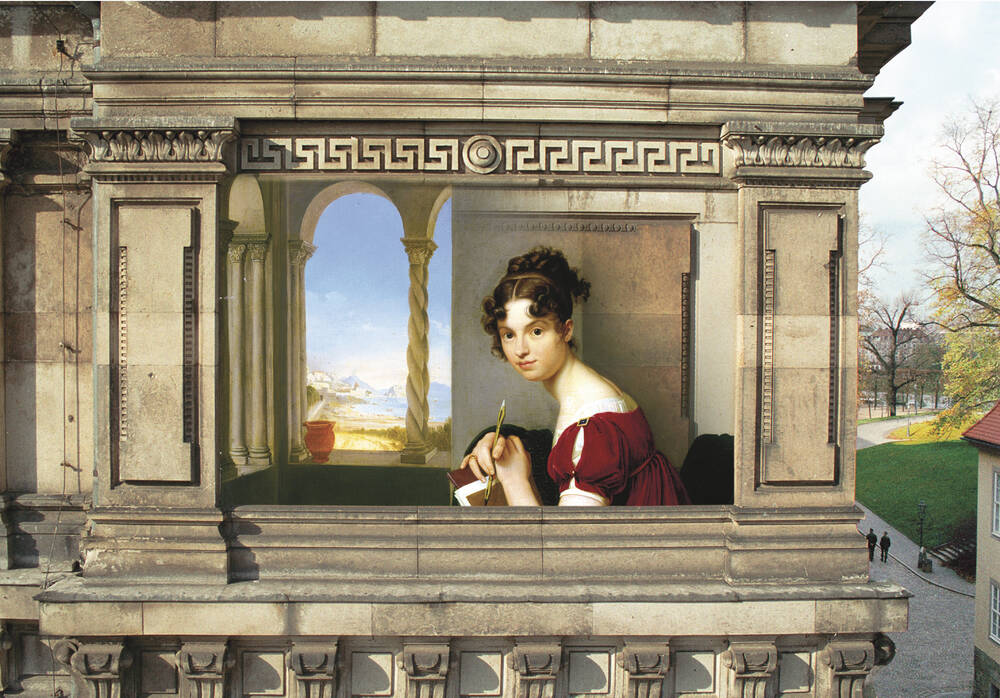
Besonders faszinierend ist die Verschränkung bei Carl Christian von Vogelstein. Neben seiner „Jungen Dame mit Zeichengerät“ öffnet sich der Blick in eine imaginäre Landschaft, gleichzeitig haben wir die Originalfassade und die fotografierten Architekturdetails im Blick.
Weitere Medien
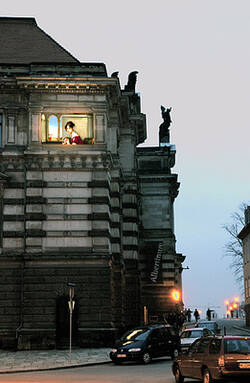
In daylight, they are hardly visible, but as soon as night falls they start to shine – the faces of five of the Albertinum’s residents. Since 2002, they have been looking out of the second floor at passers-by. The faces include the artist Curt Querner with a rather sceptical expression and an older man – painted by Anton Graff – with a look embodying the wisdom of old age. In contrast, Wilhelm Trübner’s Girl with Folded Hands seems rather bored by it all.
The idea for Keep in View came from Ulrich Bischoff, then Director of the Albertinum. It was his wish to enhance the museum’s visibility. At night, the surrounding buildings were illuminated. Only the Albertinum at the end of the Brühlsche Terrasse lay in darkness, with nothing to indicate the wealth of treasures inside. Bischoff decided to commission the work from Elisabeth Brockmann. As she recalls:
‘My job was to light up the Albertinum, but not by shining something decorative onto it. When I first visited, the director showed me round; his enthusiasm was infectious. I wanted to exploit some of the museum’s riches to tempt people passing by and spark their curiosity. But how can you tempt someone unobtrusively? Only by first allowing yourself to be tempted. I took photos of all the portraits in the paintings collection, observing which ones touched me when I saw them through the lens. I noticed how I was always moved by the ones gazing at me directly ...’
For her sixth image, Brockmann digitally processed a puppet’s face so radically we can’t be sure whether we are looking at a woman or an avatar. She chose six free spaces in the façade, photographed them and merged the images digitally with the portraits, which she had already cropped as needed. The double images were printed in high resolution on transparent material cut to size, and mounted in frames with modular light units set behind them.
In Carl Christian von Vogelstein’s Young Woman Drawing, the dovetailing of image and architecture is especially fascinating. We can look into an imaginary landscape next to the young woman, yet simultaneously see the original façade and the photographed architectural details.
Přes den jsou sotva vidět, ale jakmile se setmí, začnou zářit: tváře pěti obyvatel Albertina. Od roku 2002 se dívají na kolemjdoucí z druhého patra. Nachází se mezi nimi také malíř Curt Querner s poněkud skeptickým výrazem a jeden starší muž, kterého namaloval Anton Graff, s pohledem plným životní zkušenosti. „Dívka se sepjatýma rukama“ od Wilhelma Trübnera naopak shlíží dolů poněkud znuděně.
Nápadem k instalaci „Keep in View“ měl Ulrich Bischoff, tehdejší ředitel našeho muzea. Jeho přáním bylo: zviditelnit muzeum. Budovy v okolí byly osvětlené, jen Albertinum na konci Brühlovy terasy leželo v noci ve tmě a nic nenaznačovalo, jaké poklady se uvnitř nacházejí. Bischoff oslovil umělkyni Elisabeth Brockmannovou. Ta sama vzpomíná:
„Mým úkolem bylo osvítit také Albertinum. Budova však neměla být osvícena pouze dekorativně. Při mé první návštěvě mě ředitel provedl muzeem a jeho nadšení bylo nakažlivé. Chtěla jsem využít části pokladů, které se zde nacházejí, jako vějičky, které by kolemjdoucí svedly ke zvědavosti. Jak ale svádět nenápadně? Tak, že nejprve svedete sami sebe. Vyfotografovala jsem proto všechny portréty ve sbírce obrazů a hledala jsem, který se mě při pohledu hledáčkem kamery dotkne. A to byla díla, na nichž se na mě zobrazené osoby bezprostředně dívaly ...“
Na šestém obraze Brockmannová digitálně zpracovala obličej panenky do té míry, že si nemůžeme být jisti, zda vidíme ženu nebo přeci jen avatara. Jako místa pro instalaci vybrala šest volných polí na fasádě a vyfotografovala je. Snímky pak na počítači spojila s vybranými portréty, jejichž výřezy přizpůsobila jednotlivým polím. Tyto dvojité obrazy byly vytištěny s vysokým rozlišením na průsvitná, velká plátna, zasazeny do rámů a podsvíceny světelnými moduly.
Obzvláště fascinující je dílo Carla Christiana von Vogelsteina. U jeho „Mladé dámy s pisátkem“ se před námi otevírá pohled do imaginární krajiny. Zároveň však máme před očima původní fasádu a vyfotografované architektonické detaily.
- Ort & Datierung
- 2002
- Material & Technik
- 6-teilige Installation an der Fassade des Albertinums
- Dimenions
- Beckmann: 336,5 x 141 cm Querner: 377 x 217 cm Model: 224 x 217 cm Pappermann: 172,5 x 216,5 cm Nelly: 160 x 220 cm Vogelstein: 357,5 x 216 cm
- Museum
- Galerie Neue Meister
- Inventarnummer
- Inv.-Nr. 03/03