
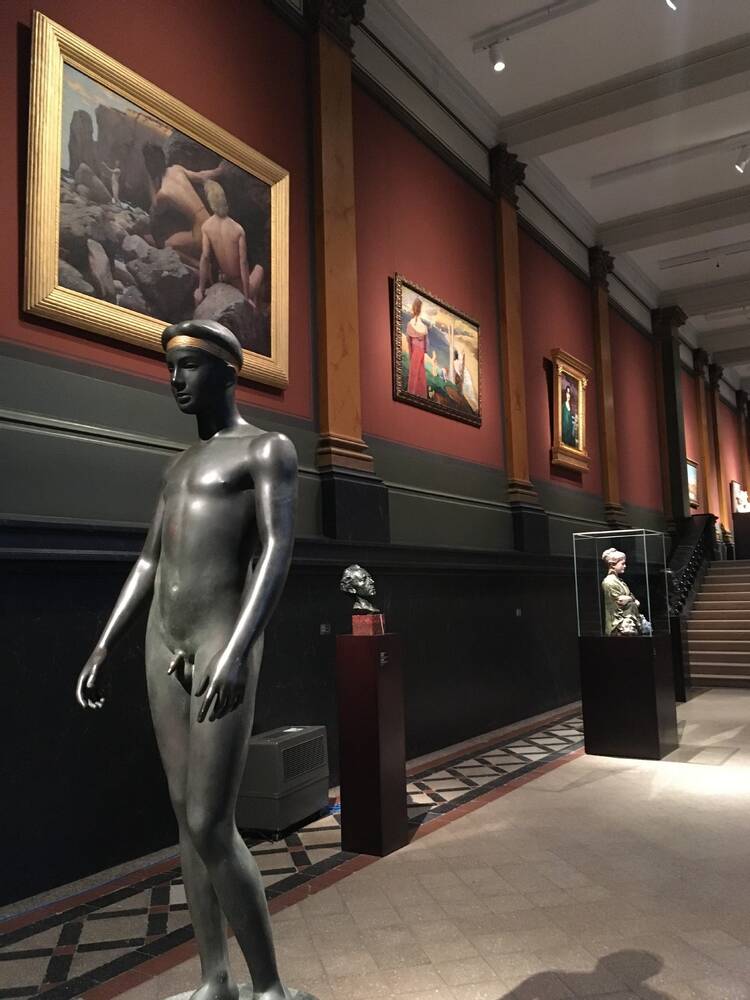
"Der Klingersaal ist ein Herzstück des Albertinum. Er vereint Malerei, Skulptur und auch architektonische Gestaltung aus der Zeit um 1900, aus der Zeit des sogenannten Fin de Siècle…. Der Klingersaal ist ein Raum voller Fantasie und Zwischenwelten, aber auch voller Zeitgeschichte“, sagt Kurator Andreas Dehmer.
Zur Wiedereröffnung des Albertinum 2010 wurde der Saal neu konzipiert. Das Farbkonzept aber orientiert sich an der Zeit, als das Museum noch ganz jung war. Ein Teil der Originalausstattung war erhalten geblieben. Was fehlte, wurde rekonstruiert. In diesem atmosphärischen Epochenraum treffen sich seitdem künstlerische Größen wie Max Klinger, Gustav Klimt, Arnold Böcklin und Auguste Rodin. Der Raum zieht viele Besucherinnen und Besucher in seinen Bann, sagt Andreas Dehmer:
„Weil die Bilder bieten sich dafür an mit ihren großen Formaten und die auch eine gewisse Dekorativität … und da steckt so viel drin an Leidenschaft, da sind Bilder von Liebe und von Schönheit, aber auch von Gewalt und von Verderben. Also eigentlich auch so Zwischenwelten oder Traumwelten, die da suggeriert werden, zugleich ist es ein fast dokumentarisches Zeitengemälde, wie widersprüchlich die Zeit auch gewesen ist. “
Ursprünglich wurde in diesem Saal die Kunst der Antike gezeigt, dann kam man aber auch in den Genuss damaliger Gegenwartskunst, so Dehmer weiter:
„Der Name Klingersaal hängt mit dem Künstler Max Klinger zusammen und geht auf ein Kunstwerk zurück, das für den Raum beauftragt worden war, aber dort nicht mehr zu sehen ist. Und zwar das 1904 geschaffene Drama, das sich jetzt in der Skulpturenhalle im Erdgeschoss befindet. Das war eigentlich damals der Dreh- und Angelpunkt des Klingersaals und heute ist es, auch von Max Klinger, die ‚Neue Salome‘. Das ist ja eigentlich die Herrscherin über die symbolistischen und Jugendstilwelten, die sich dort in einer Art fast schon, könnte man sagen, Gesamtkunstwerk treffen.“
Weitere Medien
Curator Andreas Dehmer explains the importance of the Klinger Hall:
“[…This…] is one of the Albertinum’s centrepieces. It brings together painting, sculpture and architectural design from around 1900, the era known as fin de siècle…. The Klinger Hall is not just packed with fantasy and intermediate worlds, but also contemporary history.”
The hall’s design was revamped for the opening of Albertinum in 2010. The colour scheme, though, references the era when the museum was still new. Some of the original décor had survived, and what was missing was reconstructed. Since then, this atmospheric period room has been home to works by such major artists as Max Klinger, Gustav Klimt, Arnold Böcklin and Auguste Rodin. As Andreas Dehmer tells us, many visitors find this space quite captivating:
“Because the paintings, with their large formats and decorative qualities, create an attractive display … and the subjects have so much passion in them, not only as images of love and beauty, but also of violence and decay. They seem to suggest some kind of intermediate or dream worlds, yet at the same time, these paintings are almost documentary of their age and just as contradictory as that era was.”
Originally this hall displayed art works from the classical world. But then, as Andreas Dehmer explains, the exhibits were expanded to include the contemporary art of the day:
“The Klinger Hall is named after the artist Max Klinger – because of an art work originally commissioned from him for this space. The work was his sculpture The Drama from 1904 – and though no longer shown here today, you can still see it in the Sculpture Hall on the ground floor. Back then, The Drama had a pivotal role in the display – a role now taken by another Max Klinger sculpture, his New Salome.
She is more or less the ruler over the worlds of Symbolist and Art Nouveau art coming together here in, as you might say, a kind of Gesamtkunstwerk – a total work of art.”
„Klingerův sál je srdcem Albertina: Spojují se zde malířství, sochařství a také architektonické prvky z období kolem roku 1900, z doby tak zvaného fin de siècle. ... Klingerův sál je místností jednak plné fantazie a mezisvětů, ale také historie,“
říká kurátor Andreas Dehmer.
Při příležitosti znovuotevření Albertina v roce 2010 byl sál nově koncipován. Barevný koncept však pochází z doby, kdy bylo muzeum ještě velmi mladé. Část původního vybavení se také dochovalo. A to, co chybělo, bylo podle předlohy doplněno. Od té doby se v této atmosférické dobové místnosti setkávají umělečtí velikáni jako Max Klinger, Gustav Klimt, Arnold Böcklin a Auguste Rodin. Místnost budí také velký zájem u návštěvníků, říká Andreas Dehmer:
„Protože obrazy se v tomto prostoru velmi dobře vyjímají díky velkým formátům a také jistou dekorativností ... a je v nich tolik vášně, naleznete zde obrazy o lásce a kráse, ale také obrazy zobrazující násilí a zkázu. Vznikají mezi nimi vlastně i jakési „mezisvěty“ či snové světy, ale zároveň jsou také téměř dokumentárními obrazy své doby a ukazují, jak rozporuplná ta doba byla.“
Původně bylo v tomto sále vystaveno antické umění, později se však prosadila také díla tehdejších současných umělců, jak pokračuje Andreas Dehmer:
„Název Klingerův sál se vztahuje na umělce Maxe Klingera a odkazuje na umělecké dílo, které bylo pro tuto místnost sice objednáno, ale dnes se tu již nenachází. Konkrétně se jedná o sousoší Drama z roku 1904, které se nyní nachází v sále se sochami v přízemí. Toto dílo bylo tehdy vlastně uměleckým středem Klingerova sálu. Dnes je jím jedna jiná socha, rovněž od Maxe Klingera: a sice Nová Salome.
Je zde vlastně vládkyní světa symbolismu a secese a spojuje tak díla různých uměleckých směrů – dalo by se říci – v jeden celek, tzv. Gesamtkunstwerk.“