
Hallo! Zunächst begrüßt Sie die Direktorin des Hauses, Hilke Wagner:
Herzlich willkommen im Lichthof des Albertinum. Dieser wunderschöne Ort ist 2010 entstanden, als das Albertinum umgebaut wurde. Über uns befinden sich die zentralen Depots der Alten Meister, der Neuen Meister, aber auch die zentralen Restaurierungswerkstätten. Für uns ist dieser Raum von besonderer Bedeutung, denn wir verstehen das Museum als Ort der Begegnung, als Ort des Austausches und dafür bietet sich dieser Raum natürlich besonders an.
Das Albertinum verbindet Ost und West, Skulptur und Malerei und das Heute mit dem Morgen. Und das ist natürlich eine besondere Herausforderung, dass wir drei Jahrhunderte miteinander verbinden und gleichzeitig ist diese Tatsache besonders fruchtbar, denn wir können immer wieder Verbindungen herstellen zwischen den Themen der Vergangenheit und der heutigen Zeit.
Die Skulpturensammlung ist mit diesem Haus besonders eng verbunden, denn sie befand sich im 19. Jahrhundert hier unter der Leitung des berühmten Georg Treu, einem Archäologen eigentlich, dem wir heute auch eine der größten Auguste Rodin Sammlungen der Welt – auf jeden Fall aber Europas – verdanken. Die Gemäldegalerie ist später eingezogen, sie wurde abgespalten von den Alten Meistern. Uns ist heute daran gelegen diese Medien zeitgemäß miteinander zu verbinden und eben auch mit Film, Installation, ganz anderen Medien integrativ hier zu präsentieren und für den Besucher erfahrbar zu machen.
Nun wünsche ich Ihnen viel Spaß beim Entdecken unserer Sammlung, die eigentlich die Ihrige ist. Denn für Sie und für nachfolgende Generationen bewahren, schützen, erforschen und vermitteln wir sie.
Weitere Medien
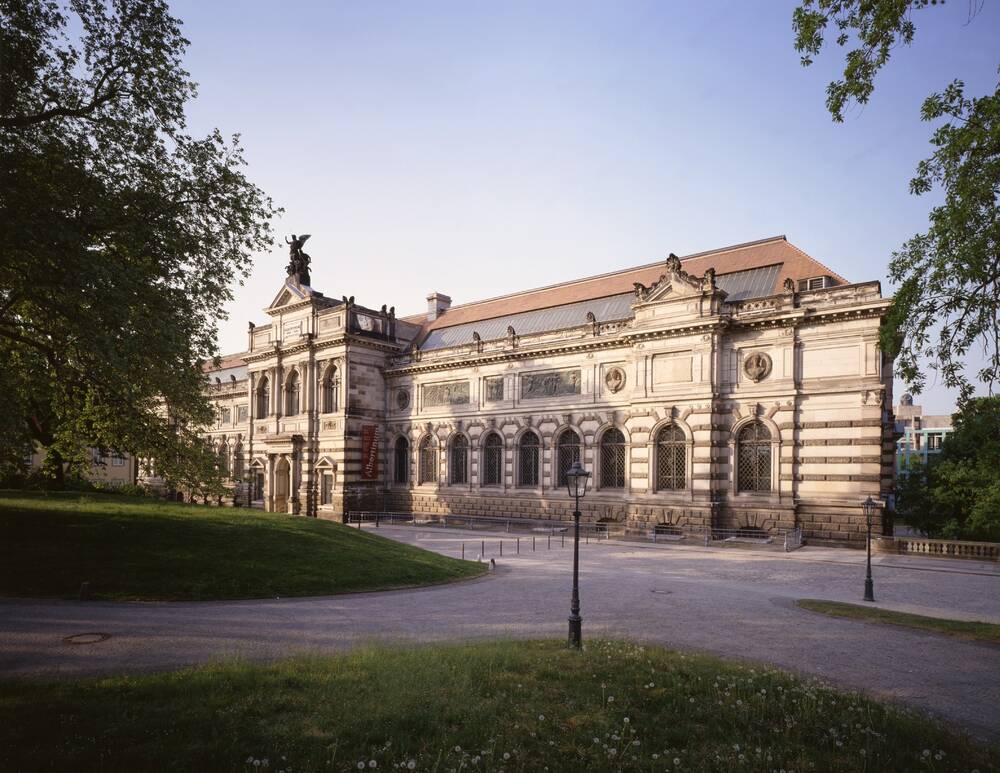
Das Albertinum, so Museumsdirektorin Hilke Wagner, „wurde zwischen 1559 und 1563 als Zeughaus gebaut und erfüllte demnach militärische Zwecke. Es wurde später im 17. Jahrhundert unter August dem Starken und im 18. Jahrhundert unter Friedrich August II. erweitert und umgebaut.
Ende des 19. Jahrhunderts erhielt das Haus zu Ehren von König Albert seinem Namen: Albertinum. In dieser Zeit wurden im Haus die Antiken- und die Abguss-Sammlung unter Direktor Georg Treu zur Skulpturensammlung vereinigt.
Georg Treu war eigentlich Archäologe, war aber jemand, der sich sehr für zeitgenössische Kunst interessierte und hat sich eingesetzt für den Ankauf z.B. von Auguste Rodin. Er hat es getan gegen die Widerstände der Stadt, es gab einen sogenannten Bildhauerstreit von lokalen Künstlern, die sich darüber echauffierten, wie man gerade einen französischen zeitgenössischen Künstler ankaufen könne. Heute verdanken wir der mutigen Ankaufspolitik von Georg Treu, dass wir eine der größten Rodin Sammlungen außerhalb Frankreichs besitzen.
Das Haus wurde 1945 infolge der Bombardierung von Dresden stark beschädigt; das Haupttreppenhaus und der Lichthof waren komplett ausgebrannt. Unsere Bestände wurden nach Moskau gebracht und kamen erst 1958 zurück.
1959 wird die Gemäldegalerie Neue Meister – das heißt die Bestände ab 1800 – aus der Gemäldegalerie Alte Meister herausgelöst und mit einer eigenen Direktion ausgestattet.
In Ermangelung anderer Ausstellungsflächen werden ab 1959 die Bestände der Skulpturensammlung, der Porzellansammlung, des Kupferstich-Kabinettes, der Neuen Meister, aber auch des Grünen Gewölbes, des Münzkabinetts und der Rüstkammer im Albertinum gezeigt.
Nach der Rekonstruktion des Zweiten Obergeschosses findet ab 1965 die ständige Ausstellung der Gemäldegalerie Neue Meister hier ihren Platz.
Alle fünf Jahre finden im Albertinum zudem die Kunstausstellungen der DDR statt – legendäre Ausstellungen, die man heute auch als „Documenta des Ostens“ bezeichnet.
2002 kam das Elbe-Hochwasser – und wir sind hier direkt an der Elbe gelegen –, überflutete Depots im Untergeschoss. Das Grüne Gewölbe zog wenig später aus, ebenso das Münzkabinett und ging ins Residenzschloss.
2005 wurde das Gerhard Richter Archiv im Albertinum gegründet. Und ihm verdanken wir, dass wir dauerhaft zwei Räume von Gerhard Richter in unserem Haus beherbergen.
2006-2010 erfolgten Umbau und Sanierung durch das Berliner Büro Staab Architekten. Der Clou dabei war natürlich die Überdachung des Lichthofes, die uns heute dieses wundervolle Forum ermöglicht.
2014 wurde die Verantwortung für die Sammlung der Galerie Neue Meister und der Skulpturensammlung ab 1800 erstmals unter eine Direktion gestellt – das war genau der Moment meines Dienstantrittes – um so den übergreifenden integrativen Ansatz des Museums der Moderne zu verstärken.“
Zusammen mit der benachbarten Hochschule für Bildende Künste und dem Ausstellungsgebäude Lipsius-Bau auf der anderen Seite des Georg-Treu-Platzes bildet das Albertinum ein gewichtiges Zentrum auch für zeitgenössische Kunst.
Hello – and to begin with, Hilke Wagner, the museum’s director, would like to welcome you to the museum.
A very warm welcome to the Atrium of the Albertinum. This wonderful space was created in 2010 when the museum was refurbished. Above us, there is the central storage facility for the Old and New Masters collections, as well as the main restoration workshops. The Atrium has a particular significance for us, since we see the museum as a place of exchanges and encounters – something which, naturally, this space especially encourages.
The Albertinum connects East and West, sculpture and painting, and the present with the future. Of course, connecting three centuries is a special challenge. Yet at the same time, this has proved especially fruitful, as we could often find points linking the topics of the past and the world today.
The Sculpture Collection, in particular, is intimately connected with this building. After all, in the nineteenth century, this was home to the collection under its renowned director Georg Treu, originally an archaeologist. We have Georg Treu to thank for acquiring what is today one of the largest collections of Auguste Rodin’s works in the world – and most certainly in Europe. Later the Gemäldegalerie – the Picture Gallery – was separated off from the Old Masters Collection and also moved into these rooms. Today, our aim to apply contemporary approaches to combining these various styles and genres and integrate their presentation with film, installations, and a variety of media to enable visitors to experience these riches to the full.
I hope you have a very enjoyable time discovering our collection. Incidentally, as a state collection, it also belongs to our visitors – after all, our task is to preserve, protect, research and pass on this important cultural heritage to the following generations.
As Hilke Wagner, the museum director, explains, the Albertinum dates from ...
“... between 1559 and 1563. Built as an arsenal, it had a military purpose. In the seventeenth century under Augustus the Strong and the eighteenth century under Friedrich August II, it then underwent a series of alterations and extensions.
It was first called the ‘Albertinum’ in the late nineteenth century in honour of King Albert of Saxony, then the reigning monarch.
At that time, under museum director Georg Treu, the Sculpture Collection was created by merging the antiquities and plaster casts collections. Although an archaeologist by profession, Treu was very interested in contemporary art. He was instrumental, for instance, in purchasing works by Auguste Rodin – even though this meant he had to push back against resistance in the city. Treu’s acquisition policy had incensed local sculptors and, in what became known as the ‘sculptor dispute’, they voiced their indignation at purchases of works by, of all people, a French contemporary artist. Today, thanks to Georg Treu’s courage and determination, we can boast one of the largest collections of Rodin’s works outside France.
The bombing of Dresden in 1945 left the Albertinum badly damaged, with the main staircase and atrium totally gutted by fire. Our holdings were taken to Moscow and only returned in 1958.
In 1959, the collection was divided into works before 1800 – the Gemäldegalerie Alte Meister – and works after 1800 – the Gemäldegalerie Neue Meister, which was also given its own management.
From 1959, due to a lack of exhibition space, the holdings of the Sculpture Collection, the Porcelain Collection, the Collection of Prints, Drawings and Photography, as well as the collection of New Masters’ paintings were also shown in the Albertinum, together with works from the Historic Green Vault, the Numismatic Collection and the Armoury.
With the second floor reconstructed by 1965, this space could be used to present the permanent exhibition of the Gemäldegalerie Neue Meister – the paintings from after 1800.
Every five years, the Albertinum also held the Art Exhibitions of the GDR – legendary exhibitions which today are also dubbed the ‘East German Documenta’.
In 2002, the River Elbe burst its banks. Since the Albertinum is located directly on the riverbank, it was badly hit, with the flood waters inundating our basement storage facilities. Two years later, the Historic Green Vault and the Numismatic Collection were moved out of the Albertinum and into the Palace.
In 2005, the Gerhard Richter Archive was founded. Thanks to the Archive, which is based in the Albertinum, we can now permanently dedicate two rooms to Gerhard Richter’s extensive oeuvre.
From 2006 to 2010, Staab Architekten, a Berlin-based architectural office, oversaw the Albertinum’s major programme of alterations and refurbishment. The project’s most ingenious feature was the idea of covering the atrium – which now provides us with this wonderful forum.
In 2014, the collections of paintings and of sculptures since 1800 were both placed under a single management team to further strengthen the museum’s cross-genre, integrative approach – and that was also the moment I started my work as director.”
Together with the neighbouring University of Fine Arts and the Lipsiusbau exhibition building on the other side of the Georg-Treu-Platz, the Albertinum is also a major centre for contemporary art.
Dobrý den! Vítáme Vás v naší galerii Albertinum. Hned na začátku Vaší prohlídky Vás chce pozdravit ředitelka naší galerie, Hilke Wágnerová:
Srdečně Vás vítám v atriu našeho Albertina. Tento krásný prostor vznikl roku 2010 během přestavby Albertina. Nad námi se nacházejí jednak centrální depozitáře Starých a nových mistrů, ale také centrální restaurátorské dílny. Pro naši galerii má atrium zvláštní význam, neboť my chápeme galerii jako místo setkání a vzájemné komunikace a k tomuto účelu je toto atrium obzvlášť vhodné.
V Albertinu se střetají východ a západ, sochařské a malířské umění stejně jako dnešek s budoucností. Pro nás je na jednu stranu samozřejmě velkým úkolem exponáty ze tří století uvést do vzájemné spojitosti, ale současně nám tato skutečnost nabízí možnost poukázat zde na různé tematické souvislosti v minulosti a současnosti.
Naše sbírka sochařského umění je s naší galerií obzvlášť úzce spojena: V 19. století ji zde vedl věhlasný Georg Treu, který byl původně archeologem a jemuž dnes vděčíme za zdejší sbírku děl Augusta Rodina – největší sbírku v celé Evropě a zároveň jednu z největších sbírek na celém světě.
Naším záměrem je představovat exponáty ve vzájemné souvislosti pokud možno moderním způsobem a prezentovat je také pomocí filmu, instalací a různých dalších médií, a tak je přiblížit našim návštěvníkům.
Nyní Vám přeju příjemný pobyt v naší galerii a hodně zábavy při objevování naší sbírky, která vlastně patří Vám. Naším úkolem je totiž sbírku chránit, opatrovat a zkoumat a zprostředkovat našim návštěvníkům – tedy právě Vám a následujícím generacím.
Albertinum, jak vypráví ředitelka muzea Hilke Wagnerová,
„bylo postaveno v letech 1559 a 1563 jako zbrojnice a sloužilo vojenským účelům. Později – v 17. století za vlády Augusta Silného a v 18. století za Fridricha Augusta II. – bylo rozšířeno a přestavěno.
Na konci 19. století byla zbrojnice na počest krále Alberta přejmenována na Albertinum. V této době také vznikla pod vedením George Treue zdejší sbírka sochařského umění – a sice sloučením sbírek antického umění a odlitků.
Georg Treu byl v první řadě archeologem, ale zároveň se také velmi zajímal o tehdejší současné umění a prosadil – přes odpor města – například nákup děl Augusta Rodina. Tato skutečnost byla důvodem tzv. sochařského sporu, ke kterému tenkrát došlo. Místní umělci se bouřili proti rozhodnutí nakoupit díla současného a navíc ještě francouzského umělce. Dnes vděčíme právě tomuto odvážnému rozhodnutí Georga Treue za jednu z největších sbírek Rodinových děl, která se nachází mimo Francii.
Albertinum bylo během bombardování Drážďan v roce 1945 silně poškozeno, hlavní schodiště a atrium zcela vyhořely. Zdejší sbírky byly odvezeny do Moskvy a zpět do Drážďan se vrátily až v roce 1958.
V roce 1959 byla sbírka děl Nových mistrů – tedy díla, jejichž vznik se datuje po roce 1800 – oddělena od sbírky děl Starých mistrů a bylo jí přiděleno vlastní ředitelství.
Kvůli nedostatku výstavních prostor byly v Albertinu od roku 1959 vystaveny jak sbírky sochařského umění, porcelánu, grafického umění a děl Nových mistrů, tak také exponáty z Grünes Gewölbe – česky Zelené klenby, tedy klenotnice saských kurfiřtů a králů –, numismatické sbírky a zbrojnice.