
Wer ist diese junge, in sich gekehrte Frau? Obwohl der Titel „Frl. Wandel in Dessau“ ihren Namen und Wohnort verrät und Kurator Andreas Dehmer intensiv recherchiert hat, liegt ihre Identität bis heute im Dunkeln. Unklar ist auch, so Dehmer, für wen und zu welchem Zweck August Hudler dieses intime Porträt geschaffen hat:
„Als Repräsentationsporträt wäre es ein bisschen leger. Das ist ein leichtes Untergewand und auf der einen Schulter hängt noch ein ebenso leichter Mantel herab. Es gibt ähnliche Porträts, die auch so ein bisschen in sich gekehrt sind und sehr starke Ruhe ausstrahlen, in der Grabkunst. Aber offenbar ist das Bildwerk nicht aufgekauft worden oder hat den Auftraggeber nicht erreicht oder die Auftraggeberin. weil es aus dem Nachlass des Künstlers ins Museum gekommen ist.“
Für den Verkauf hätte der Bildhauer die Figur in Bronze gießen lassen müssen. Vielleicht ist dies auch geschehen – und das Modell verblieb beim Künstler. Darüber ist aber nichts bekannt. So bleibt es ein Werk mit offenen Fragen, allerdings auch mit vielen Erkenntnissen, die sich aus der Untersuchung des Materials ergaben:
„Man denkt, es könnte eine metallene Form sein, ein Material, das edel ist. Aber es handelt sich einfach um Gips. Um eine Reproduktionsmasse, die der Künstler aber gezielt eingesetzt hat, um daran auch etwas probieren zu können. Und zwar verschiedene Effekte.“
Der Grünton des Körpers und die schimmernden Brauntöne der Kleidung imitieren die Patina von Bronze. Die Haut hat Hudler glatt und ebenmäßig modelliert, die Kleidung mit Falten und kleinen Unregelmäßigkeiten. Auch Maltechniken probierte er aus, denn er hatte in München zunächst eine Ausbildung als Maler erhalten, bevor er an der Akademie Bildhauerei studierte.
Im Jahr 1900 kam der Künstler nach Dresden und machte schnell auf sich aufmerksam, unter anderem auch den Direktor der Skulpturensammlung Georg Treu.
In einem Hohlraum im Inneren der Büste fand man einen Zettel mit dem Hinweis, dass „Frl. Wandel“ 1901 auf der Internationalen Kunstausstellung in Dresden ausgestellt war. Wenige Jahre später starb August Hudler mit nur 37 Jahren. Sein Werk blieb lange unbekannt. Heute aber berührt „Fräulein Wandel“ wieder viele Menschen, ganz im Sinne des Künstlers:
„Bei ihr ist das so eine Verinnerlichung, so eine ganz starke Kontemplation, die ihm aber in seiner Kunst sehr wichtig gewesen ist…“
Weitere Medien
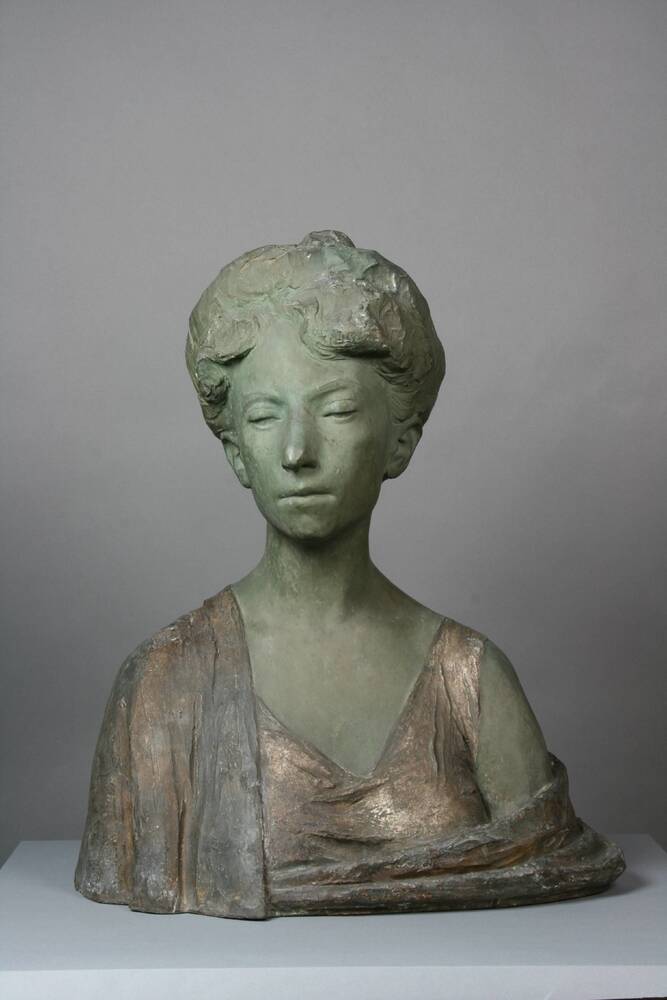
Who is this young woman, lost in her thoughts? Although the title Fraulein Wandel in Dessau tells us her name and the town where she lived, her identity remains a mystery even now – despite intensive research by curator Andreas Dehmer. As he points out, it’s also unclear why August Hudler created this intimate portrait, or who it was for:
‘This would be a bit too casual as a prestigious portrait for display. The woman is dressed in a light undergarment, with a similarly light gown hanging down from one shoulder. The figure seems withdrawn, yet very calm and composed – and portraits with a similar mood can be found in funerary art. The work entered the museum from the artist’s estate, so evidently it was never sold, or never reached the person who commissioned it.’
To sell this work, Hudler would have had the figure cast in bronze. Possibly, he did just that – and simply kept this model. But here too, there is no concrete evidence one way or the other. So Hudler’s sculpture continues to be a work of speculation and unresolved questions – yet with many insights gained in the examination of the material.
‘When you look at this sculpture, it seems to be some sort of noble metal. In reality, though, it’s simply made of plaster – a material to reproduce works, and also deliberately used for trying out other approaches, in this case, testing different effects.’
The body’s green tone and the shimmering brown hues of the garments imitate a bronze patina. Hudler modelled the skin evenly and smoothly, while the robes have folds and little irregularities. He also experimented with painting techniques – after all, he had initially trained as a painter in Munich before he studied sculpture at the art academy.
In 1900, he moved to Dresden. Here, he quickly became known in art circles and also attracted the attention of, for instance, Georg Treu, Director of the Sculpture Collection.
A note found in a hollow inside the bust stated that ‘Fraulein Wandel’ was shown at Dresden’s International Art Exhibition in 1901. August Hudler died a few years later, aged just 37. For a long time, his oeuvre remained largely unknown. Today, though, ‘Fräulein Wandel’ touches many viewers, just as the artist had hoped:
‘She has precisely that introspection, that strong sense of contemplation, so very important to Hudler in his art…’
Kdo je tato mladá, introvertní žena? Přestože název „Slečna Wandelová v Desavě" prozrazuje jméno zobrazené a zároveň její místo pobytu a přestože se kurátor Andreas Dehmer usilovně snažil její identitu vypátrat, dodnes její totožnost neznáme. Podle Dehmera také není jasné, pro koho a za jakým účelem August Hudler tento intimní portrét vytvořil:
„Jako reprezentační portrét je toto dílo trochu moc ležérní. Mladá žena má na sobě lehké spodní prádlo a pravé rameno halí také jen lehký plášť. Podobné portréty, na kterých je zobrazená nějaká osoba zahloubená do svých myšlenek vyzařující velký klid, se vyskytují častěji jako náhrobky. Toto dílo zřejmě nikdo nevykoupil nebo se nikdy nedostalo k původnímu zákazníkovi či zákaznici. Do našeho muzea se dostalo přímo z umělcovy pozůstalosti.“
Aby autor sochy mohl své dílo prodat, musel by jej nechat odlít do bronzu. Možná tomu tak dokonce bylo – a u umělce zůstal jen tento model. Ale o tom nám není nic známo, a tak zůstává nezodpovězeno mnoho otázek. Z průzkumu materiálu vyplývá však také několik poznatků:
„Člověk by si mohl myslet, že se jedná o bronz, tedy o ušlechtilý materiál. Ale portrét je odlit pouze ze sádry, tedy z reprodukčního materiálu. Umělec jej použil úmyslně, aby si na něm mohl něco vyzkoušet – a sice různé efekty.“
Zelený odstín použitý na pleti a třpytivé, hnědé tóny oblečení imitují patinu bronzu. Povrch těla vymodeloval Hudler hladce a rovnoměrně, šaty ale zobrazil s různými záhyby a drobnými nerovnostmi. Na patině si vyzkoušel také různé malířské techniky. Před studiem sochařství na Akademii se totiž nejprve v Mnichově vyučil malířem.
Když roku 1900 přišel Hudler do Drážďan, upoutal rychle pozornost veřejnosti – mimo jiné také ředitele naší sochařské sbírky Georga Treue.
Odlitek busty je dutý a byl v něm nalezen lístek s poukazem, že „ Slečna Wandelová“ byla vystavena na Mezinárodní výstavě umění v Drážďanech roku 1901. O několik málo let později August Hudler zemřel ve věku pouhých 37 let. Jeho dílo zůstalo dlouho neznámé. Dnes však „Slečna Wandelová“ znovu budí pozornost a city mnoha lidí, zcela v duchu umělce:
„Vyvolává v nás téměř vnitřní rozjímání, takovou velmi silnou kontemplaci, která pro jeho umění byla velmi důležitá …“
- Ort & Datierung
- 1899
- Material & Technik
- Gips, farbig differenzierte bronzeimitierende Fassung,
- Dimenions
- H: 61,0 cm, B: 50,0 cm, T: 30,0 cm
- Museum
- Skulpturensammlung
- Inventarnummer
- ASN 0950