
Ein großes Tor öffnet sich auf ein abendliches Gräberfeld, das vom Mondlicht und Nebelschwaden in eine geheimnisvolle Stimmung getaucht wird. Vor dem linken Pfeiler stehen zaghaft ein Mann und eine Frau. Obwohl das Tor geöffnet ist, zögern sie, den Friedhof zu betreten. Ihre Blicke richten sich auf eine Stelle direkt hinter dem Eingang. Dort ist als dunkler Fleck ein frisch aufgeworfenes Grab zu erkennen, rechts daneben liegt eine Leiter, auf der vermutlich der Leichnam herbeigeschafft worden ist.
Die Vermutung liegt nahe, dass wir hier ein Paar vor dem Grab ihres gerade erst verstorbenen Kindes sehen. Als Caspar David Friedrich das Bild um 1825 malte, hatte er gerade selbst das zweite seiner insgesamt vier Kinder verloren. Wahrscheinlich ist „Der Friedhof“ ein höchst intimes Erinnerungsbild. Dazu würde auch passen, dass er dieses Werk nie verkauft hat.
Bei aller Tragik steckt aber auch etwas Tröstendes in seinem Motiv. Denn es sind noch zwei andere Figuren anwesend, die Friedrich so fein gemalt hat, dass man sie nur schemenhaft erkennen kann: direkt über dem Grab ein Oberkörper mit Kopf und Armen und auf Höhe der Baumwipfel ein Engel mit ausgebreiteten Armen. Ein Freund des Malers, der russische Staatsrat Wassili Schukowski, der das Gemälde damals in seinem Atelier sah, beschreibt die Szenerie so:
„Sie glauben zu sehen, dass sich ihr Kind aus seinem Grab erhebt, dass die Schatten seiner Ahnen sich auf es zu bewegen und ihm die Arme entgegenstrecken, und dass ein Friedensengel (…) über ihnen schwebt, und sie vereint.“
Ob Caspar David Friedrich diese geisterhaften Figuren absichtlich so belassen oder das Bild einfach nicht zu Ende gemalt hat, ist unklar.
Weitere Medien
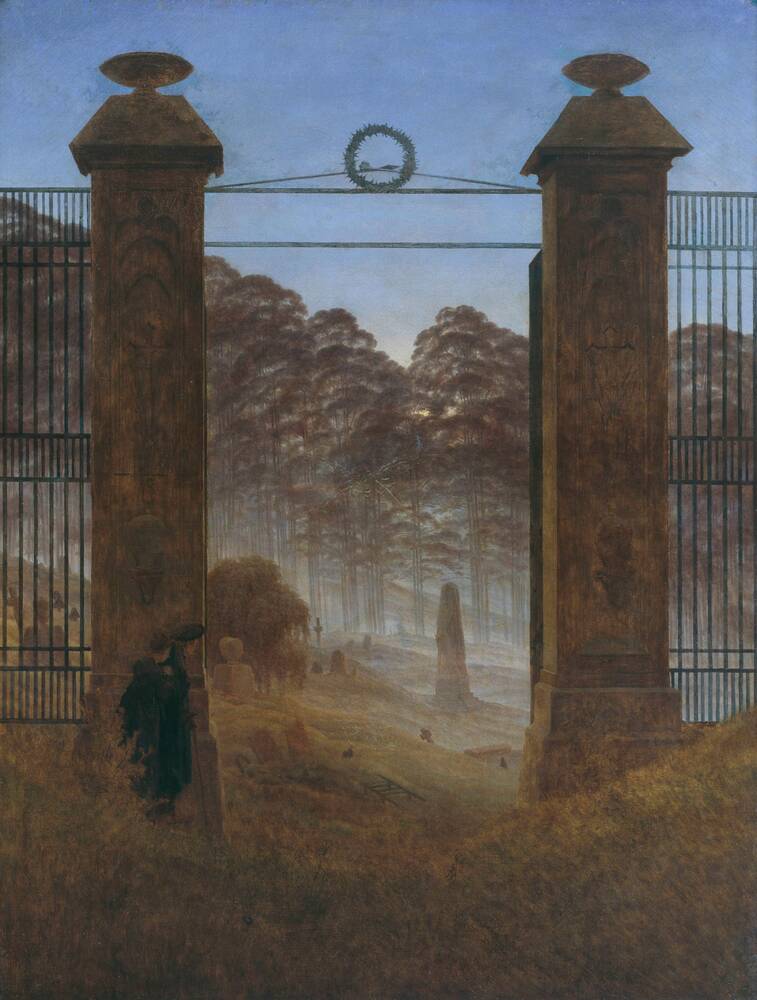
A large gate opens onto a cemetery in the evening. With its moonlight and patches of drifting fog, the scene has a mysterious, other-worldly atmosphere. On the left, a man and a woman stand indecisively at the large stone gatepost. Even though the gate is open, they hesitate to enter. They gaze is fixed on a point directly behind the entrance, where a dark patch of ground indicates a freshly dug grave. To the right, the ladder lying in the grass may have been used to carry the body to the cemetery.
It seems likely, then, that we are looking at a couple in front of the grave of their child who had just died. When Caspar David Friedrich painted this work in around 1825, he had recently lost the second of his four children. Quite possibly, The Cemetery is a highly intimate painting, a personal memento – an idea also supported by the fact Friedrich never sold this work.
Despite the scene’s tragic nature, his composition also has a consoling element – evident in the two other figures here as well, painted so finely they seem hazy and indistinct. Directly over the grave, we can see a torso with a head and arms, and there’s also an angel with outspread arms at the height of the trees. Friedrich was friends with the Russian poet and privy councillor Vasily Zhukovsky, who saw the painting in the artist’s studio and later described it in the words:
‘They think they can see their child rising from its grave, the shades of its ancestors moving towards it, stretching out their arms to the child, and an angel of peace (...) floating over them and uniting them.’
But it remains unclear whether Caspar David Friedrich intentionally left these ghostly figures as they are or just never finished painting them.
Velká brána tu stojí otevřená a my vidíme večerní hřbitov s náhrobky, které se v měsíčním světle a mlžném oparu halí do tajemné nálady. Před levým sloupem nesměle stojí muž a žena. Přestože je brána otevřená, váhají, zda vstoupit na hřbitov. Svůj pohled upírají na jedno místo hned za branou. Tam se nachází čerstvě vykopaný hrob s tmavou půdou. Vpravo od něj leží žebřík, na němž sem asi bylo přineseno tělo zesnulého.
Zdá se být pravděpodobné, že se díváme na manželský pár před hrobem jejich dítěte, které právě zemřelo. Když Caspar David Friedrich obraz kolem roku 1825 maloval, právě přišel sám o druhé ze svých čtyř dětí a na obraze „Hřbitov“ pravděpodobně zachytil své intimní vzpomínky. Tuto domněnku podporuje také skutečnost, že obraz nikdy neprodal.
Přes veškerou tragiku skrývá však motiv obrazu také něco utěšujícího. Jsou na něm totiž zobrazeny další dvě postavy, které Friedrich namaloval tak jemně, že je lze sotva rozeznat: přímo nad hrobem torzo s hlavou a rukama a ve výšce korun stromů anděla s rozpaženýma rukama. Malířův přítel a ruský státní rada Vasilij Žukovskij, který obraz tehdy viděl v umělcově ateliéru, popisuje výjev takto:
„Tento pář věří, že vidí, jak jejich zesnulé dítě vstává z hrobu, jak se k němu blíží stíny jeho předků a vztahují k němu ruce, a že se nad nimi vznáší anděl míru (...) a spojuje je.“
Zda Caspar David Friedrich tyto nadpřirozené postavy na obraze záměrně ponechal nebo obraz prostě nedokončil, není jasné.
- Ort & Datierung
- Um 1825 Um 1825 (Bestandskatalog 2010) 1825
- Material & Technik
- Öl auf Leinwand
- Dimenions
- 143 x 110 cm
- Museum
- Galerie Neue Meister
- Inventarnummer
- Gal.-Nr. 2197 B