
Further Media
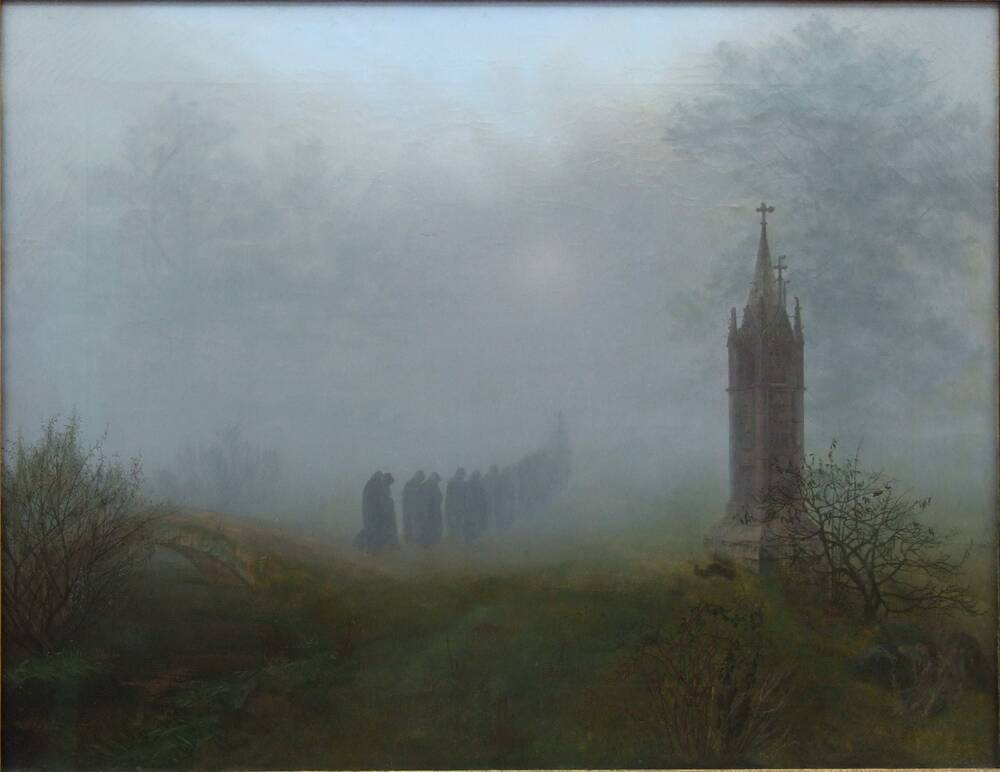
A wayside shrine in the foreground and figures vanishing into a misty background – a scene with a mysterious, sombre quality. You almost seem to feel the damp, chilly air and hear the murmur of the monks as they chant their prayers. In a few moments, the procession will be swallowed by the mist – and already the cross carried at the head of the column is hardly discernible. But this is not a scene without hope. The first rays of sun cut through the misty greyness, hints of shimmering blue sky appear, and the crowns of tall trees emerge – all signalling the promise of new day.
Ernst Ferdinand Oehme was just 31 years old when he successfully captured this atmospheric depiction of a misty morning – a subject much loved by the Dresden Romantic painters. Here, Oehme directly references Caspar David Friedrich, his great artistic inspiration, who viewed landscape painting as a vehicle to express emotions. In Friedrich’s Abbey in the Oak Wood, for instance, there is also a group of monks in a landscape set against a dark bank of fog. Yet by taking the misty blur as the subject of his work, Oehme gives the topic a very new interpretation all his own. For Romantic artists, this blurring also had a religious significance, alluding to the ultimate divine presence of God behind the world of appearances.
But in terms of painting, a blurred image is a challenge, sketching in something, alluding to it and, in this way, bringing it alive. For curator Holger Birkholz, this offers a very interesting comparison with one of the contemporary artists on show in the Albertinum – none other than Gerhard Richter.
“In Richter’s case, the blurring always runs across the entire image. To produce that effect, he drags a squeegee or a dry brush over the wet surface. The Dresden Romantic painters always combined areas. The foreground was often composed as a drawing with the contours of objects still visible, creating a sense of perspective. In this work, for instance, the bushes in the foreground are still well delineated, as are the birds, and they have a haptic quality. Oehme’s blurred painted elements then allow him to develop a sense of spatial depth…“
Zasmušile a tajuplně na nás působí scéna, na níž v popředí vynikají Boží muka. Skoro se zdá, jako by až k nám pronikal ten vlhký chlad a jako bychom slyšeli tiché mumlání modlících se mnichů. Ještě pár okamžiků a průvod zmizí v mlze, kříž v čele procesí je ještě sotva vidět. A přece scéna vyzařuje naději: Jemná modř a první sluneční paprsky se prodírají šedými mraky. V mlžném oparu již tušíme košaté stromy a s nimi příslib nového dne.
Ernestu Ferdinandu Oehmeovi bylo pouhých 31 let, když se mu podařilo vytvořit toto působivé vyobrazení mlhavého rána – typického motivu pro drážďanský romantismus. Oehme se zde staví do přímé linie se svým vzorem Casparem Davidem Friedrichem, který chápal krajinomalbu jako vyjádření malířových pocitů. Také na Friedrichově obraze „Opatství v Eichwaldu“ vidíme skupinu mnichů v krajině, kterou halí temný závoj mlhy. Oehme však dochází ke zcela vlastní, nové interpretaci tohoto motivu a jako hlavní námět zde volí právě nezaostřený pohled na krajinu. Pro romantiky to má spirituální význam, neboť poukazuje na skutečnost, že krajina je pouhým božím otiskem a za vším zdáním stojí Bůh.
Nezaostřený pohled však z hlediska malířské techniky vyžaduje značnou dovednost: motiv je pouze naznačen a tím vyvolává dojem pohybu. Proto je pro kurátora Holgera Birkholze velmi zajímavé srovnání s jedním současným umělcem zastoupeným v Albertinu: s Gerhardem Richterem.
„Nezaostřenost v Richterově díle postihuje vždy celý obraz, to znamená, že nezaostřený pohled vzniká narušením ještě mokré barvy – buď stěrkou nebo štětcem. U drážďanských romantiků se ale na obrazech ještě střídají části, které jsou malířsky přesnější, na kterých jsou viditelné jednotlivé kontury – to bývá většinou v popředí, a tím malíři dosahují hloubky na obraze. Zde jsou takto zobrazeny keře vepředu, které jsou téměř hmatatelné a jsou dobře vidět, nebo také ptáci. Vedle toho Oehme prohloubil prostor prostřednictvím prvků, které vidíme nezaostřeně.“
- Location & Dating
- 1828
- Material & Technique
- Oil on Canvas
- Dimenions
- 81 x 105,5 cm (Katalogmaß 2010) 83 x 106,3 cm (Inventurmaß, 26.04.2010) 95,7 x 119,7 x 9 cm (Rahmenmaß, Tobias Lange, 26.04.2010)
- Museum
- Galerie Neue Meister
- Inventory number
- Gal.-Nr. 2219 C