
Further Media
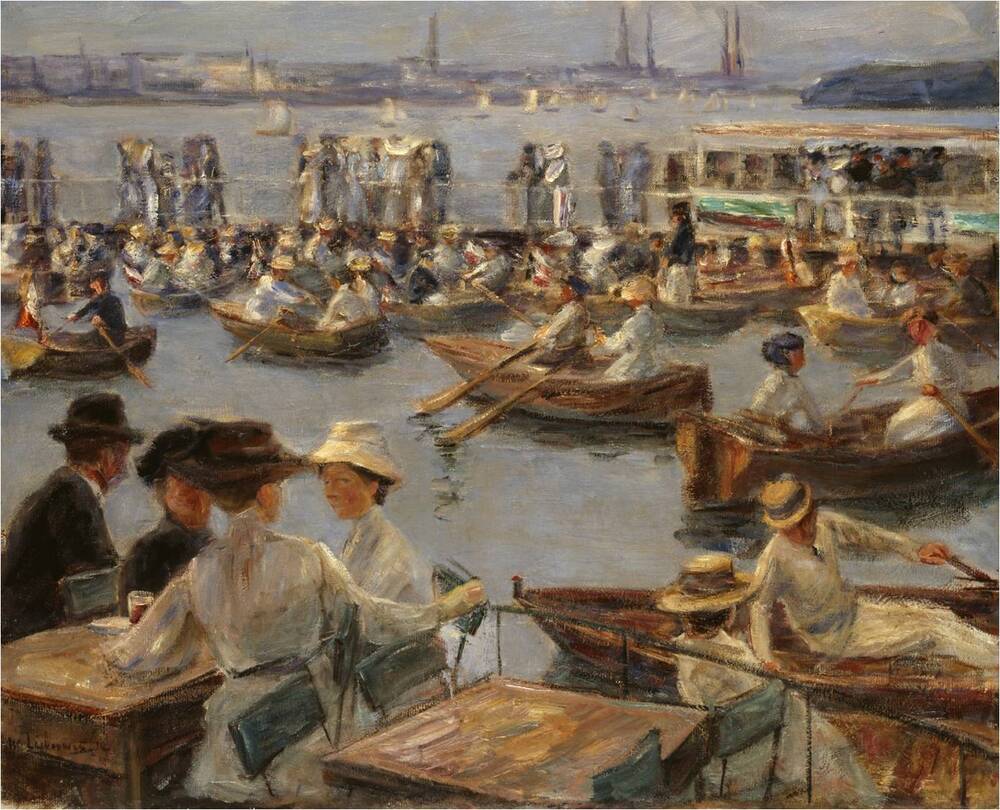
In a slight haze, the tranquil evening light lies across Hamburg’s Outer Alster lake – a magical atmosphere perfect for a parade of rowing boats. Men and women from the well-to-do classes come here to relax and chat, some are manoeuvring their boats past each other on the water, but all are enjoying moments of leisure as the day draws to a close.
When he painted this work in 1910, Max Liebermann was already a renowned artist. The painting was commissioned by Alfred Lichtwark, director of the Hamburger Kunsthalle. After executing some initial studies at the Uhlenhorst ferry house, Liebermann completed this work in his Berlin studio – and did not, as might be deduced from the impressionist style, capture such momentary impressions directly at the Alster lake.
In fact, Liebermann reworked the painting a number of times. At least three versions of it are known today. He was constantly battling to balance the scene – how many details could he include without losing the atmosphere and its sense of lightness? Ultimately, Liebermann decided against a detailed depiction of individual motifs in favour of a composite design emphasising the surface of the work.
In 1913, this version of the painting was acquired for Dresden’s Gemäldegalerie. This was just the second Liebermann in its collection – even though at that time there were over 50 oil paintings by the artist in the city’s private collections.
Nad jezerem Vnější Alstera – německy „Außenalster“ – se již rozprostírá poklidný závoj večerního světla a okouzlující atmosféra je jako stvořená pro projížďku lodí. Dámy a pánové z lepší společnosti se scházejí, povídají si, někteří se snaží proplout na loďce kolem ostatních a všichni si užívají lehkosti doznívajícího se dne.
Když Max Liebermann roku 1910 tento obraz maloval, byl již dlouho známý. Zakázku pro toto dílo dostal od ředitele hamburské Kunsthalle, Alfreda Lichtwarka. Po studiích na místě přívozu v Uhlenhorstu Liebermann obraz dokončil ve svém berlínském ateliéru – a nikoliv, jak by člověk díky impresionistickému stylu mohl předpokládat, přímo u jezera, kde by malíř býval zachytil dojmy z okamžiku přímo na plátno.
Liebermann obraz několikrát přepracoval, známé jsou tři další verze. Neustále zde bojoval o rovnováhu: Kolik detailů je možné zachytit, aniž by atmosféra ztratila svou lehkost? Malíř nakonec upustil od detailního zobrazení jednotlivých motivů ve prospěch sjednocujícího, plošného zobrazení.
Drážďanská Galerie Nových a starých mistrů obraz získala roku 1913, přičemž se jednalo teprve o druhé Liebermannovo dílo, zatímco v soukromých sbírkách drážďanských sběratelů se již tenkrát nacházelo více než jeho 50 olejomaleb.
- Location & Dating
- 1910
- Material & Technique
- Oil on Canvas
- Dimenions
- 85,5 x 104 cm (Katalogmaß 2010) 84,5 x 104 cm (Inventurmaß, 04.05.2010) 115,5 x 136,3 x 14,5 cm (Rahmenmaß, Tobias Lange, 04.05.2010)
- Museum
- Galerie Neue Meister
- Inventory number
- Gal.-Nr. 2457 A