
Further Media
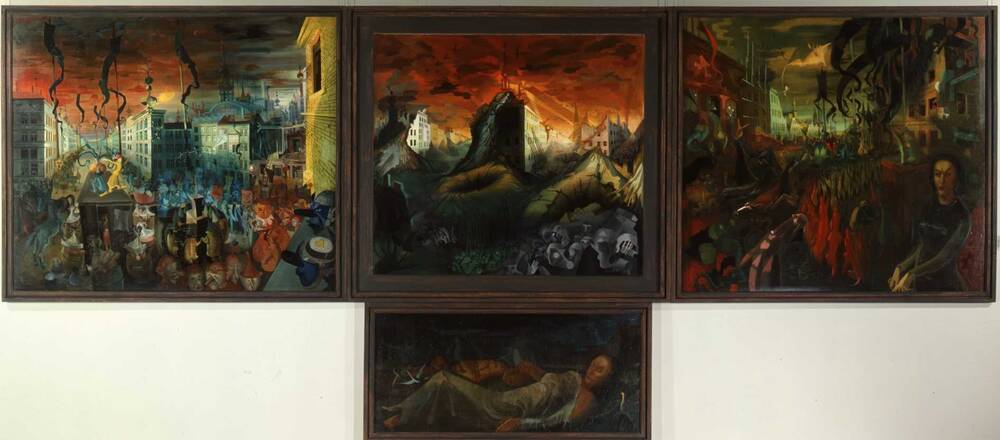
Writing in retrospect about his triptych The Thousand Year Reich, Dresden artist Hans Grundig noted.
“As far as possible with my abilities as an artist, I portrayed this terrible period of unspeakable barbarism.”
Grundig was an active and convicted communist. He painted this work secretly in his studio in the 1930s during the years of the Nazi regime. To prevent the massive panels from being discovered if his studio was searched, he fixed them on the ceiling with their painted sides hidden. For his triptych, Grundig developed imaginative, fantasy scenes in the tradition of an artist such as Hieronymus Bosch. He first painted the left-hand panel Carnival in 1935, describing it as:
“A parade in a vast city which, with the blood-red sky above, seems to be on fire. People and masks have gone crazy, marching through the streets, deluding themselves and others. Solely in the left-hand corner, the communists are still standing, unwavering and steadfast.”
In 1936, Hans Grundig painted the central panel Vision. It shows a burning city of ruins and bomb craters, as if he could foresee Dresden’s destruction in a devastating bombing raid.
Two years later, in 1938, he finished the third panel, Chaos. On the left, the rearing horses symbolise the victims of the Nazi regime. The pack of wolves in fiery red and poisonous yellow represent the Nazis. They are baying at the yellow pig on a pedestal. On the far right, the artist’s wife, the graphic artist Lea Grundig, turns away from the events to look out of the picture. She is also shown below in the predella scene, asleep and surrounded by doves of peace.
Under the Nazi regime, Hans Grundig was arrested numerous times for his communist beliefs, and spend some years in the Sachsenhausen concentration camp. His wife Lea Grundig, from a Jewish background and also a communist, fled to Palestine in 1939. The couple were only reunited in Dresden in 1949.
"Snažil jsem se celou svou uměleckou silou zachytit strašlivé období nevýslovného barbarství",
... píše ve svých vzpomínkách drážďanský malíř Hans Grundig o svém triptychonu "Tisíciletá říše". Grundig byl přesvědčeným a aktivním přívržencem komunismu. Všechny čtyři obrazy vytvořil tajně ve svém ateliéru během nacistického režimu, a aby nebyly při domovních prohlídkách objeveny, připevnil je malovanou stranou nahoře pod stropem ateliéru.
Grundig zde zobrazil fantastické motivy připomínající dílo Hieronyma Bosche. Jako první namaloval roku 1935 levou část triptychu s názvem "Karneval".
"Ulice obrovského města, které jakoby hořely pod krvavě červenou oblohou. Ulicemi táhnou šílení lidé a masky, které klamou sebe samy a ostatní. Jen v levém rohu stojí komunisté, neohrožení a neotřesení ve svých názorech."
Roku 1936 vznikla střední část: "Vize" hořícího, zničeného města se stopami po bombách - téměř jakoby Grundig tušil a předpovídal zničení Drážďan na konci druhé světové války.
Dva roky později namaloval třetí obraz: "Chaos". Vlevo vidíme vzpínající se koně - symbol obětí režimu; vpravo smečku vlků v ohnivě červené a jedovatě žluté, která vyje před žlutým prasetem na podstavci - symbol pro nacisty. Úplně vpravo se Grundigova žena, grafička Lea Grundigová, znechuceně odvrací od toho, co viděla. Dole na predely ji vidíme opět, spící a obklopenou holubi, symboly míru.
Komunista Hans Grundig byl během vlády nacistů v Německu vícekrát zatčen a strávil několik let v koncentračním táboře Sachsenhausen. Lea Grundigová, také přívrženka komunismu a navíc židovského původu, uprchla roku 1939 do Palestiny. Teprve po válce roku 1949 se manželé opět setkali v Drážďanech.
- Location & Dating
- 1935-38
- Material & Technique
- Oil on wood, Predella: oil on canvas
- Dimenions
- 150 x 178 cm (linke Tafel), 130 x 152 cm (Mitteltafel), 152 x 170 cm (rechte Tafel); Predella: 67 x 146 cm (Katalogmaß 2010) 2981 A (linke Tafel): 152,7 x 179,8 cm (Inventurmaß, Tobias Lange, 18.11.2010) 2981 A (linke Tafel): 160,7 x 187,5 x 3,7 cm (Rahmenmaß, Tobias Lange, 18.11.2010) 2981 B (mittlereTafel): 130 x 152 cm (exakte Prügfung nicht möglich, da Bildtafel rückseitig mit Leisten abgedeckt. Tobias Lange, 18.11.2010) 2981 B (mittlere Tafel): 160,4 x 175,7 x 3,7 cm (Rahmenmaß, Tobias Lange, 18.11.2010) 2981 C (rechte Tafel): 152,6 x 170,4 cm (Inventurmaß, Tobias Lange, 18.11.2010) 2981 C (rechte Tafel): 160,5 x 178,4 x 3,7 cm (Rahmenmaß, Tobias Lange, 18.11.2010) 2981 D (Predella): 70,6 x 151,1 cm (Inventurmaß, Tobias Lange, 18.11.2010) 2981 D (Predalla): 76,6 x 156 x 3,7 cm (Rahmenmaß, Tobias Lange, 18.11.2010)
- Museum
- Galerie Neue Meister
- Inventory number
- Gal.-Nr. 2981