
Further Media
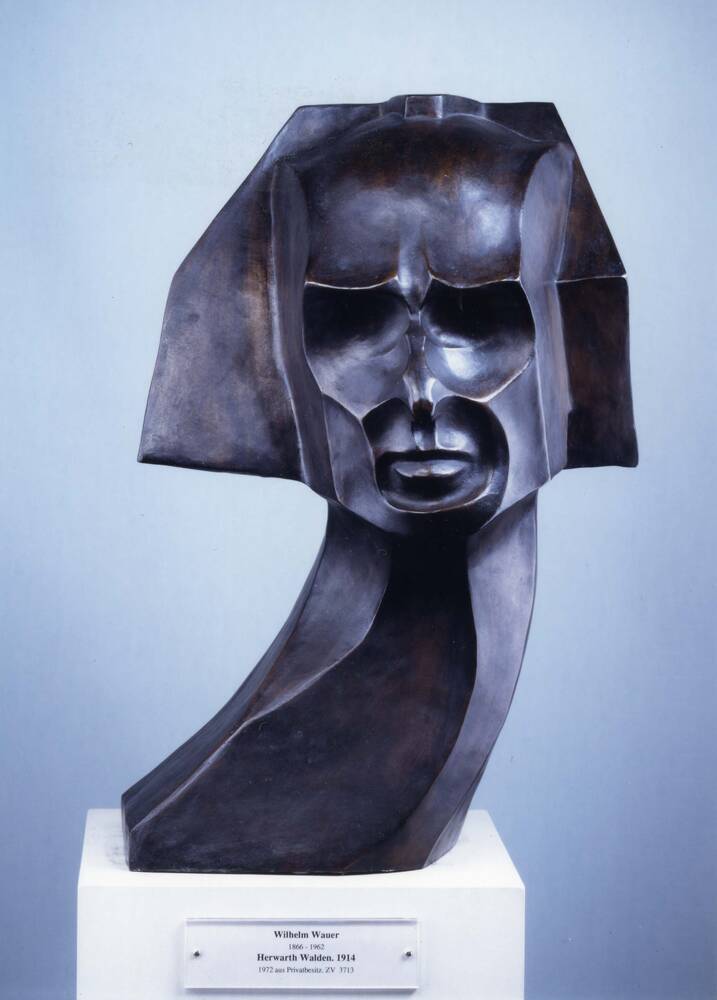
This bronze portrait head tells the story of two exceptionally talented figures. The head is the work of William Wauer – artist, sculptor, art critic, writer and director. The sitter was Herwarth Walden – musician, composer, writer and one of the leading promoters of the German avant-garde in the early twentieth century. Walden had an ingenious and eccentric mind, constantly searching for new forms in literature and the visual arts – and this portrait head reflects just those qualities.
This work from 1917 was one of William Wauer’s first sculptures. At that time, he had already made a name as a film director – and the influence of the aesthetics of early black-and-white cinema, with its strong contrasts, is only too evident in this work. Set on a distinctly elongated and curved neck, the head is composed of sharply juxtaposed surfaces and dips. Behind the extremely high forehead, the hair is shaped like a box around the back of the head. Although the eyes are not defined at all in the deep-set sockets, the figure seems to gaze out inscrutably. There is only one detail true to life – the mouth with its full lower lip, which lends the angular face a certain softness. Despite its radically abstracted features, the portrait remains a recognisable likeness.
Herwarth Walden was born in 1878 as Georg Lewin, and given his pseudonym by his first wife, the poet Else Lasker-Schüler. For 22 years, Walden issued Der Sturm, a magazine which attracted contributions from many renowned writers. Walden’s art gallery in Berlin also became famous under the same name. There, he helped such figures as Wassily Kandinsky and Max Ernst to their breakthrough as artists, showed works by members of the Blaue Reiter group as well as the Italian Futurists – works which may have inspired this portrait head by Walden’s friend Wilhelm Wauer.
Tato bronzová plastika vypráví příběh dvou mimořádně nadaných osobností. Autorem je William Wauer – malíř, sochař, kritik umění, spisovatel a režisér. Portrétovaným je Herwarth Walden – hudebník, skladatel, spisovatel a jeden z nejvýznamnějších podporovatelů německé avantgardy na počátku 20. století. Byl to chytrý a výstřední člověk, který hledal nové formy v literatuře a ve výtvarném umění – a přesně to se odráží v našem portrétu.
Když William Wauer roku 1917 na této soše – jako jedné ze svých prvních – pracoval, byl již známým filmovým režisérem. Nelze přehlédnout, že toto dílo silně ovlivnila estetika raného černobílého filmu a jeho výrazné kontrasty. Na prohnutém a příliš dlouhém krku sedí hlava složená z jednotlivých ploch s ostrými hranami. Za extrémně vysokým čelem leží vlasy tvořící téměř krabici kolem zadní části hlavy. Pohled z hlubokých očních důlků se zdá být velmi pronikavý, ačkoli oči samotné nejsou vůbec vymodelované. Jediným realistickým detailem jsou ústa s plným spodním rtem. Dodávájí hranatému obličeji jemný a měkký rys. Navzdory radikální abstrakci je portrétovaný dobře poznat.
Herwarth Walden se narodil roku 1878 pod jménem Georg Lewin. Za svůj pseudonym vděčil své první ženě, básnířce Else Lasker-Schülerové. Po 22 let vydával časopis Der Sturm, do nějž přispívala řada známých literátů. Ve své stejnojmenné berlínské galerii pomohl umělcům, jako například Wassilu Kandinskému a Maxu Ernstovi, k jejich prvním úspěchům. Vystavoval zde díla členů umělecké skupiny Der Blaue Reiter – česky Modrý jezdec – stejně jako italských futuristů, kteří možná ovlivnili jeho přítele Wilhelma Wauera u tohoto portrétu.
- Location & Dating
- 1917
- Material & Technique
- Bronze
- Dimenions
- H: 53,3 cm, B: 34,5 cm, T: 34,0 cm
- Museum
- Skulpturensammlung
- Inventory number
- ZV 3713