
Further Media
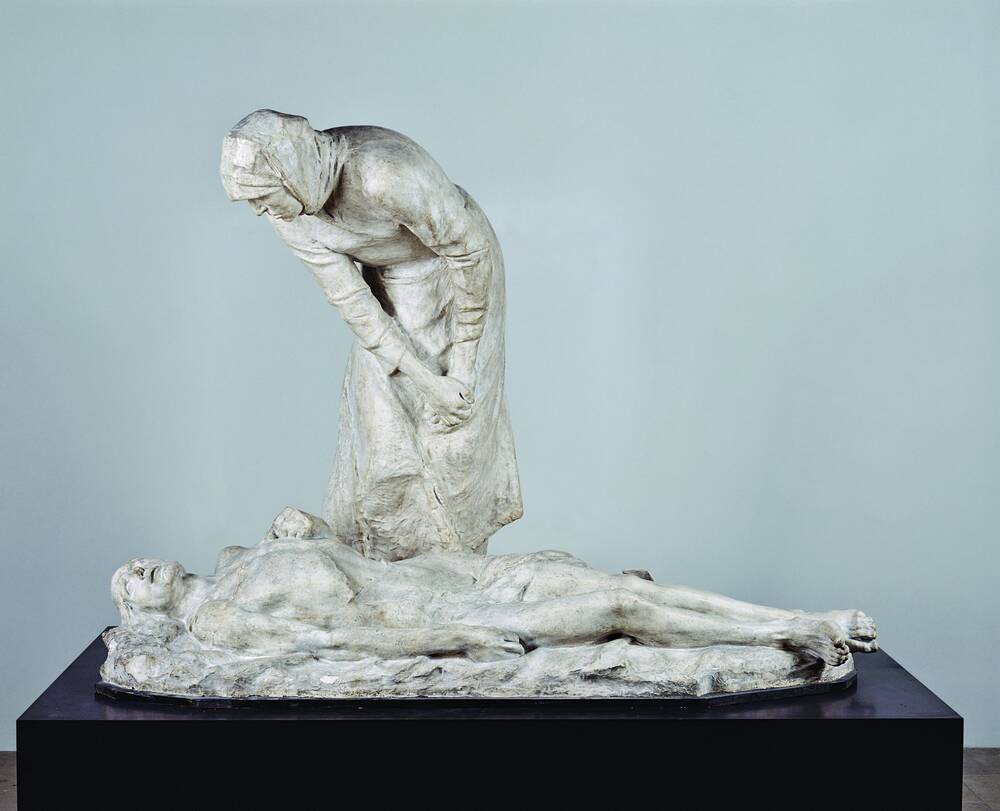
On 4 March 1887, over 100 coalminers lost their lives in a mining disaster in Belgium’s Borinage coalfield. Constantin Meunier immediately went to the site of the accident. He witnessed how the bodies were brought to the surface and identified by their relatives. He spent days making drawings which later inspired one of his major works – a sculpture of a mother bending over her son’s naked corpse. The young man’s head is thrown back, his lips slightly apart, his left hand gripping a piece of material. He died in the mine in an explosion of firedamp – a flammable gas.
The composition of Meunier’s Firedamp sculpture recalls a pieta, though Meunier gives this religious subject a modern meaning. He neither dramatises the scene, nor idealises the figures. Instead, it is their simple gestures which move us. This plaster copy was acquired by Georg Treu, then Director of the Sculpture Collection in Dresden. He wrote about this work:
“It is as if the sculptor found the tragedy of this mother’s pain too solemn, too dignified, to try and improve on it. Here, only the most unadorned truth and greatness could offer a suitable form for such an event.”
Meunier had travelled through this region of vast coalfields a few years before the mine disaster. At that time, he had given up sculpture for painting, But he would soon decide to go back to the genre of art he’d originally studied as a young man. As he later wrote, his trip through this “black country” was one reason to return to sculpting.
“I was struck by the tragic and wild beauty. I felt in myself the revelation of my life’s work An enormous sense of pity overcame me. I was still not thinking in terms of sculpture. I was 50 years old, and I sensed in myself an unknown power, like a second youth...”
4. březen roku 1887: Při důlním neštěstí v belgickém uhelném revíru Borinage umírá více než 100 horníků. Constantin Meunier se okamžitě vydává na místo neštěstí a stává se svědkem toho, jak záchranáři vynášejí těla horníků a příbuzní je musí identifikovat. Po několik dnů zde vše zachycuje na svých kresbách, z nichž později vznikne jedno z jeho hlavních děl: matka skloněná nad nahým tělem svého syna. Jeho hlava je zakloněná, ústa mírně pootevřená, levá ruka svírá kus látky. Udusil se při výbuchu plynu v podzemí.
Důlní plyn připomíná zobrazení Panny Marie s Kristovým tělem. Meunier však dává náboženskému motivu aktuální význam. Nic neidealizuje, ani nedramatizuje; jsou to právě prostá gesta, která nás dojímají. Ředitel muzea Georg Treu, který sádrový odlitek pro Drážďany získal, napsal:
„Máme pocit, že pro umělce byla tato tragédie mateřské bolesti příliš vážná, než aby si s ní umělecky pohrával. Jen nejprostší pravda a velikost zde byly důstojným výrazem pro takovou událost.“
Meunier tento kraj – tzv. „černou zemi“ – navštívil již několik let před tímto neštěstím. Tenkrát byl ještě malířem. Netrvalo však dlouho a vrátil se k sochařství, jemuž se věnoval už jako mladý muž na začátku své umělecké kariéry. Jedním z důvodů byla právě jeho cesta, jak později napsal:
„Byl jsem dojat tragickou a divokou krásou. Cítil jsem, jak se ve mně odhaluje moje životní dílo. Zmocnil se mě velký soucit. Na sochařství jsem přitom ještě nemyslel. Bylo mi padesát let a cítil jsem v sobě neznámou sílu, něco jako druhé mládí ...“
- Location & Dating
- 1888-1890
- Material & Technique
- Plaster
- Dimenions
- H: 155,0 cm, B: 214,0 cm, T: 110 cm
- Museum
- Skulpturensammlung
- Inventory number
- ASN 3980