
Further Media
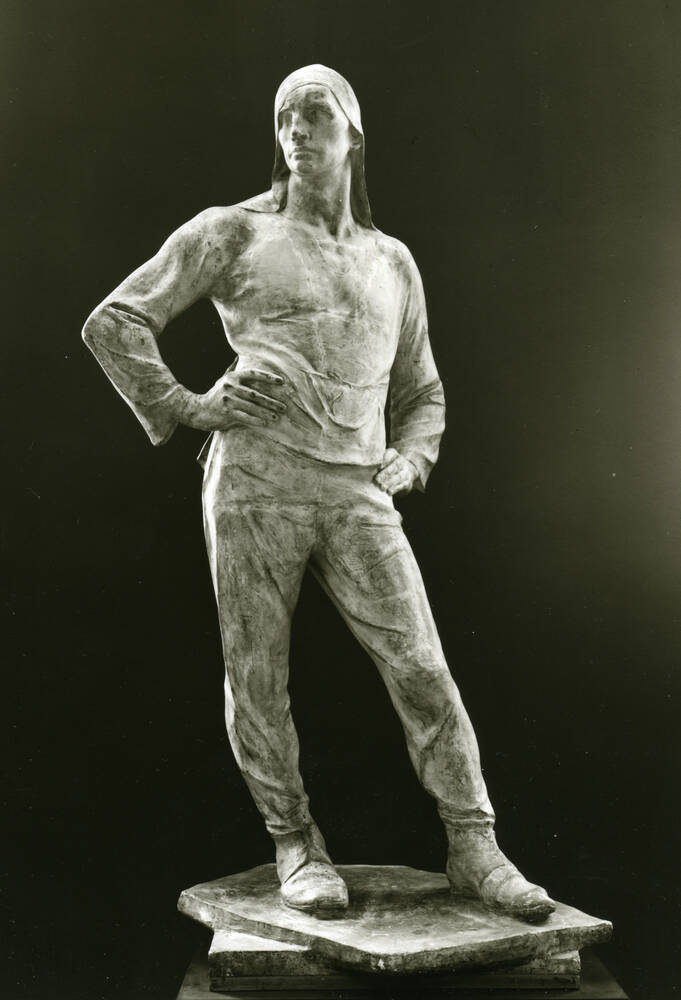
Belgian artist Constantin Meunier was the first sculptor to take the fate of industrial workers as his subject – a topic previously only addressed in painting. He was very sympathetic to the lives of ordinary working people. In 1902, he wrote in a letter:
“[... The worker... ] is worthy of our attention and is often most horribly exploited – I consider the work honourable enough to be glorified.”
And so he shows his porter in a self-confident pose, as upright and powerful as an athlete – and not someone buffeted by fate and life’s vicissitudes. Yet a porter’s work was extremely hard and poorly paid. Day after day, the porters in Antwerp harbour had to lug heavy sacks, with only a thin hood to protect their shoulders and neck.
Although the porter’s physique and posture is informed by the idealised beauty of classical sculpture, his garments and the simplicity of his appearance locate him firmly in the harsh realities of life at the end of the nineteenth century.
Today, bronze sculptures of Meunier’s Porter are on show in many European cities. It was Georg Treu who brought this plaster cast to Dresden. Curator Astrid Nielsen:
“In 1898, Georg Treu, then Director of the Sculpture Collection, published the first monograph on Constantin Meunier. He was, as it were, the one who discovered this Belgian artist as a sculptor, since he integrated a large number of his works, around 60 in total, as a special exhibition in the first International Art Exhibition in Dresden in 1897 – a show which set new standards in presenting contemporary art. That’s why Constantin Meunier also felt indebted to Georg Treu and also why the Albertinum has such comprehensive holdings of Meunier’s works.”
Belgian artist Constantin Meunier was the first sculptor to take the fate of industrial workers as his subject – a topic previously only addressed in painting. He was very sympathetic to the lives of ordinary working people. In 1902, he wrote in a letter:
“[... The worker... ] is worthy of our attention and is often most horribly exploited – I consider the work honourable enough to be glorified.”
And so he shows his porter in a self-confident pose, as upright and powerful as an athlete – and not someone buffeted by fate and life’s vicissitudes. Yet a porter’s work was extremely hard and poorly paid. Day after day, the porters in Antwerp harbour had to lug heavy sacks, with only a thin hood to protect their shoulders and neck.
Although the porter’s physique and posture is informed by the idealised beauty of classical sculpture, his garments and the simplicity of his appearance locate him firmly in the harsh realities of life at the end of the nineteenth century.
Today, bronze sculptures of Meunier’s Porter are on show in many European cities. It was Georg Treu who brought this plaster cast to Dresden. Curator Astrid Nielsen:
“In 1898, Georg Treu, then Director of the Sculpture Collection, published the first monograph on Constantin Meunier. He was, as it were, the one who discovered this Belgian artist as a sculptor, since he integrated a large number of his works, around 60 in total, as a special exhibition in the first International Art Exhibition in Dresden in 1897 – a show which set new standards in presenting contemporary art. That’s why Constantin Meunier also felt indebted to Georg Treu and also why the Albertinum has such comprehensive holdings of Meunier’s works.”
- Location & Dating
- 1893
- Material & Technique
- Plaster
- Dimenions
- H: 210 cm, B: 130 cm, T: 80 cm Gewicht: ca. 60 kg
- Museum
- Skulpturensammlung
- Inventory number
- ASN 5043